Blue Cross and Blue Shield of Alabama paid $13.1 billion to Alabama hospitals, physicians and pharmacies in 2025, more than $1 billion over the prior year and $2.3 billion over 2022, and finished the year with a $3.2 million net loss, according to financial documents provided to Yellowhammer News.
The payments cover claims for both the company’s insured members and the self-funded employer plans it administers for large Alabama employers.
Physicians and other practicing providers received $5.17 billion, an increase of $285 million, or 5.8%. It was the largest single-year jump in physician payments in the four years covered by the documents and nearly double the rate of the year before. Hospitals and other facilities received $5.7 billion, up $390 million, or 7.3%.
Alabama pharmacies received $2.23 billion, up 19.6% in a single year and 52% since 2022.
A recently-published Yale School of Public Health study in JAMA Health Forum reached the same conclusion on a national scale, finding that the cost of care, and not insurer profit, accounts for nearly all of the growth in premiums paid by privately insured Americans.
Yale economist Zack Cooper and University of Wisconsin economist Stuart Craig tracked premiums and health spending across the large-group, small-group and individual markets from 2011 through 2024.
Premiums rose 78.4% over that period. Health spending rose 84.2%.
Growth in spending, the authors wrote, “accounted for 91% of the overall growth in mean premiums.” Insurer markups fell from 18.6% of premiums in 2011 to 14.9% in 2024.
“If we want coverage to be more affordable, we have to turn our attention to reducing the cost of care,” Cooper, who directs Yale’s Healthcare Affordability Lab, told Fierce Healthcare.
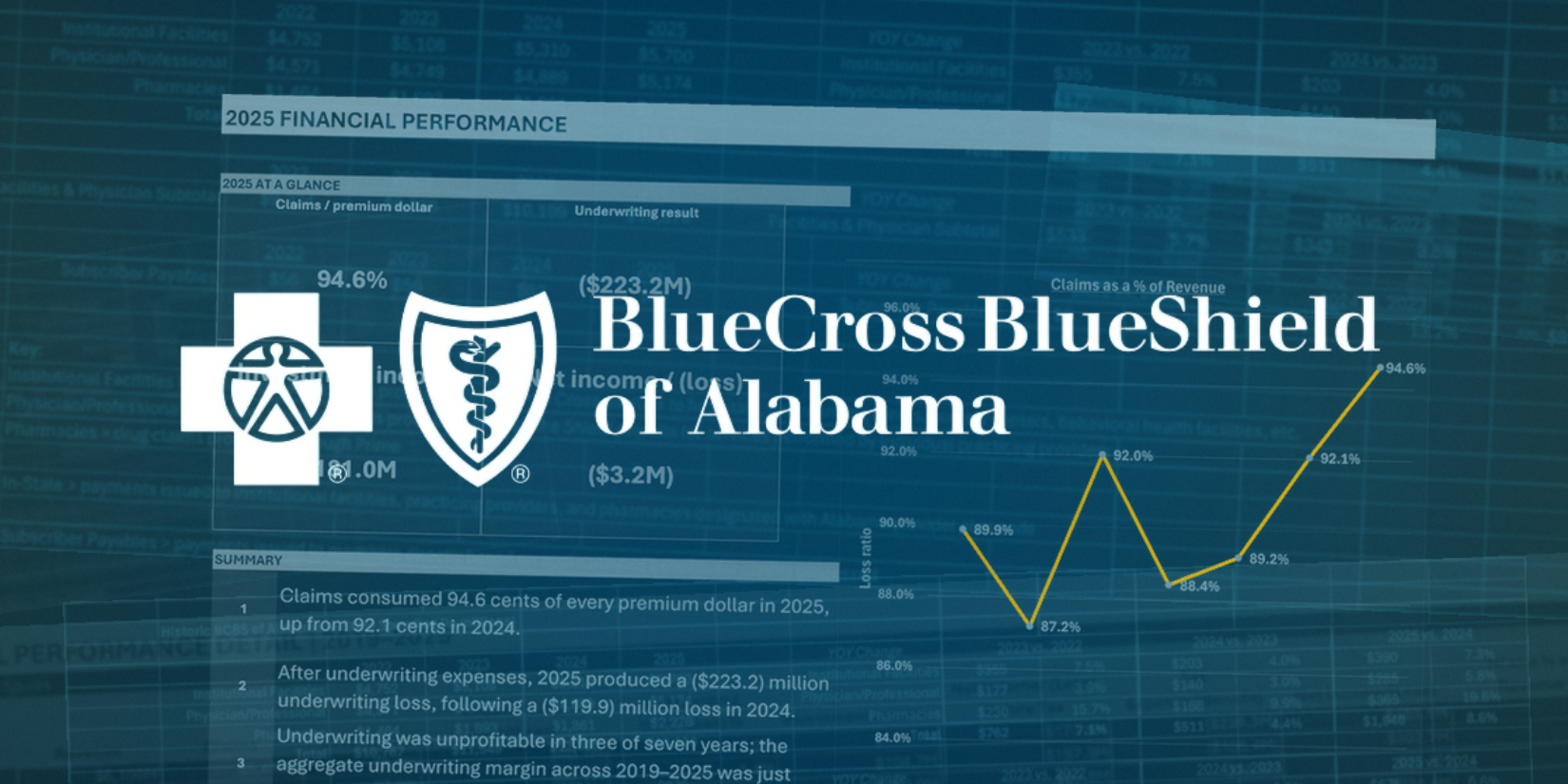
Blue Cross’s annual statement figures show the same pattern in Alabama, and a sharper one. Since 2019, the company’s premium revenue has grown 46%. Its claims have grown 53%. Claims consumed 94.6 cents of every premium dollar in 2025, up from 92.1 cents in 2024 and 89.9 cents in 2019.
“We must look at where the money actually goes, and this research shows that it is primarily driven by increasing healthcare costs,” Cooper, who directs Yale’s Healthcare Affordability Lab, said in a statement.
“If we want coverage to be more affordable, we have to turn our attention to reducing the cost of care.”
The authors wrote that “efforts to slow insurance premium growth should focus on reducing the growth of health spending.”
A June survey found 47% of Americans blame insurers first for rising healthcare costs.
“We must look at where the money actually goes, and this research shows that it is primarily driven by increasing healthcare costs,” Cooper said in a statement. The authors wrote that “efforts to slow insurance premium growth should focus on reducing the growth of health spending.”
Underwriting, the business of collecting premiums and paying claims, lost $223.2 million in 2025 on top of a $119.9 million loss in 2024. Across all seven years the underwriting margin averaged 0.3%. Investment income from the company’s reserves, $181 million last year, is what kept the year from ending further in the red.
“Our customers remain our top priority and are at the center of everything we do,” Sophie Martin, director of corporate communications and community relations for Blue Cross and Blue Shield of Alabama, said in a statement to Yellowhammer News.
“The rising cost of healthcare presents an ongoing significant challenge and directly impacts Alabama families, individuals and employers. Blue Cross paid more than $13 billion in claims last year in Alabama with ninety-six cents of every premium dollar we received paid for healthcare services for our members. We remain committed to being good stewards of those dollars and work towards solutions that improve affordability and provide access to care across our state.”
Blue Cross’s $3.5 billion in capital and surplus, a figure critics often cite as evidence of excess, would cover about five months of member claims at the 2025 rate.
The company paid out $23 million a day in claims last year.
Grayson Everett is the editor in chief of Yellowhammer News. You can follow him on X @Grayson270.