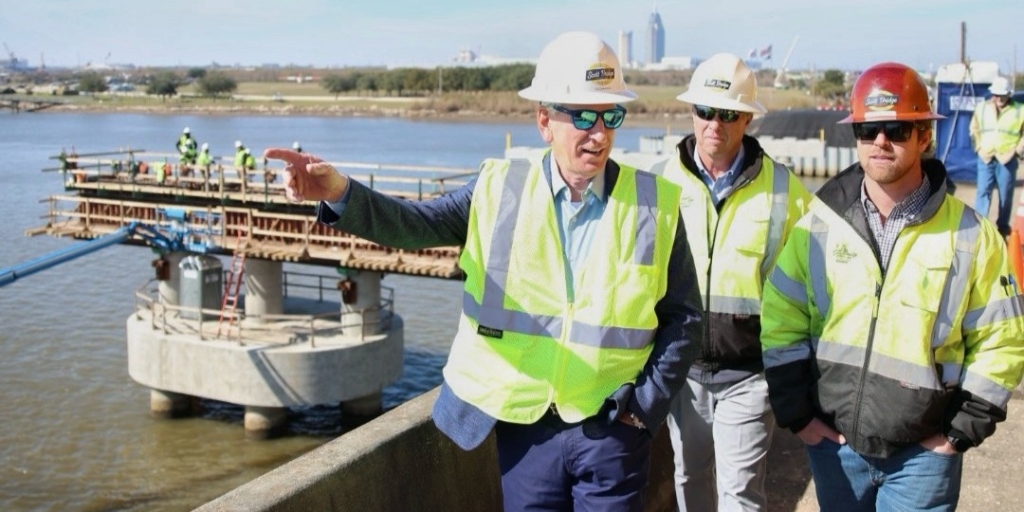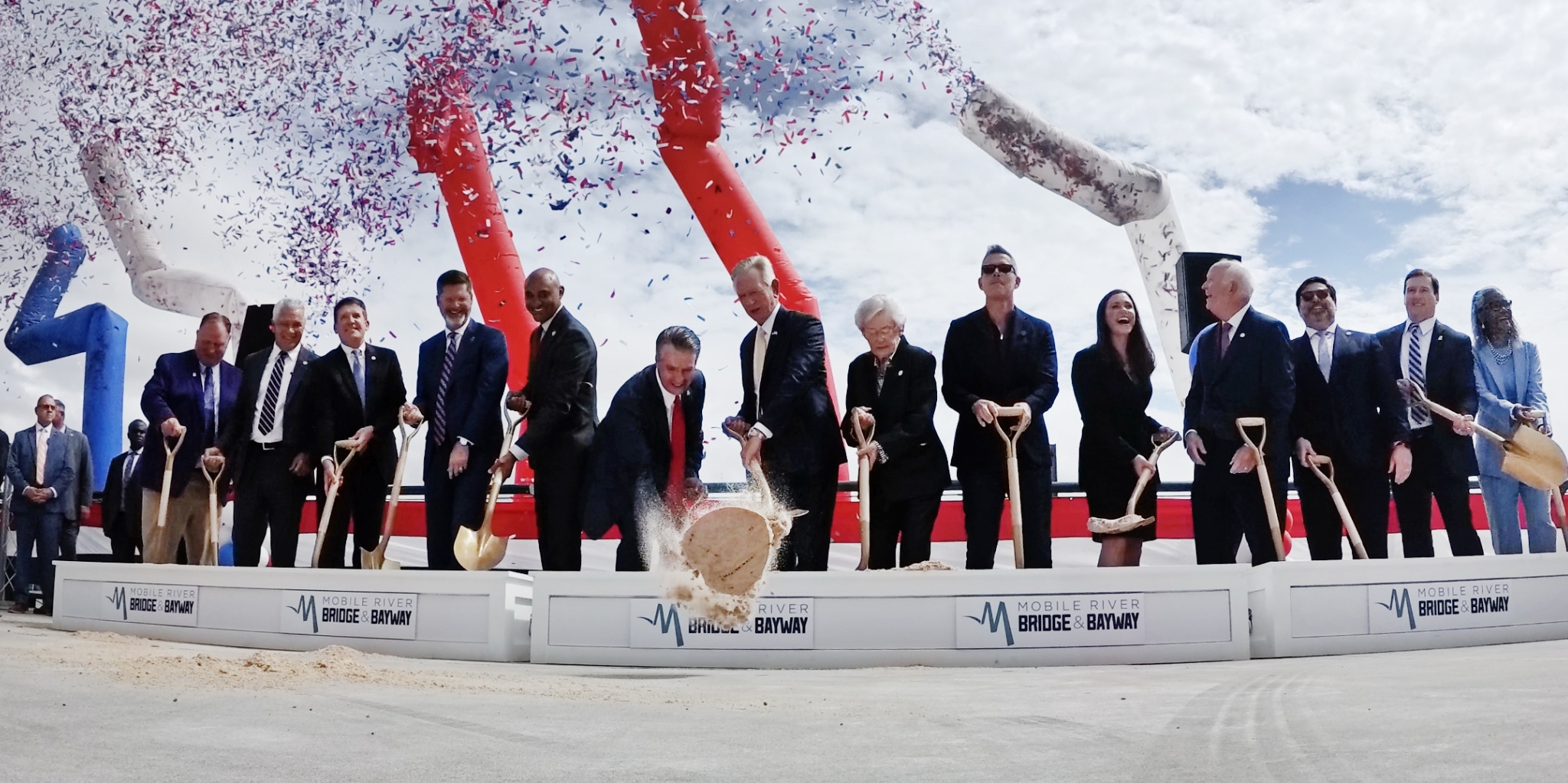
Alabama broke ground Friday on the Mobile River Bridge and Bayway, a $3.2 billion Interstate 10 crossing that has been studied, promised – and shelved – since 1990.
But today, it is the largest transportation project in state history, and it is on track for completion.
Governor Kay Ivey, U.S. Transportation Secretary Sean Duffy, U.S. Senators Katie Britt (R-Montgomery) and Tommy Tuberville (R-Auburn) and Congressmen Barry Moore (R-Enterprise) and Shomari Figures (D-Mobile) tossed the first shovels of sand on the Mobile riverfront.
The Alabama Department of Transportation issued a notice to proceed to the Kiewit Massman Traylor design-build team on September 25 after the bond sale closed and the federal government finalized a $2.52 billion TIFIA loan. Construction is expected to take five years, with the six-lane, cable-stayed bridge opening in late 2031.
“Y’all, we are finally breaking ground on the Mobile River Bridge and Bayway Project,” Ivey said. “1990. That’s how long ago a new I-10 crossing has been talked about. And if you know me, you know I’m not one for chit-chat. I just prefer to get things done.”
Ivey said the existing crossing was designed for 35,000 vehicles a day and now carries as many as 95,000 at its peak.
“Well, y’all, this new bridge is simply a must,” she said. “Secretary Duffy, you and President Trump made a very wise investment in Alabama. So let’s build this bridge, and let the good times roll.”
AFTER DECADES OF DELAY, ALABAMA IS BREAKING GROUND
The largest infrastructure project in Alabama’s state history is officially under way‼️
The I-10 Mobile River Bridge & Bayway Project will EASE CONGESTION and cut 30 minutes off the commute for drivers in Mobile, thanks to… pic.twitter.com/ZuU0jHcAZO
— Secretary Sean Duffy (@SecDuffy) October 2, 2026
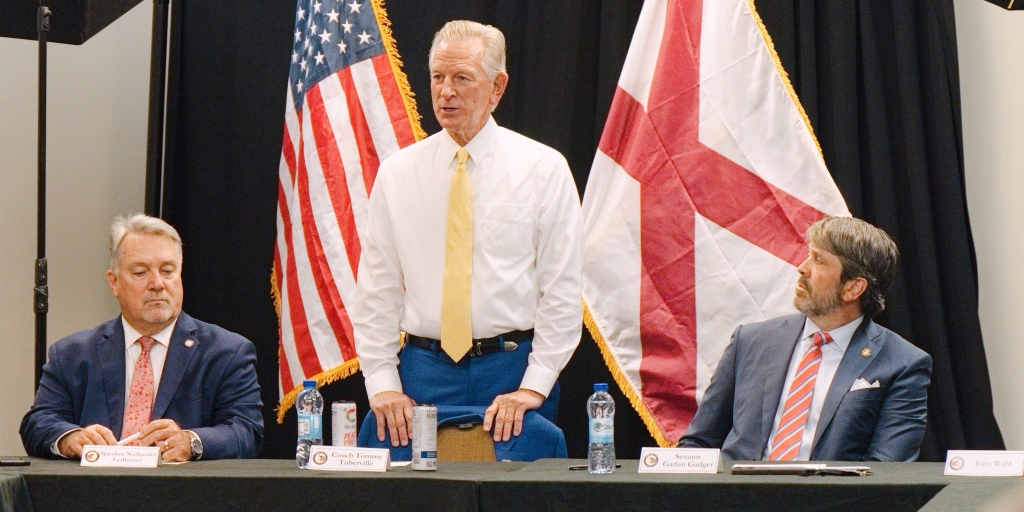
Tuberville told the crowd how the Washington end of it went. He and Britt went to see Duffy about a year ago.
“He wasn’t fired up about it. He said we don’t have the money,” Tuberville said.
“He said, ‘Katie, I know you’re good friends with the president, and he’s going to call me after you talk to him. I’m going to tell him, Mr. President, I ain’t got the money. And then I know, Coach, you’re gonna play golf with him, and you’re gonna hammer him for that entire golf round. He’s gonna call me, get that bridge done. I gotta tell him, I ain’t got the money.’ Well, that’s how it goes in D.C.”
Britt backed him up.
“Coach, that’s how I heard it go down too,” Britt said. “You and I sitting there saying we need it. This one right here, and he knew our tactics too. He called us out.”
“I will say this would not have happened without President Trump,” she said. “Without you, without Susie Wiles, and without President Trump, we wouldn’t be standing here today.”
Duffy confirmed the call came.
“When you get a call from the president, he’s like, ‘Sean, I love Alabama. Alabama’s amazing. I love it. Good people in Alabama. I-10. I think we need to build that bridge, Alabama,’” Duffy said. “And I’m like, ‘Okay, Mr. President.’”
“You’re going to save on average 30 minutes plus in travel, and that’s time they get with their husbands, their wives, their grandkids, their kids,” Duffy said.
“There was a time that people wanted to build bike paths, and I love bikes, by the way,” Duffy said. “But we have a choice to build bike paths or build bridges, and I think bridges have a way bigger impact on your life than a bike path. And we only have so much money. So this administration, we are investing in roads and bridges that move people and products.”
Britt has carried the project in Washington since taking office.
In January she wrote Duffy calling the bridge “the largest shovel-ready infrastructure project in the country” and asking him to put senior department staff in a room with the state to clear the remaining obstacles.
In March she and Tuberville met with Duffy in person to press for the TIFIA loan, and she pushed the project from her seat on the Senate Appropriations Committee, which writes the Transportation Department’s budget.
Bonner said she was working on the bridge as Senator Richard Shelby’s chief of staff before she ever ran for office.
“Without your willingness to listen and try to figure out what is a pathway forward, that’s what a servant leader is: is not someone who just immediately says no, but says, ‘Let me hear what you need, and let me see is there a pathway forward,’” Britt said to Duffy.
“You not only recognize the importance of the project, but you help us cut through the red tape.”
“This corridor is going to be a lifeline for Alabama, for the region, and for the nation,” Britt said. “It’s going to connect the port of Mobile. It’s going to connect our shipbuilders, our military assets, our hardworking Alabamians, and wonderful Americans who travel to visit our great state. This investment will mitigate ongoing safety concerns and also strengthen our hurricane evacuation routes.”
In July, the Trump administration stripped federal requirements for a pedestrian and bicycle path and an “observation overlook” from the project, items Britt and Tuberville wrote “added to the cost but did nothing to solve the central problem.”
Tuberville said Alabama is building what other states cannot.
“There’s a bridge that has been okayed to be built in Cincinnati, Ohio. There’s a bridge that’s been okayed to build in Baltimore, Maryland, the one that got knocked down by that barge. They’re not building them,” Tuberville said. “This has been approved by the best president that’s ever been in this country, Donald Trump. He figured out a way to do it with Secretary Duffy, the best transportation secretary we’ve ever had, and they got it done.”
Today is a GREAT day in Mobile.
We broke ground on the much needed Mobile River Bridge and Bayway project. This project would not have been possible without the leadership of @POTUS and @SecDuffy.
We got the money, now the real work begins. Time to roll up our sleeves and get… pic.twitter.com/YwPU0Aiskd
— Coach Tommy Tuberville (@SenTuberville) October 2, 2026
Figures, a Democrat, thanked the Trump administration and then the one before it.
“I would be remiss not to thank the Biden administration as well,” Figures said. “The Biden administration made a huge investment in this project, $550 million.”
Phase one is financed with $675 million in federal grants, the $2.52 billion TIFIA loan, at least $250 million from the state and bonds issued through the Alabama Toll Road, Bridge and Tunnel Authority, the first project ever built under the authority.
Tolls start when the bridge opens: $3 per trip with an ALGO Pass or $60 a month unlimited. The Causeway, the tunnels and the existing bridges stay free.
Tuberville, who is running for governor, singled out Kiewit executive Doug Glaser, a former Nebraska offensive lineman he coached against as Miami’s defensive coordinator.
“So, Doug, we’re counting on you. We’re going to be good friends if I can somehow win this governor’s race between now and that time,” Tuberville said. “Governor Ivey’s going to be on you, and then I’m going to be on you for five years.”
Duffy picked up the same thread when he asked for an invitation to the ribbon cutting.
“I hope to come back in five years, Governor. Governor, or Senator, almost Governor, maybe. I don’t want to be prejudging,” Duffy said.
University of South Alabama President Jo Bonner, who emceed the ceremony, was on Congressman Sonny Callahan’s staff when Alabama got the first $10 million to study the crossing in 1997.
“I wish we had just built it back then; it would have been a lot cheaper,” Bonner said.
Trump is in Mobile tonight for a rally at South Alabama’s Mitchell Center.
“He’s going to come in tonight,” Duffy said. “But this is meaningful to him. It’s meaningful to me. It’s meaningful to this delegation. So let’s build a bridge, man. Let’s do it.”
Grayson Everett is the editor in chief of Yellowhammer News. You can follow him on X @Grayson270.