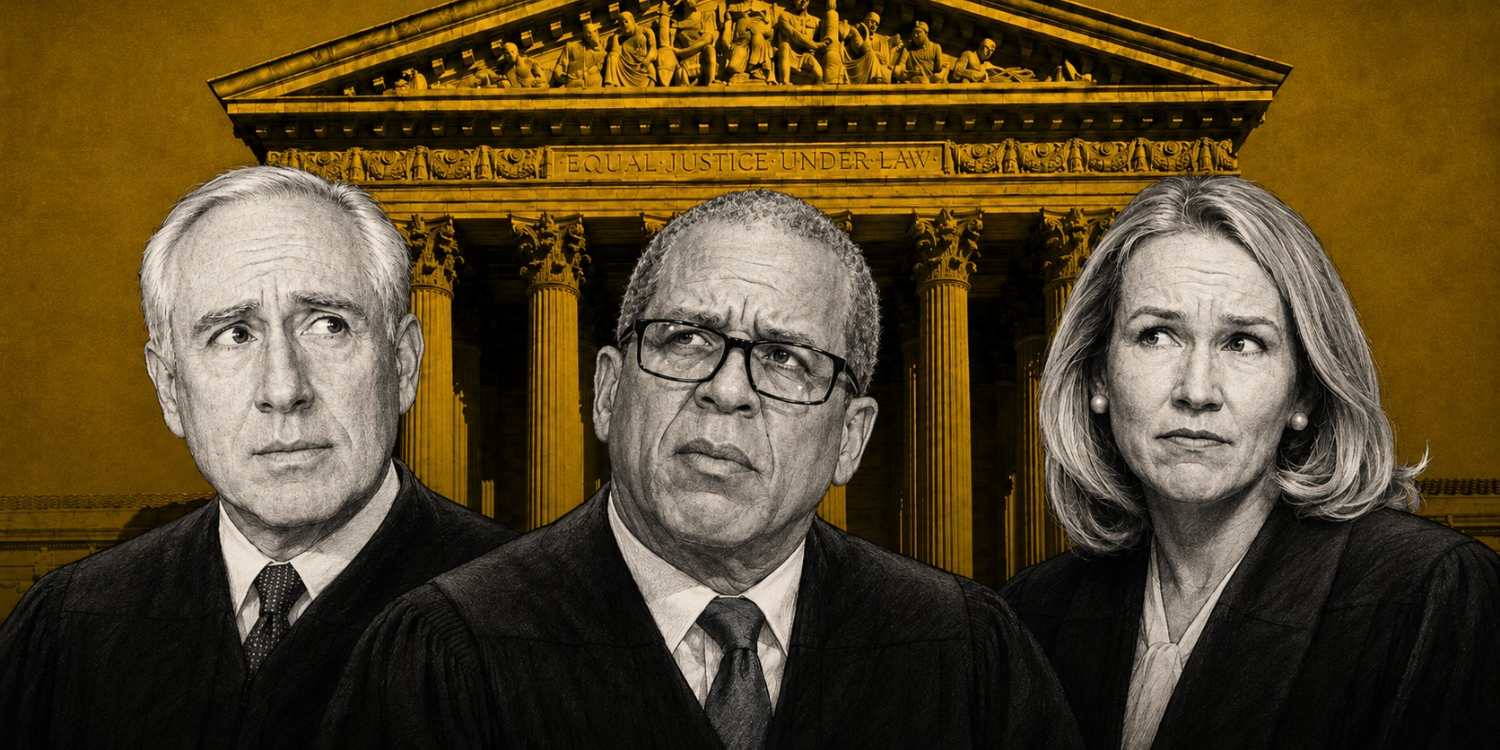
On Wednesday, Alabama Attorney General Steve Marshall hauled Alabama’s redistricting fight back before the U.S. Supreme Court, filing emergency stay applications in all three redistricting cases, Allen v. Singleton, Allen v. Caster, and Allen v. Milligan, and asking the Justices to act by 10 a.m. on Monday, June 1.
The filings ask Associate Justice Clarence Thomas to immediately stay the preliminary injunction issued on Monday by the same panel — Eleventh Circuit Judge Stanley Marcus and U.S. District Judges Anna Manasco and Terry Moorer — that has now ruled against Alabama four times.
The state is also requesting an administrative stay so that election preparations under the 2023 Livingston map can resume in the meantime.
It is the third time in three years that Alabama has asked the U.S. Supreme Court to overrule this district court. The state won the most recent trip just 16 days ago, when the high court vacated the panel’s permanent injunction in light of Louisiana v. Callais.
The panel responded by issuing a new injunction.
“Yesterday’s decision was disappointing but was not surprising,” Alabama Attorney General Steve Marshall said in a statement alongside his motions today.
“The Supreme Court made it clear in Callais that courts should not impose or require states to draw racially gerrymandered congressional maps. But the three-judge district court set that rule aside and once again replaced Alabama’s map with one that sorts voters based on race.
The extent to which there is confusion about the maps which Alabama uses for congressional districts seems to be with the three-judge panel, not the voters. The fact that our State’s conservative electorate has conservative representation is democracy, not an attack on it.
I believe we should have a 7-0 Republican congressional delegation that reflects Alabama’s voters and complies with the Supreme Court’s ruling in Callais, and a stay from this decision is now the best avenue to achieve that goal. If the court will not uphold the law, I am confident that the Supreme Court will.”
The 36-page application, signed by Solicitor General Barrett Bowdre and a team of senior attorneys at the AG’s office, joined by veteran appellate counsel at Balch & Bingham and Consovoy McCarthy, makes three primary arguments to the Supreme Court.
What’s in the filing
First, on the 14th Amendment. The filing tells the justices that the panel doubled down on a constitutional holding that “finds no home in our Constitution: that Alabama intentionally discriminated by refusing to intentionally discriminate.” The Legislature, the state argues, drew the 2023 Livingston map to keep the Gulf Coast together as it had been for 50 years, to reunify the Black Belt in as few districts as possible, and to protect incumbents. The panel labeled all of those nonracial goals “illegitimate” and found racial animus in keeping the Gulf Coast whole.
Second, on Section 2 of the Voting Rights Act. The filing argues the panel “flouted Callais” by refusing to require plaintiffs to bring an alternative map that meets the State’s actual political goals. Under Callais, plaintiffs challenging a state’s map must show their proposed alternative achieves the state’s legitimate districting objectives “just as well.” The panel held that they don’t have to. Because in its view, Alabama’s longstanding priorities aren’t “legitimate” in the first place.
Third, on the Purcell principle. Even sharper, the panel justified its new injunction in part on grounds that returning to the court-drawn map would save the state administrative cost and complexity. Marshall’s brief calls that “turn[ing] Purcell on its head” — using a doctrine designed to shield state-enacted election rules from late-breaking federal interference as a sword to impose a court-drawn map on the eve of an election.
The brief lays out, in detail, that all of Alabama’s elections infrastructure was already mid-pivot to the 2023 Livingston map when the panel acted. The Governor had issued a proclamation, the Secretary of State had posted the map, candidates had qualified, county registrars had begun reassigning voters. Director of Elections Jeff Elrod testified under oath at last week’s hearing that the state could implement the 2023 map — “[w]hile it is an aggressive timeline, I think it is safe to say that registrars could get done with what they have assigned.”
The panel enjoined the map anyway.
Alabama’s federal redistricting arc as reported by Yellowhammer News:
- 2021: Reapportionment done. Legislative races begin.
- 2023: U.S. Supreme Court rejects Alabama Legislature’s maps
- 2023: Federal judges issue final map to Alabama
- 2025: Lawmakers propose special primaries if Louisiana overturned
- 2026: Alabama gets new shot at full-GOP-sweep congressional map
- 2026: Alabama lawmakers pass contingency plan
- 2026: U.S. Supreme Court cancels race-based redistricting in Alabama
Shortly after Marshall filed today, Justice Clarence Thomas declined to immediately restore Alabama’s 2023 map through an administrative stay, but ordered the Voting Rights Act plaintiffs to respond by 4 p.m. Monday, June 1.
Alabama had requested a ruling by 10 a.m. that same day, “or as soon as possible thereafter.”
Thomas’s order puts the full Supreme Court on a fast track to rule on the stay within days, well inside the operational window Alabama needs to know which map governs the August 11 special primary.
Grayson Everett is the editor in chief of Yellowhammer News. You can follow him on X @Grayson270.