In Alabama, it is genuinely hard to get a sitting judge suspended.
The state constitution requires a nine-member Judicial Inquiry Commission to dig through complaints in secret, build a case, and file formal charges with a separate nine-member tribunal called the Court of the Judiciary. The system is slow on purpose. The bar is high on purpose. Judges almost always finish their terms.
The JIC almost never moves this fast. A 120-page complaint filed on a Thursday that suspends a sitting judge by Thursday afternoon is not a routine filing.
That is what happened on May 21 to Yashiba G. Blanchard, the first-term Jefferson County Probate Judge elected in November 2024. And the complaint is, in a word — wild.
Presiding Circuit Judge Elisabeth French tapped retired Circuit Judge Carole Smitherman — wife of State Sen. Rodger Smitherman, a former Birmingham mayor and city council president, and an Alabama Ethics Commission appointee — as the county’s interim Chief Election Official.
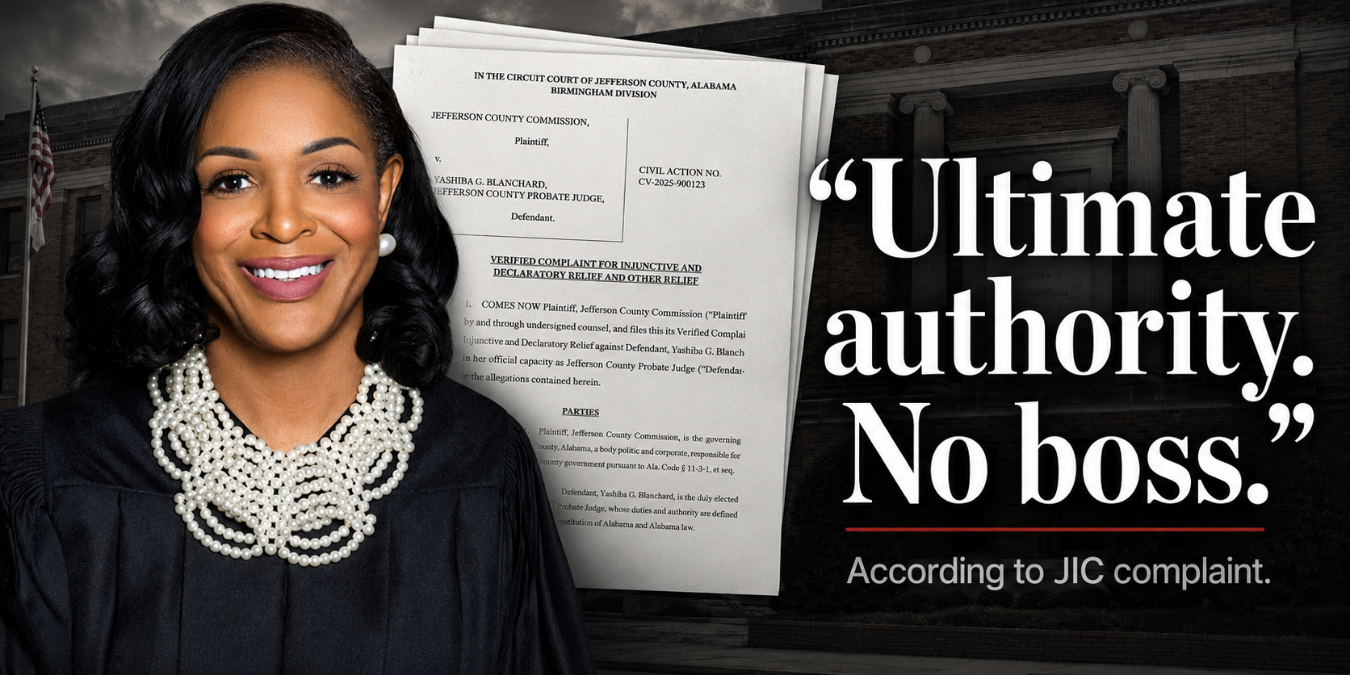
“Ultimate authority. No boss.”
According to the JIC, Judge Blanchard told her own staff she was the “ultimate authority” in her courtroom and that she had “no boss.”
She is the only judge in Alabama who has said this. She is not, however, the only judge in Alabama who has ever thought it. The difference is that she allegedly said it out loud, to the people who work for her, and then ran her court like she meant it.
Probate court in Alabama is not glamorous. It handles wills, estates, adoptions, guardianships, conservatorships, and — critically — involuntary commitments, the hearings that decide whether someone in a mental health crisis stays locked in an inpatient facility or goes home. It is the court that touches Alabamians at the worst moments of their lives.
Judge Blanchard, the complaint says, did not hold a single involuntary commitment hearing for nine months after taking office.
Nine months. In a county of 660,000 people.
“I am so worried that my client is going to die”
Buried in the complaint are 24 case examples. Families waited months. Some waited a year. Hearings were canceled hours before they were set to start. One canceled hearing involved a respondent who was about to be discharged from inpatient care and sent home — except the hearing got pulled, and they presumably weren’t.
The line that should haunt every Alabamian who reads this complaint comes from an attorney’s email, responding to yet another rescheduling notice:
“Just hoping we do not have a continuance because I am so worried that my client is going to die.”
That is a lawyer, in writing, begging a judge to do her job before a human being expires.
December from home, and a denial letter delivered on the bench
The complaint paints a picture of a judge who couldn’t be bothered with being a judge.
She allegedly tried to get a “blanket order” appointing a substitute probate judge to cover for her — not for emergencies, but so she could be “in the office and get work done.” She allegedly requested coverage for the entire month of December so she could work on orders from home. The presiding circuit judge, Elisabeth French, said no — she needed specific dates and specific reasons.
When Blanchard requested another special-judge appointment in April 2026, French denied it. And here is where it crosses from arrogance into farce: the denial letter was reportedly delivered to the substitute attorney while he was already on the bench hearing cases he was not properly appointed to hear.
The substitute, in other words, found out from a courier that he was not actually a judge — mid-hearing.
Then there are the people who worked for her.
The complaint accuses Blanchard of harassment, intimidation, and retaliation against probate court staff, and of allowing another court official under her control to do the same. One staffer named in the complaint, Reid, had her desk moved into a cubicle in front of the bailiff after she complied with a JIC subpoena.
That’s retaliation against a witness in the very investigation that has now taken Blanchard’s job.
Blanchard is also accused of filing an unsupported State Bar complaint against an attorney who challenged one of her orders — the judicial equivalent of weaponizing the disciplinary system against someone for filing a motion.
What happens next
Blanchard faces seven charges under the Alabama Canons of Judicial Ethics, including patterns of failing to discharge judicial duties, failing to follow the law, exhibiting bias against attorneys, failing to disqualify from a case where she had been an attorney, and harassment of court staff.
The Court of the Judiciary will hear the case. The JIC will prosecute. Blanchard will get her defense. The same court has, in recent memory, removed Jefferson County Judge Nakita Blocton in 2021 on similar allegations of staff mistreatment and docket chaos. Blanchard’s case looks bigger.
For now, retired Probate Judge Sherri Friday, who held the seat from 2006 to 2024, has been sworn back in. Retired Judge Carole Smitherman is the county’s interim Chief Election Official. The adults, as one Birmingham lawyer put it this week, have re-entered the building.
The people most affected are Jefferson County residents with cases pending in probate court — families settling estates, parents finalizing adoptions, and individuals awaiting commitment hearings. The Court of the Judiciary will now determine whether the allegations are substantiated and what sanctions, if any, apply.