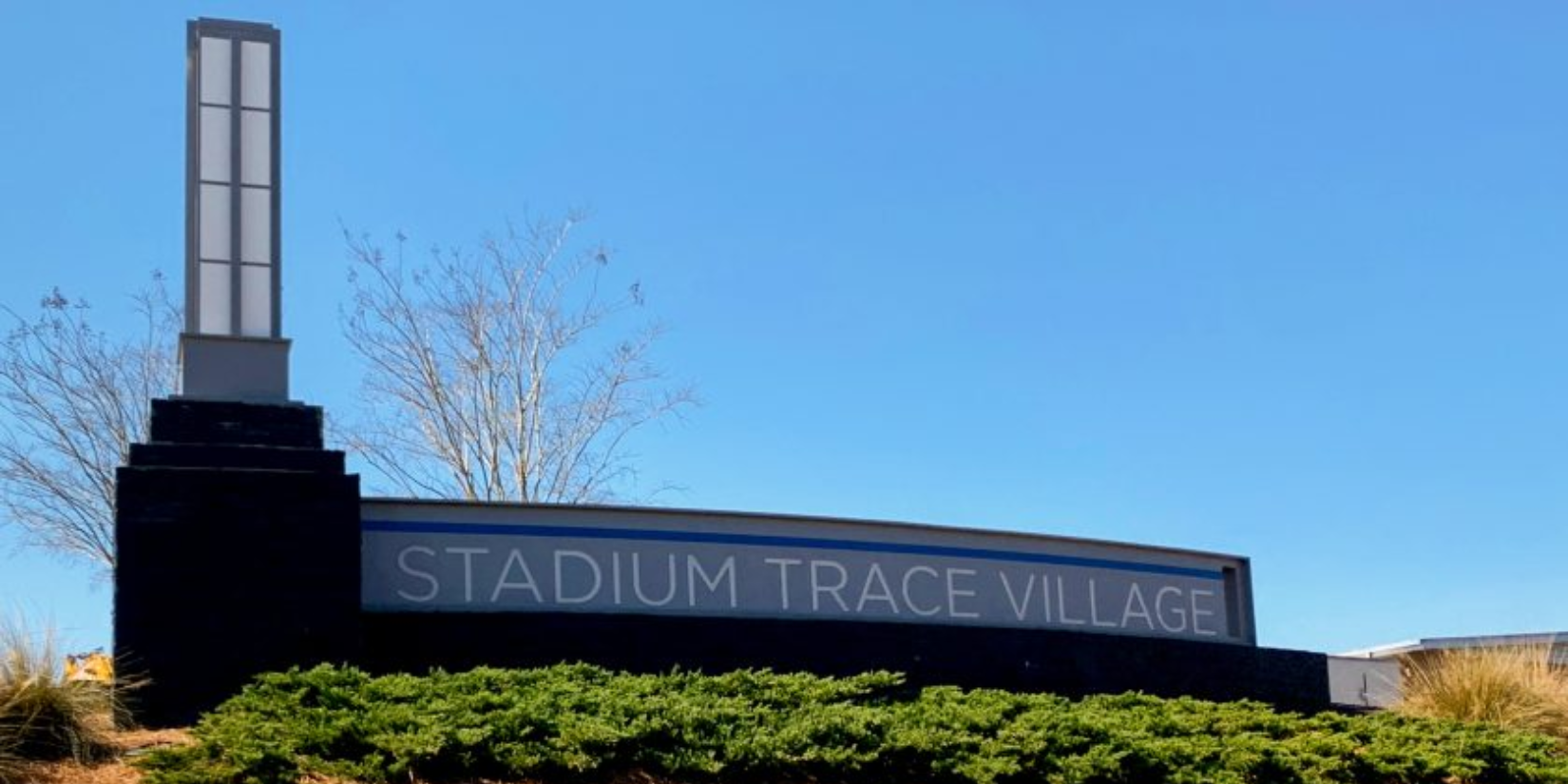
The Hoover City Council votes tonight on an incentive package for Stadium Trace Village’s $200 million expansion — a medical and surgical campus, senior living and entertainment venues on mine-riddled land along Interstate 459 that has resisted development for decades.
Broad Metro, the developer, has already begun clearing land. A vote would close out one of the longest-running economic development sagas in the Birmingham metro.
The deal arrives at roughly half the value Hoover once put on the table itself. Under the previous administration, the city attorney extended a counteroffer valued at $57 million.
Then-Mayor Frank Brocato later cut that to a $22 million proposal that stripped out a planned performing arts center, and negotiations collapsed in the spring of 2024. The package before the council tonight totals $23 million in performance-based incentives, capped at $28 million, and has been posted for public review for three weeks.
The city’s only cash outlay is $4 million for stormwater and roads, and it does not move until a court validates the agreement.
Everything else is rebated from sales, lodging and construction taxes the project itself generates, revenue that does not exist today.
No property tax is shared, and the existing first-phase rebate cap rises from $20 million to $25 million with four additional years to collect it.
The projections are the city’s own.
City Administrator Brian Muenger’s June 22 presentation puts Hoover’s take at $27.1 million over 20 years, with the $4 million recovered within four to five years, $24.6 million in new property taxes flowing to Hoover City Schools, and $63.8 million combined across the city, Jefferson County, the state and the schools.
After year 13, the city keeps 100% of sales and lodging revenue — about $1.9 million a year. Mayor Nick Derzis called the payback timeline a “pretty remarkable investment of our funds.”
The first phase is the evidence base. Open seven years, it now draws about 3.5 million visitors annually, roughly half from outside Hoover, and has generated $7.4 million for the city and schools, Muenger told the council, saying that record and the potential to spur another $200 million in private investment make the upfront money worth it.
For regional context: Irondale last year approved up to $70 million in performance-based incentives — rebating as much as 88% of non-educational city sales taxes — to land a $105 million Costco and 200 to 300 jobs.
Hoover’s cap is $28 million against more than $200 million in private investment.
The incentives exist because of the site itself: at least nine abandoned vertical mine shafts, some 71 feet deep, and roughly $42 million in reclamation and infrastructure work before construction can begin, per Muenger.
A $5.9 million federal reclamation grant and the city’s $4 million leave about $30 million of that on the developer.
The neighbors with the most at stake have already voted. A sonar survey commissioned by the Trace Crossings Residential Association found more than 65% of Scout Lake now measures two feet deep or less — a sediment problem the board says has cost the association hundreds of thousands of dollars and would take some 14,000 cubic yards of dredging to fix.
On that council, Steve McClinton has been the most vocal supporter — “This project’s long overdue. Broad Metro is a proven developer,” he told ABC 33/40.
The plans include an 80,000-square-foot surgical plaza with an outpatient surgery center and diagnostics, a senior living campus from independent living through memory care, a Chasing Aces golf entertainment venue, trails and boardwalks wrapped around the pond system.
If the council votes yes, one step remains: court validation before the city’s $4 million moves.
Grayson Everett is the editor in chief of Yellowhammer News. You can follow him on X @Grayson270.