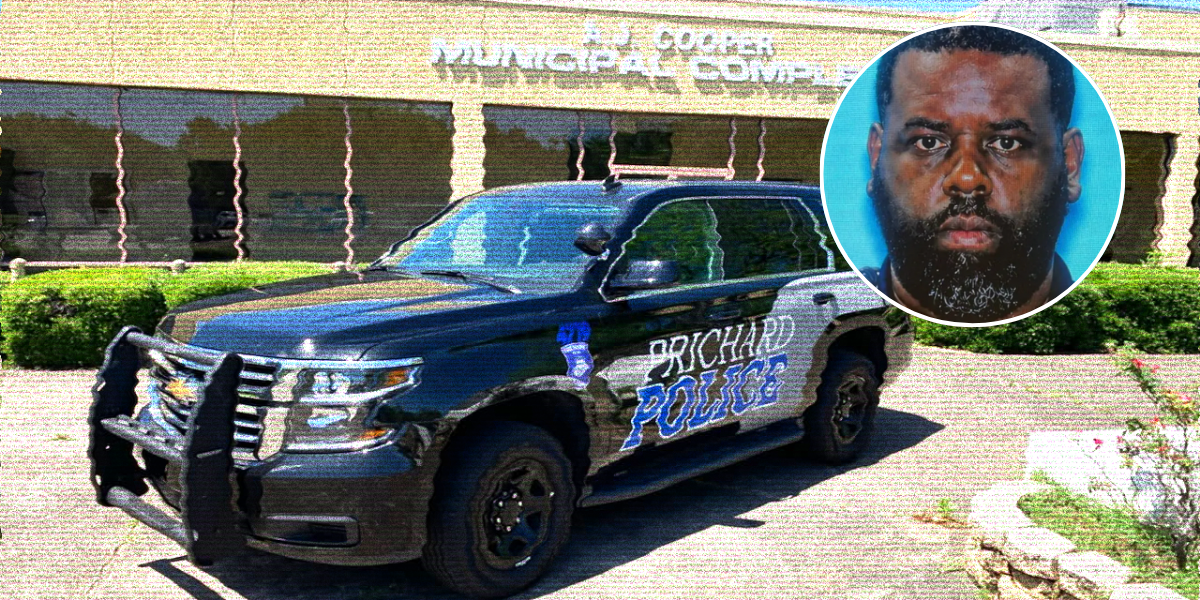
Prichard no longer has full control of its own police department.
The Mobile County Sheriff’s Office is handling day-to-day law enforcement. The city’s 911 calls are going to the county. Prosecutors are reexamining criminal cases, including murders, because the conduct of one Prichard officer may have contaminated far more than his own badge.
That officer, Emanuel Naman Dotch II, was ordered held in federal custody Thursday after an FBI agent testified that Dotch admitted to years of street-level extortion, bribes, evidence tampering and a staged drug arrest. The allegations are ugly enough on their own. The bigger question now is how many cases — and how many officers — they pull down with him.
Dotch, 50, was arrested June 16 on a federal criminal complaint charging civil rights violations, conspiracy, bribery, evidence tampering and extortion. He is presumed innocent unless and until proven guilty.
But in court Thursday, FBI Special Agent Evan Fischer testified that Dotch acknowledged after his arrest that he had extorted people on the street, taken bribes and helped engineer a bogus drug arrest to frame an innocent man.
“He’d been doing it for a long time,” Fischer testified.
U.S. Magistrate Judge Bradley Murray ordered Dotch detained pending trial, saying the allegations showed “an absolute disregard for playing by the rules.”
“We’ve got a defendant who for years has operated as up is down and left is right,” Murray said.
Dotch’s attorney, Fred Helmsing, did not argue that prosecutors lacked enough evidence for a grand jury to consider an indictment, possibly as early as next week. He argued that Dotch should not remain jailed while the case proceeds.
The judge rejected that request.
Assistant U.S. Attorney Justin Roller described the government’s case in plain terms.
“By the defendant’s own admission … he has spent years operating as a criminal with a gun and a badge,” Roller said.
According to a 22-page FBI affidavit, the case reaches into several corners of Prichard police work.
In one instance, federal investigators sought the file from a May 2021 shootout tied to one of Mobile’s most notorious murder-for-hire conspiracies. Prichard police produced a single incident report, with no photos, video or interviews.
The complaint alleges Dotch helped make the evidence disappear after an associate instructed him to “make it disappear.” Investigators later found the missing footage on Dotch’s iCloud account, according to the affidavit.
In another, prosecutors say Atlanta attorney Terry Bailey came to Prichard last November expecting a business meeting and instead was set up with planted drugs outside a strip club. The alleged frame job involved enough fentanyl to expose him to a life sentence and was intended to help another person in a custody dispute, according to the complaint.
Bailey spent days in Metro Jail before the case collapsed. He has since filed a notice of claim against Prichard and Mobile County exceeding $1 million.
The affidavit also alleges Dotch hauled bulk marijuana for $2,500 per shipment and accepted $1,000 with another officer to let two men walk away from a bar fight, including one with an active warrant and another on pretrial release. Asked his rate by a cooperating informant wearing a wire, Dotch allegedly replied, “If the wheel ain’t broke, don’t try to fix it.”
The case is no longer limited to Dotch.
The complaint accuses him of conspiring with other, unnamed Prichard officers in unlawful stops and detentions. The U.S. Attorney’s Office has publicly asked anyone with information to call 1-800-CALL-FBI. A senior Homeland Security Investigations official called the case “a very significant step forward in a very serious, long-term investigation.”
Mobile County District Attorney Keith Blackwood has said the fallout could affect more than 230 defendants. His office is working to revive cases that were dismissed, including murders, because evidence tied to Prichard police may now be in question.
One Eight Mile man has already told the FBI that property seized by Prichard police went missing from department custody. He said he does not believe his case is unique.
That is the institutional problem now facing Prichard: criminal files that may not be reliable, evidence that may not be accounted for and officers — plural, according to federal authorities — under scrutiny.
Fischer also testified that Dotch left the Mobile Police Department in 2013 “under an investigation of allegations of a similar nature.”
Helmsing disputes that account. He said Dotch resigned to care for his ailing mother, not because he was under a cloud. A Mobile police spokesman could not immediately confirm the circumstances.
The case lands in a city already defined by collapsed public institutions.
Prichard’s pension fund ran dry in 2009. The city stopped mailing checks to retirees and filed for bankruptcy twice. Its water system later fell into court-ordered receivership after years of financial and operational failures, including massive water loss and questionable spending.
The police department was one of the last major public functions Prichard still ran for itself.
Now the county is running that too.
The FBI built the case. Federal prosecutors charged it. A federal judge ordered Dotch jailed. The county sheriff stepped into the gap. Accountability reached Prichard, but not from inside Prichard.
Dotch’s case is expected to go before a federal grand jury, possibly within days. The wider investigation is continuing.
Dotch is charged by criminal complaint and is presumed innocent unless and until proven guilty. His attorney says he will mount a vigorous defense.
Grayson Everett is the editor in chief of Yellowhammer News. You can follow him on X @Grayson270.