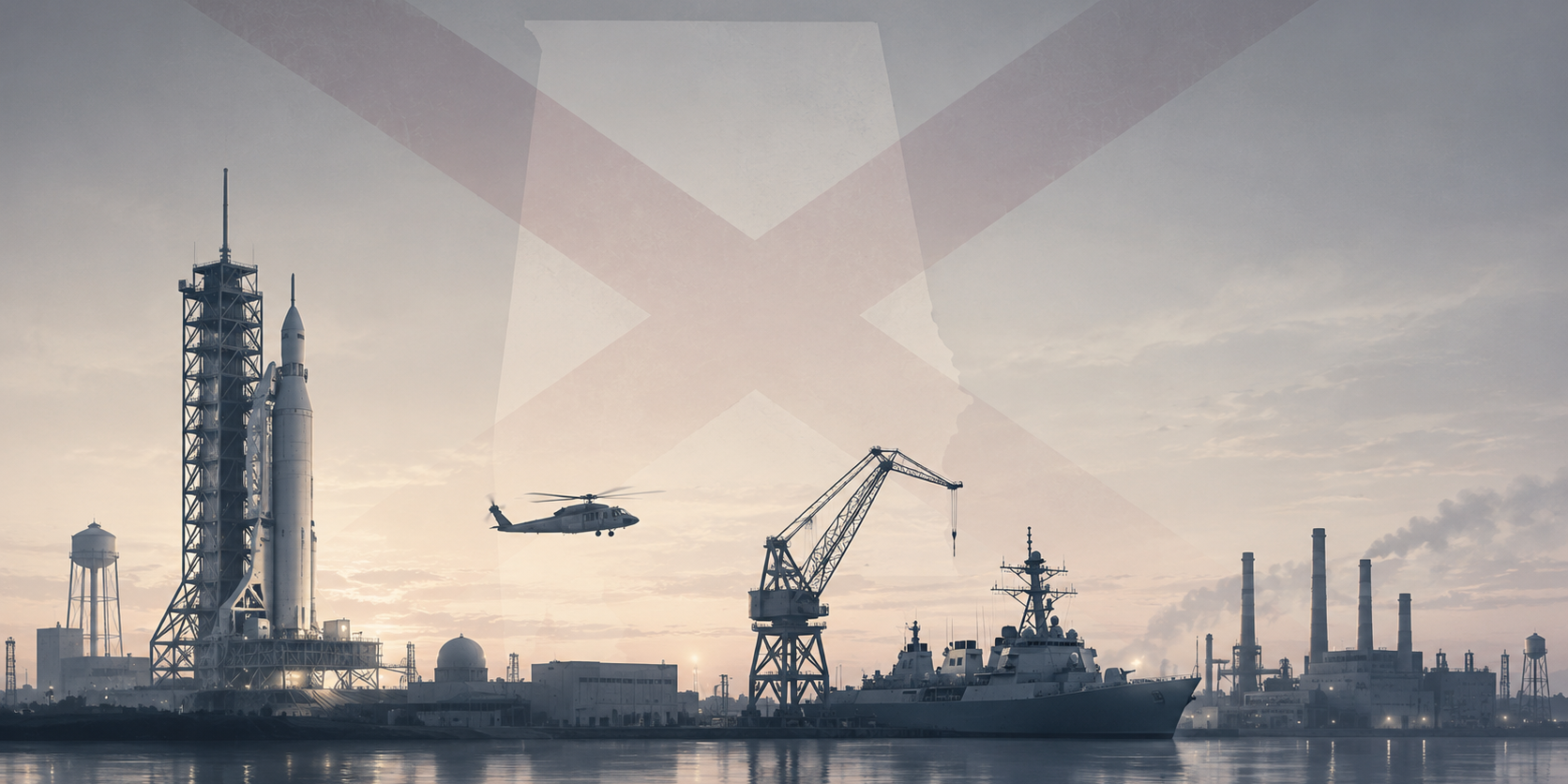
As America marks 250 years of independence, Alabama’s defense legacy shows how deeply the state has been tied to the nation’s security and how important that role may become in the years ahead.
For more than a century, Alabama has helped supply, train, repair, launch and defend. From wartime production in the Tennessee Valley to today’s aerospace, shipbuilding, aviation, missile defense and cybersecurity work, the state has repeatedly served as one of the places where American defense capacity becomes real.
One early example came in northwest Alabama.
During World War I, the federal government turned to Muscle Shoals as part of a major effort to produce nitrates for explosives. The project reflected a basic reality of national defense: wars are not won only on the battlefield. They also depend on industrial capacity at home.
That pattern has continued across Alabama.
Huntsville and Redstone Arsenal have become central to missile defense, aviation, space, research and advanced technology. Mobile remains tied to shipbuilding, ports and the Gulf Coast’s maritime role. Fort Novosel is one of the nation’s most important aviation training centers. Maxwell-Gunter Air Force Base continues to serve a major role in military education, cyber operations and Air Force infrastructure. Anniston Army Depot has long supported vehicle maintenance, repair and military readiness.
Together, those assets make Alabama far more than a state with a proud military past. They make Alabama a working part of America’s defense base.
The numbers reflect that role. Alabama’s defense sector accounts for billions of dollars in economic impact and supports military installations, defense contractors, suppliers, engineers, technicians and workers across the state.
But Alabama’s defense story is not only industrial. It is personal.
The state is home to hundreds of thousands of veterans, along with military families, active-duty personnel, reservists and National Guard members. In many Alabama communities, military service is not an abstraction. It is part of family history, civic life and local identity.
That gives the state’s defense role a different character. Alabama is not simply host to federal facilities or defense contracts. It is a state where military service, defense production and national purpose have long overlapped.
As the United States enters its next 250 years, that role may become more important.
The next era of national defense will depend not only on traditional military strength, but also on energy reliability, advanced manufacturing, shipyards, aerospace engineering, cyber defense, resilient supply chains, workforce training and the ability to produce critical systems at scale.
Those are national security issues, but they are also state-level economic and industrial questions.
Alabama already has many of the pieces: defense installations, ports, manufacturers, community colleges, engineering talent, aerospace firms, power infrastructure, veterans and a culture that understands military service.
The question now is how deliberately the state builds around those strengths.
Alabama’s defense role has changed over time, but it has not faded. In many ways, its place in America’s defense future is still taking shape.
Sawyer Knowles is a state and political reporter for Yellowhammer News. You may contact him at [email protected].