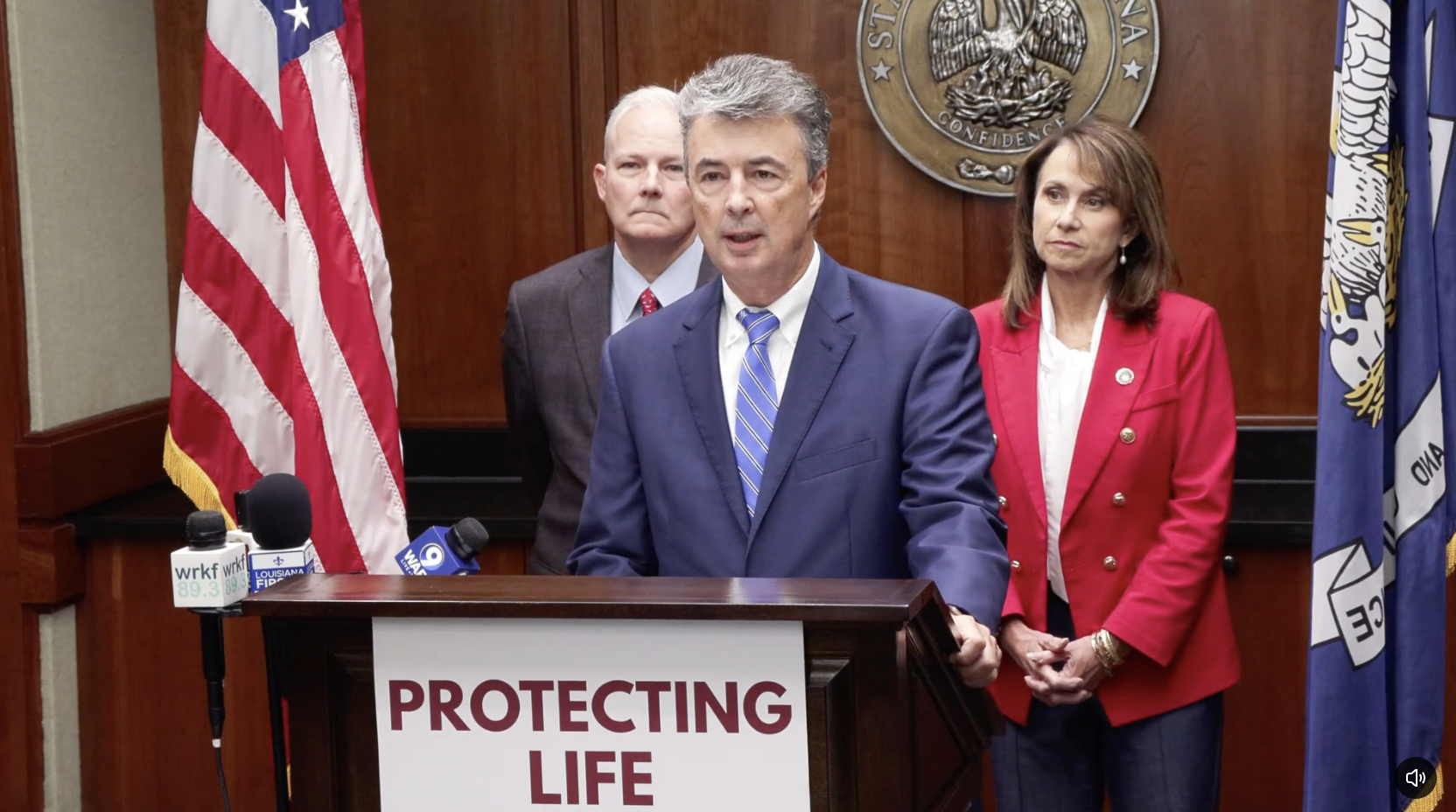
Alabama Attorney General Steve Marshall is taking the fight over mail-order abortions to the U.S. Supreme Court, joining two fellow pro-life attorneys general on Wednesday to challenge Democrat states accused of shielding abortion providers who knowingly violate Alabama law.
Marshall, Louisiana Attorney General Liz Murrill and Arkansas Attorney General Tim Griffin announced Wednesday that their states are suing California, New York and Massachusetts over so-called “shield laws” — protections the Republican attorneys general say allow abortion activists to funnel pills into pro-life states while hiding behind sympathetic blue-state governments.
For Marshall, the confrontation comes down to whether Alabama’s laws mean anything when out-of-state abortion providers decide to ignore them.
“Y’all, I think both of these actions raise a very simple and straightforward question: Who gets to decide?” Marshall said.
The three attorneys general are asking the Supreme Court to intervene in the dispute between states. They also announced a separate federal lawsuit in Louisiana against 30 individuals and organizations accused of advertising, prescribing, dispensing and shipping abortion drugs into their states illegally.
Marshall said providers have continued operating despite explicit warnings to stop — and accused activists of turning the effort to undermine pro-life laws into a social occasion.
“We need and deserve the opportunity to be able to enforce our laws against those who have chosen, despite their knowledge of the illegality, to continue to foster abortion in our state,” Marshall said.
Despite cease-and-desist notices, he continued, “they choose to host parties with wine and pizza, gleefully coming together, knowing that they are engaging in unlawful activity.”
“These cases are going to ensure that activity stops.”
Asked later about the gatherings, Marshall said the Louisiana complaint details a defendant’s efforts to bring people together to violate the states’ laws.
“It’s offensive, and again, contrary at all to the rule of law,” he said.
Marshall’s office announced in June that it had issued cease-and-desist letters to six companies accused of illegally advertising and facilitating access to abortion-inducing drugs in Alabama. Wednesday’s announcement escalates that enforcement fight to a direct confrontation with the states protecting providers.
The attorneys general argue that blue-state officials are attempting to defeat the practical effect of the Supreme Court’s Dobbs decision by insulating providers from consequences when they send abortion drugs across state lines.
Murrill said the challenged laws restrict cooperation with investigators, limit extradition and obstruct enforcement of out-of-state judgments and subpoenas.
“For this reason, these laws are not shields at all; they’re swords disguised as shields and driven into pro-life states,” Murrill said. “Today pro-life states are fighting back.”
The dispute already extends to criminal cases.
Murrill said New York and California have refused to extradite doctors accused of illegally prescribing abortion pills into Louisiana. In one Louisiana case, she said, pills were sent to a mother accused of forcing her daughter to take them, ending a pregnancy the daughter wanted to continue.
Murrill said investigators conducted controlled purchases in all three plaintiff states. She alleged that the distribution system allows buyers to misrepresent their identities and the stage of a pregnancy while obscuring who prescribed the drugs.
The separate lawsuit in the Western District of Louisiana seeks to hold the providers and organizations accountable under state consumer protection and public nuisance laws. The states are seeking an injunction, damages and civil penalties, among other relief.
Griffin accused providers of minimizing risks and telling women to conceal their use of abortion pills if they seek emergency care.
“A legitimate healthcare provider would never tell a patient to lie if they have to go to the emergency room,” Griffin said.
New York Attorney General Letitia James defended her state’s protections Wednesday, arguing that the Republican states were attempting to impose their abortion bans on New York and punish doctors for care legal there.
Murrill rejected that framing, saying the states are seeking to enforce their laws against conduct occurring within their own borders.
“This is not something that we are saying we want to go enforce our laws in New York,” she said. “We want to be able to enforce our laws within the boundaries of our states.”
The Supreme Court must still decide whether to accept the states’ original action, Murrill acknowledged.
For Marshall, the objective is to ensure Alabama’s decision to protect unborn life cannot be overridden by abortion providers operating with political cover from another state.
“Alabama has chosen very squarely where they land,” Marshall said, “and that is that we’re going to protect life.”
Grayson Everett is the editor in chief of Yellowhammer News. You can follow him on X @Grayson270.