A recent, jarring exchange on national television perfectly illustrates the cultural and intellectual crisis facing our republic.
As reported by The Daily Signal, an MSNBC host expressed utter bewilderment during a broadcast when discussing Speaker of the House Mike Johnson’s assertion that our rights do not derive from the government, but rather from our Creator.
The host incredulously questioned whether Johnson was “putting God over the Declaration of Independence.”
This stunning display of ignorance from mainstream media highlights a profound historical illiteracy. The idea that rights are endowed by a Creator isn’t an evangelical fringe theory; it is literally written into the second sentence of our nation’s birth certificate.
When elite cultural newsmakers cannot grasp the basic premise of American liberty, it serves as yet another wake-up call for states working to preserve foundational values. If we do not properly educate the next generation on our founding principles, we risk losing the constitutional republic altogether.
Alabama has earned some well-deserved credit for taking steps to combat this exact brand of civic amnesia. State law mandates that students pass a 100-question citizenship test—modeled after the U.S. naturalization exam, as part of their required high school government coursework.
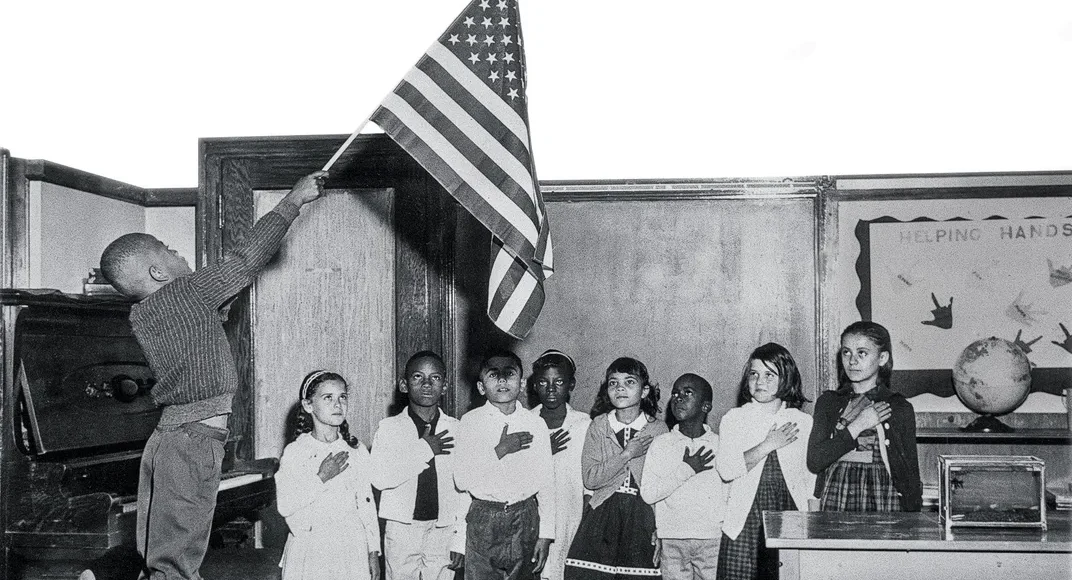
Voters will have the option in November to restore the prayer and pledge to our public schools and require the National Anthem on a weekly basis.
The Alabama State Board of Education recently overhauled its K-12 Social Studies Course of Study, dismantling an antiquated framework that had remained stagnant for 14 years.
What the state did well with this overhaul was fix a broken timeline. Under the updated standards, civics instruction is no longer treated as a “one-and-done” checkbox bottlenecked into a single semester. Instead, core civics concepts are introduced sequentially starting in the sixth grade and reinforced through the ninth grade, while a continuous historical narrative spreads Alabama history across a three-year elementary sequence.
Where Alabama fell short, however, is confusing structural scaffolding with deep, content-rich substance. National civics groups and conservative analysts have pointed out that the actual benchmarks within the new standards frequently favor broad, vague skillsets over specific historical knowledge. Rather than establishing a distinct, rigorous course dedicated to Western Civilization, the very cradle of our constitutional principles, the new standards continue to submerge these foundational ideas into a generalized “World History” track. When standards are vague, they leave local classrooms vulnerable to progressive interpretations that rely on modern textbook terminology rather than strict adherence to traditional historical texts.
The ultimate test of any educational standard isn’t a 165-page document written by bureaucrats; it is the physical textbook placed on a student’s desk. This is where Alabama’s structural progress has collided with a harsh political reality. The State Board of Education narrowly approved the recommended social studies textbook list. A 5-4 razor-thin majority was pushed over the edge with the Governor’s vote; the split vote mirrored intense public pushback from parent advocacy groups and conservative organizations like API who thoroughly vetted the proposed books.
The complaints were highly specific and troubling. For example, in a seventh-grade world history text, reviewers pointed out a glaring double standard: the historical spread of Christianity was framed primarily through the lens of military conquest and colonization, while the spread of Islam was sanitized as a peaceful byproduct of trade and cultural exchange. In other high-school level texts, modern political figures were inserted into highly biased, contemporary sections regarding “threats to democracy” rather than maintaining objective historical distance.
This textbook battle proves why a superficial approach to history is dangerous, and why truly comprehensive civics education requires us to look past modern publishers and return directly to the philosophical friction point that defines the American experiment: the relationship between the Declaration of Independence and the United States Constitution.
From a conservative perspective, understanding the distinct yet inseparable roles of these two documents is paramount. The Declaration of Independence reflects our nation’s ideological soul. It establishes the why of America: the immutable, foundational truth that our rights are God-given, pre-existing any king, congress, or court. Government does not grant us freedom; it is merely an earthly tool established to protect it.
Conversely, the United States Constitution is the practical framework—the how of America. It does not invent rights; it binds the hands of government to prevent it from infringing upon the liberties already promised to us by God and articulated in the Declaration. Left-wing progressive ideology frequently attempts to sever this tie, treating the Constitution as an infinitely malleable document detached from any absolute moral anchor.
Without the moral absolute of the Declaration, the Constitution risks being reduced to a moldable rulebook subject to the whims of whoever holds temporary political power.
This philosophical distinction has a massive, direct impact on Alabama’s elections and our state government. When voters understand that their rights are inherent and that government’s primary function is negative, meaning it exists to limit itself and protect individual liberty, they vote differently. They see ballot boxes not as mechanisms to demand government handouts or manufacture rights, but as a defense mechanism to preserve religious liberty, economic freedom, and local autonomy.
Civics-educated voters hold state legislators accountable to the rule of law rather than the rule of special interest groups. They look for educators and school board members who understand that source material trumps biased synopsis. They look for leaders who respect the separation of powers and federalism, ensuring that Montgomery remains accountable to the people of Alabama, rather than bowing to federal or bureaucratic overreach. When citizens lack this foundational knowledge, state elections devolve into mere popularity contests, and government naturally expands, chipping away at the very freedoms it was designed to safeguard.
Alabama has built a stronger structural framework with its updated social studies standards, but because the state board passed a list of compromised textbooks to support it, the responsibility now falls entirely on local superintendents, school boards, and vigilant parents to reject flawed materials. We must ensure that our classrooms are not merely treating government like a sterile machine.
We must boldly teach the philosophy of liberty. Students must read essays like the Federalist Papers, debate the anti-Federalist perspective, and intimately understand why the Framers feared a pure, unchecked democracy just as much as they feared a monarchy.
If we fail to teach our children that their rights come from God and that the Constitution is the shield protecting those rights from the state, we will raise a generation of citizens who believe they are completely dependent upon the government for their livelihood and their liberty.
Alabama must lead the charge in rejecting this progressive drift. By grounding our students in the timeless truths of our founding, we secure the future of our state government, the integrity of our elections, and the preservation of American liberty for generations to come.
Stephanie Holden Smith is the President and CEO of the Alabama Policy Institute.