The First Amendment did not emerge fully formed from the minds of James Madison and our founding fathers.
Like most great constitutional principles, religious liberty evolved over centuries through a series of political experiments, legal compromises, and the hard-earned, practical lessons of trial and error.
Perhaps the most overlooked turning point occurred not in Philadelphia or Williamsburg, but in the German city of Speyer five hundred years ago this month.
Long before philosophers articulated a universal right of conscience, the First Diet of Speyer confronted a practical question: Can a central government successfully dictate people’s religious beliefs?
The answer it reached, though born of political necessity rather than philosophical idealism or religious zeal, marked the beginning of a journey that ultimately found its fullest expression in the Bill of Rights in the U.S. Constitution.
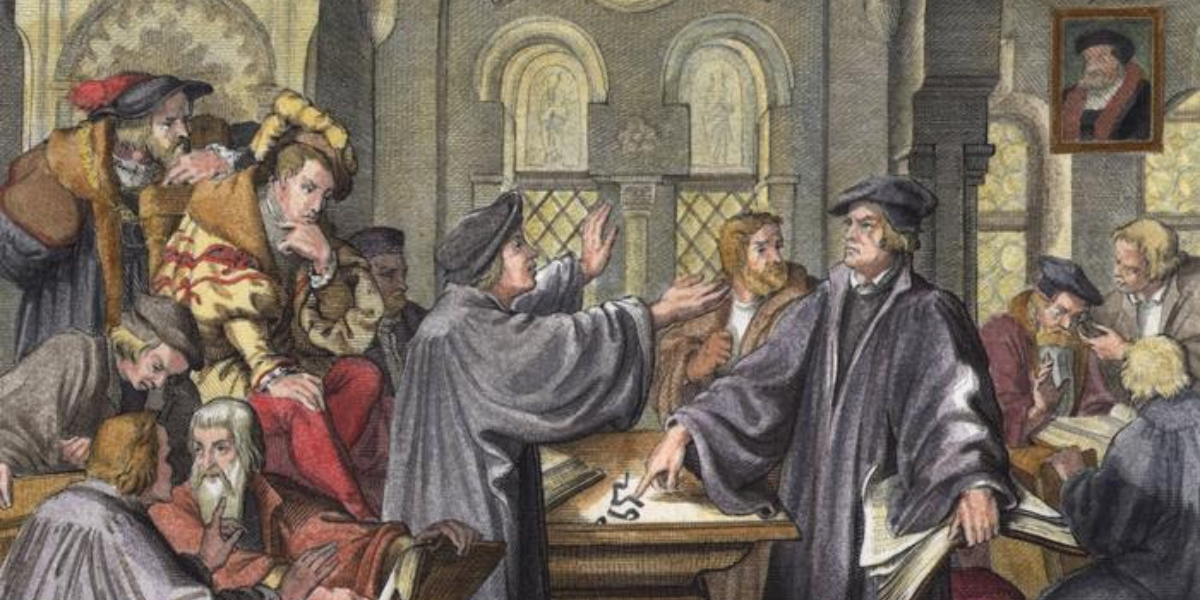
The story begins five years earlier at the Diet of Worms. In 1521, Emperor Charles V issued the Edict of Worms, declaring Martin Luther an outlaw, prohibiting his writings, and ordering every prince throughout the Holy Roman Empire to suppress the growing Reformation.
The principle was straightforward: one Emperor, one Empire, one Faith.Yet the policy proved impossible to enforce.
Luther’s teachings spread rapidly throughout Germany. Princes, city councils, and ordinary citizens embraced the Reformation in increasing numbers, and for many local rulers, enforcing the Emperor’s decree meant compelling their own people to violate their conscience.
The Holy Roman Emperor soon found himself caught between domestic reality and international crisis as the Ottoman Empire threatened Europe from the east while France and the Papacy challenged him from the west.
He needed the military and financial support of the German princes far more than he needed another religious confrontation; attempting to impose religious uniformity by force had proven to be politically unsustainable.
When the Imperial Diet met at Speyer in August 1526, its delegates recognized an unavoidable truth – insisting upon complete religious conformity would fracture the Empire.
The compromise they reached was modest but revolutionary.
Until another council could resolve the controversy, each territory would “so live, rule, and believe as it may hope and trust to answer before God and His Imperial Majesty.”
The Recess of Speyer did not establish religious liberty as we understand it today because individual citizens remained subject to the religion chosen by their prince under the familiar principle of “whose realm, his religion.” Those who disagreed often had little choice but to emigrate.
Nevertheless, Speyer accomplished something profoundly important.
For the first time, a central political authority formally acknowledged that it lacked the practical ability to impose religious uniformity throughout its realm. Authority over religion was no longer treated as an exclusively imperial prerogative, so, instead, it devolved to local governments.
That constitutional shift deserves greater attention than it has received.
Before Speyer, religious dissent was widely regarded as both theological error and political rebellion. Civil authority and ecclesiastical authority united in support of a single universal religious order. By recognizing the limits of centralized power, however reluctantly, the delegates at Speyer undermined the centuries-old assumption that one government could successfully govern every conscience.
The principle proved irreversible.
When Charles V attempted to revoke the compromise at the Second Diet of Speyer in 1529, the Lutheran princes issued their famous Protestation, from which the word “Protestant” is derived. They declared that “in matters concerning God’s honor and the salvation of souls, every person must stand and give account before God for himself.”
That declaration moved the conversation one step further. If conscience ultimately answers to God, then civil authority necessarily has limits.
Europe would spend the next century learning that lesson through painful experience. The Peace of Augsburg, the Dutch struggle for independence, The Peace of Westphalia, The English Civil War, and John Locke’s writings on toleration all reflected the growing recognition that governments could preserve civil peace without compelling religious conformity.
The devastating religious wars of the seventeenth century confirmed what Speyer had first exposed – coercion could secure outward compliance but never genuine faith; one way or another, individual liberty always prevailed.
The American Founders inherited the accumulated wisdom of those centuries.
They understood that Europe’s religious conflicts were not accidents of history but the predictable result of governments attempting to regulate conscience. Their solution differed fundamentally from the compromise reached at Speyer.
Speyer transferred authority over religion from the Emperor to the territorial prince.
The First Amendment completed the journey by denying that authority to the federal government altogether. Rather than empowering rulers to determine religion, it recognized that matters of conscience belong beyond the reach of civil government, and as a result, Congress could neither establish a national church nor prohibit the free exercise of religion.
The progression is remarkable.
Authority first rested in a universal empire. It then deflected to local governments. Finally, constitutional liberty placed conscience with the individual, where it properly belongs.
The delegates assembled at Speyer in 1526 did not intend to create the free exercise of religion. They were attempting to preserve a fragile empire amid political crises, yet history is often shaped by the unintended consequences of practical decisions.
In admitting that religious uniformity could no longer be enforced from the center, they acknowledged a truth that later generations would develop into one of the defining principles of constitutional government.
While the Bill of Rights did not begin at Speyer, one of its deepest assumptions, that civil government has inherent limits when it comes to matters of faith, was first recognized there.
In granting territories the freedom to choose their own worship, interpret their own Bibles, and govern their own spiritual lives, Speyer struck the first decisive blow against the totalitarian union of global political power and religious dogma.
It was an imperfect beginning of a grand idea: every human being possesses an innate, inviolable right to worship according to the dictates of their own conscience.
The road from the Rhine to Philadelphia was long and winding, but the constitutional journey toward religious liberty passed unmistakably through Speyer.
Will Sellers is an Associate Justice on the Supreme Court of Alabama. He is best reached at [email protected].