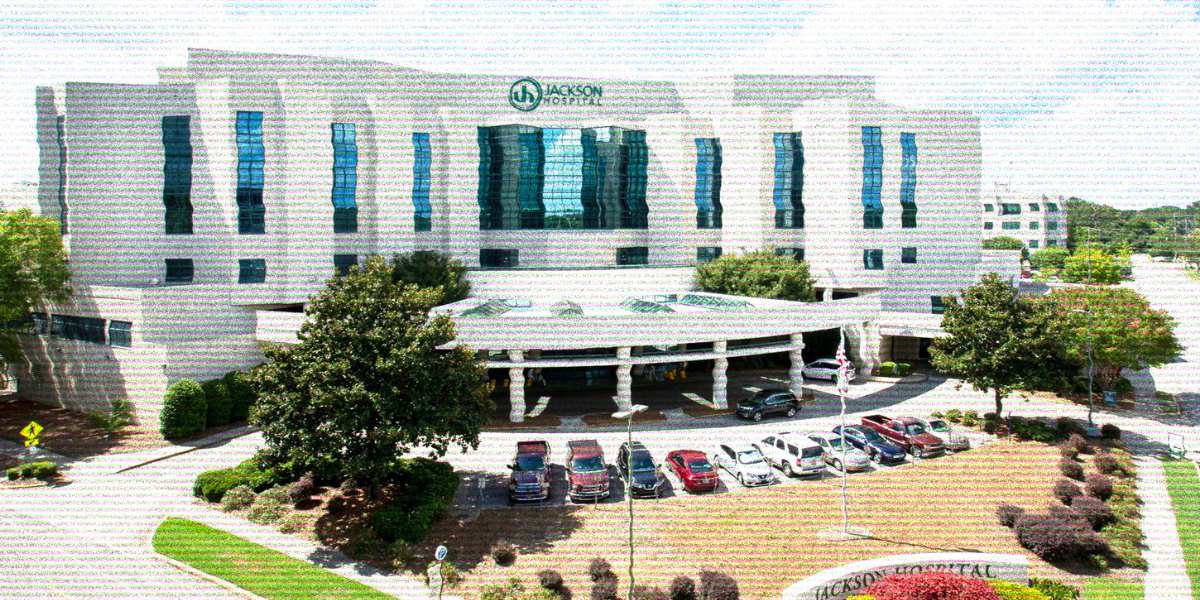
Jackson Hospital & Clinic, Inc. in Montgomery, which bankruptcy filings have described as carrying between $100 million and $500 million in liabilities, filed a lawsuit last week against Blue Cross and Blue Shield of Alabama, claiming they are to blame for the hospital’s impending closure.
In the December 18 filings, Jackson makes sweeping and accusatory claims. The complaint, itself entitled “The Sad Story of Jackson Hospital and Blue Cross Alabama,” argues the dispute is a moral one of “corporate abandonment and greed.”
Jackson’s new legal sweep also makes a blockbuster damage demand “in excess of $250 million,” while seeking emergency injunctive relief from a bankruptcy judge in the Middle District of Alabama.
The filings cast BCBS of Alabama as the villain. However, the hospital has been drifting toward a financial crisis for years – and its current lifeline is being financed by an out-of-state investment group with a loan that accrues interest at 14%.
In 2015, the hospital issued $61 million in revenue bonds to finance improvements, but less than five years later, it was struggling to pay its debts.
Jackson Hospital & Clinic also burned through about $60 million in reserves by mid-2021 to cover operating losses, leaving it in a virtually irreversible cash position without outside funding lifelines.
By April 2024, Jackson Hospital defaulted on a variety of its secured loans, and in September 2024 it missed an interest payment on the 2015 bonds.
That bond default prompted S&P to downgrade the hospital’s bonds to a “D” or default rating.
Bondholders, through the Medical Clinic Board of Montgomery, demanded full payment of roughly $60 million outstanding, which Jackson Hospital could not do.
Now in December 2025, days away from impending closure – seeking a $100 million infusion from the Montgomery City Council, Montgomery County Commission, the Alabama Legislature, and federal government – Jackson’s new legal strategy makes an extraordinary ask of the bankruptcy court system.
In the TRO motion, Jackson argues antitrust and breach-of-contract. But the immediate “emergency” relief request is a mandatory injunction that asks a judge to rewrite reimbursement rates and compel BCBS to pay Jackson “at a minimum” what it pays Baptist Hospital in Montgomery.
Jackson claims in the motion and corresponding complaint that BCBS reimburses Jackson around 120% of Medicare, below what it calls Alabama’s “average” and far below national “commercial average” comparisons.
BCBS pays Baptist “approximately 30-40% more” for comparable services “upon information and belief,” from Jackson. Jackson warned BCBS that the 2026 rates BCBS “intends to impose” would likely prevent Jackson from emerging from bankruptcy.
Hospitals and insurers fight about rates non-stop. What is unusual is either party requesting a bankruptcy judge, on an emergency basis, to compel parity with a competitor’s confidential contract.
That’s not how normal payer-provider contracting works – but it is how political campaigns work. And the complaint reads like one:
“Doing what is necessary to keep Jackson Hospital open is literally a matter of life or death. Blue Cross Alabama knows all this. But Blue Cross Alabama does not care.”
“Blue Cross Alabama calls itself a ‘nonprofit,’ but the insurance giant has become one of the most powerful and profitable corporations in Alabama – sitting on billions in reserves, paying executives multi-million-dollar salaries/bonuses, and posting hundreds of millions in annual surpluses while hospitals across Alabama (like Jackson Hospital) struggle to stay open and patients go without critical care.
By the time Jackson filed Chapter 11 in February, the hospital had already defaulted on roughly $61 million in municipal bond debt.
U.S. Bankruptcy Judge Christopher Hawkins warned that, “Operating at a loss is just not sustainable,” as his patience with the case thinned.
Additional court filings described in that same reporting show Jackson owed “more than $100 million in trade debt to vendors and others,” according to a declaration by the chief restructuring officer.
Jackson’s public disclosures also revealed deferred maintenance needs to the order of $100 million+ in infrastructure repairs, including elevators, parking, and patient-critical services like emergency care access.
However, Jackson’s latest legal strategy against BCBS of Alabama is begging many to wonder why it is being parsed as a public affairs campaign.
Jackson Hospital announced in February it received a commitment for debtor-in-possession (DIP) financing from Jackson Investment Group, LLC, the Atlanta-based parent of Jackson Healthcare, to facilitate the bankruptcy process.
Through its staffing, consulting, and financing work across the healthcare industry, Jackson Healthcare maintains a presence in all 50 states.
At that time, the news was received with outsized optimism in the region, which was in short supply for Jackson Hospital’s future.
While all entities coincidentally share “Jackson” in their names, Jackson Hospital & Clinic is under separate ownership and operations. However, it is not the first time the two have done business together.
Shane Jackson, President of Jackson Healthcare, acknowledged during the DIP announcement earlier this year that Jackson Hospital is, “a long-standing client of ours,” and that “we know the critical work it performs.”
“The people of Montgomery and the surrounding areas count on and respect this wonderful institution among the other excellent healthcare providers in the community,” Jackson said in February.
“Helping ensure current and future patients continue to have access to care is vital – as is providing support during this transitional period to help Jackson Hospital & Clinic emerge even stronger on the other side.”
DIP lenders set terms, impose milestones, and demand control protections, especially when there’s real risk they won’t be repaid.
Extensive reporting on Jackson Hospital’s bankruptcy shows explicit links between those dynamics.
By the end of October 2025, Jackson Investment Group sought to amend its DIP credit agreement and reinsert milestones requiring commitments to $100 million in government grants.
In the time since, those requirements have been sought expeditiously, and have borne fruit in the form of taxpayer funds.
“The State of Alabama, Montgomery County, and the City of Montgomery have stepped up and committed to substantial grants needed for Jackson Hospital to successfully emerge from bankruptcy,” Jackson Hospital’s complaint against BCBS expressly notes.
Last week, the Montgomery City Council voted to approve additional funding for Jackson Hospital, increasing the city’s total financial commitment from $15 million to $22.5 million. The Montgomery County Commission has already committed a $10 million infusion, however, a vote to increase their obligation by $7.5 million fell short last week.
According to the terms of the revised DIP, once $100 million in public grants are secured – which is currently nowhere near the case – Jackson Hospital’s board will be “reconstituted with members acceptable to the DIP lender,” giving Jackson Investment Group authoritative leverage over all its assets.
The agreement also sets interest at 14% annually, with a 19% default rate if a default is triggered.
Under those terms, if Jackson Hospital survives long enough to repay, it would generate substantial earnings for Jackson Investment Group.
In October, Jackson Investment Group sought to undo the hospital’s participation in a Blue Cross class action settlement because, they argued, the hospital’s opting-in could release valuable claims against BCBS without court approval.
All told, the time left on Jackson’s bankruptcy clock fuels a separate question: Is Jackson suing BCBS of Alabama as a legal remedy or as a monetization attempt inside Chapter 11?
DIP documentation itself identifies “The Blue Cross Litigation” as a commercial tort claim of the estate.
In a statement responding to Jackson’s litigation, Blue Cross and Blue Shield of Alabama pushed back strongly against what they call “misinformation.”
“From the start, Blue Cross has negotiated with Jackson Hospital in good faith and has repeatedly increased Jackson Hospital’s reimbursement rates in recognition of its financial difficulties. Jackson Hospital is more than fairly compensated by Blue Cross for the services it offers. Although Blue Cross customers make up only 25% of the patients that Jackson Hospital treats, Jackson Hospital’s Texas lawyers seek Blue Cross customers to pay for the hospital’s mismanagement.
Contrary to the misinformation contained in the complaint, Blue Cross and Blue Shield of Alabama is a tax-paying not for profit health plan. It is – and has been for many decades – one of the most efficient health insurance companies in the country paying out more than 90% of every premium dollar to hospitals and other healthcare providers. Our personnel costs – salaries and all benefits for our more than 3,000 Alabama-based employees – are less than 4% of our revenue. In the past five years Blue Cross has paid more than $400 million in taxes into the Alabama General Fund.
We know this is a challenging environment for both patients and healthcare providers. The cost of healthcare – what providers charge, including Jackson Hospital, continues to rise rapidly each year. We are obligated to our premium paying employers and families to provide high-quality, cost-effective healthcare. We know our members come to us by choice and we don’t take that for granted.”
If Jackson Hospital does not secure emergency relief from public, taxpayer funds, or stabilize its finances privately, it has warned the court it risks permanently closing its doors.
The final deadline to file their Chapter 11 plan is December 31, now nine days away.
Grayson Everett is the editor in chief of Yellowhammer News. You can follow him on X @Grayson270.