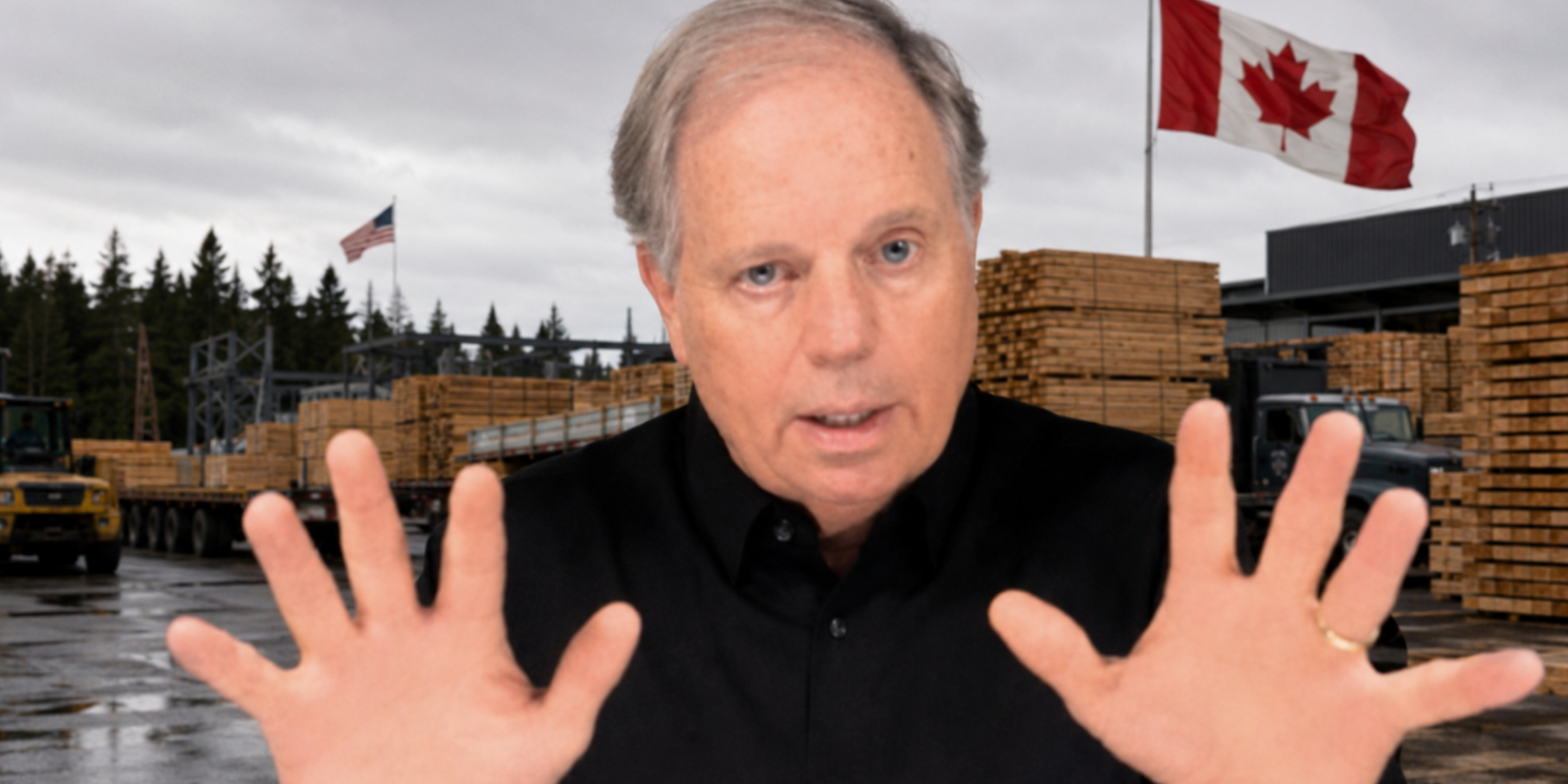
Doug Jones took to Facebook to lecture U.S. Senator Tommy Tuberville (R-Auburn) about taking “a knee any time Trump speaks” on Canada.
Also on Wednesday, Tuberville was in Athens warning 200 Limestone County business leaders that subsidized Canadian lumber is killing Alabama’s foresters.
Caroline Dauzat has spent her career in the middle of that fight.
She’s a fourth-generation owner of Rex Lumber, a family company that has sawed Southern Yellow Pine since 1926, runs four mills across Florida, Mississippi and Alabama, employs more than 700 people and ranks among the largest softwood producers in the country.
She has testified before House committees on the industry and sits on the board of the U.S. Endowment for Forestry and Communities, the nonprofit created under the 2006 U.S.-Canada Softwood Lumber Agreement.
In 2018 she and her family chose Troy for a sawmill that has grown into a $150 million, 300-acre operation in Pike County that promised 110 jobs and hired 170.
Asked whether Trump’s trade fight is hurting the Alabama workers she employs, she called Jones’s claim “completely inaccurate.”
The Democrat nominee for governor said in a video posted to his social media, “You know, this has been a tough week for farmers and workers in Alabama because of Trump’s tariff policies. Once again, he has targeted things that are going to hurt Alabama a lot.”
“Canada is the biggest importer of Alabama goods and Trump’s trade war with Canada is gonna hurt Alabama workers,” Jones said.
He willfully omitted an Alabama industry that has spent a decade fighting Canada in Washington: Forestry, a $36 billion-a-year business supporting more than 55,000 jobs in a state that ranks 4th nationally in lumber production.
“It’s completely inaccurate,” Dauzat said in an interview with Yellowhammer News.
“What President Trump is trying to do is create a level playing field where there’s inequity between the countries, and there is. Canadians do some things differently, and it supports their industry in a way that makes it unfair to our industry. And when you’re operating from a disadvantage, you have to have those trade protections to keep your industry vital and viable.”
Last summer the U.S. Department of Commerce found Canadian producers were dumping subsidized softwood into the U.S. market and more than doubled the penalties on Canadian lumber to roughly 35%. Trump’s 10% national security tariff was added in October, putting most Canadian lumber at a 45.16% import tax.
Jones has company in Ottawa.
Canadian officials called the policy unfair and unwarranted when they were imposed and Canadian governments have answered enforcement with more than $2.1 billion in new forestry subsidies in seven months.
“We are constantly fighting Canadian dumping,” Dauzat said. “The Canadian system of government ownership of timberland is inherently unfair, because when we go out and buy our timber to make lumber, we have to negotiate with landowners, from the federal government to states to individual landowners to REITs … and get to a fair market price.”
“In Canada, they are given allocations of timber, and the government basically has complete control of the timber,” she said.
Effectively, Canada’s government owns the forests, names the price, and pays its mills to keep undercutting Alabama’s.
RELATED: Alabama is the state where money does grow on trees: Forestry industry hits $36.3 billion
“I would say the Troy mill is a product of the trade case,” Dauzat said, speaking for Rex Lumber rather than the coalition.
“Our industry has blossomed since that trade case has been in effect.” Take the penalties and the tariff away, she said, and “you just start losing industry in the U.S., because we’re going to be undercut, and you just can’t survive.”
“It’s a basic question, and Trump nails this every single time,” Dauzat said.
“Do we want the jobs here, and do we want to have the value added here, or are we outsourcing everything? Being a family business that’s been here for 100 years, I want to make stuff in the U.S.”
Senator Tuberville has spent his time in Washington advocating for more leverage over U.S. trade competitors.
In Athens on Wednesday, Tuberville said Canada subsidizes its lumber industry and “they’re shipping lumber into our country, in our state, and it’s killing our foresters.”
The Alabama Forestry Association endorsed Tuberville for governor well over a year ago.
In a statement to Yellowhammer News, AFA President and CEO Chris Isaacson pointed to the two days the senator spent touring the industry in October 2024.
“A couple of years ago, Senator Tuberville took two days out of his busy schedule to tour the state to learn about Alabama’s extensive forest industry,” Isaacson said.
“During his trip across rural Alabama he got to meet loggers and their operations, tour forest products mills, and visit with landowners. Along the way, he was able to see, hear, and understand our industry’s needs and challenges and I must say, he quickly grasped the value of the timber industry to the state.”
“Coach’s record is second to none in fighting for the forest industry in the U.S. Senate,” Isaacson said.
“His work to roll back regulations that hinder businesses and fight for Alabama First policies have been his hallmark in Washington. As Governor, we know he will bring with him that same energy and commitment to fight for Alabama’s forest industry and grow our state’s rural economy.”
Jones and Tuberville are slated for a November 3 rematch of the 2020 Senate race, which Tuberville won by roughly 20 points.
“We’ve got to be able to make things in this country and effectively do it at a price that is affordable, but also that we can maintain a business,” Dauzat said of the plot Jones has lost.
“Because if you can’t make money, you can’t pay your employees, and you just end up gone,” she said.
Grayson Everett is the editor in chief of Yellowhammer News. You can follow him on X @Grayson270.