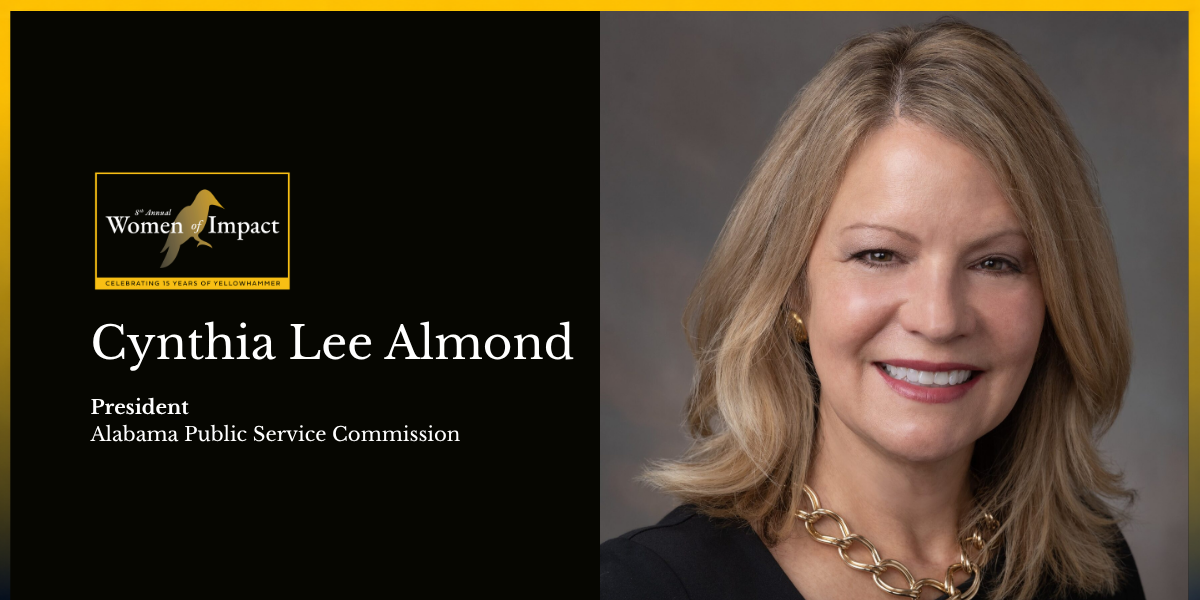
A single conversation helped set Cynthia Lee Almond on a path that would take her from the Tuscaloosa City Council to the Alabama Legislature and, ultimately, to the leadership of the Alabama Public Service Commission.
In 2005, a colleague encouraged Almond to consider running for the Tuscaloosa City Council. She weighed the demands of public office against her legal career and responsibilities at home before deciding to take that first step.
“Looking back, I remain especially grateful to the colleague who recognized my interest, saw potential in me, and encouraged me to seek office,” Almond said. “Without that encouragement, I may never have taken the first step. My career has reinforced my belief that one person’s encouragement can profoundly influence another person’s future.”
RELATED: Yellowhammer News honors 2026 Class of Alabama ‘Women of Impact’
More than two decades later, Almond’s commitment to public service has earned her recognition as one of YHN Media Group’s 2026 Women of Impact. The annual recognition honors women whose leadership, service and professional accomplishments are making a difference across Alabama. Through their own words, the honorees share the experiences, values and relationships that have shaped their lives and careers.
A family tradition of public service
For Almond, an interest in government began long before she entered public office.
“I grew up in a household where public service and politics were a regular part of family conversation,” she said. “My father served for a time in the Alabama Legislature, and even after leaving office, he remained actively engaged in public affairs. His example undoubtedly sparked my own interest in government and public service.”
Almond was elected to the Tuscaloosa City Council and served four terms, spanning 16 years. The position allowed her to see the effects of local government decisions firsthand as she worked with residents to address neighborhood concerns and plan for the city’s future.
“Serving on the Tuscaloosa City Council allowed me to work directly with constituents every day,” she said. “Whether helping resolve neighborhood concerns or collaborating with fellow council members to shape the city’s future, the work was immediate and deeply rewarding.”
From the State House to the PSC
After completing her City Council service, Almond was elected to represent District 63 in the Alabama House of Representatives. She served nearly four years before receiving a call from Gov. Kay Ivey’s office asking whether she would accept an appointment as president of the Alabama Public Service Commission.
“It was a tremendous honor, and I was grateful for the opportunity to continue serving the people of Alabama in a new capacity,” Almond said.
A legislative record focused on transparency and education
Throughout her legislative career, Almond sponsored or helped advance measures affecting economic development, government transparency, education and health care.
As part of the governor’s four-bill Game Plan package, Almond served as the House sponsor of legislation requiring the Alabama Department of Commerce to publish additional information about projects receiving economic development incentives.
She also served as the House sponsor of legislation setting timelines for government agencies to respond to public records requests.
Almond also supported the Mary Anne Leonard Educators’ On-The-Job Injury Act, which established an on-the-job injury compensation program for eligible public education employees. She sponsored legislation creating the Alabama School of Healthcare Sciences in Demopolis, the state’s fourth statewide public specialty high school.
“By preparing students for careers in healthcare, this school is helping build the workforce our state will need for generations to come,” she said.
The Colby Act
However, one of the most personal examples of Almond’s impact began with a phone call from an attorney with the Alabama Disabilities Advocacy Program.
The attorney asked whether she would support legislation allowing adults who do not need a guardianship or conservatorship to retain their legal rights while receiving help from trusted supporters with certain decisions.
Almond soon met Colby Spangler and his mother. Spangler was born with cerebral palsy, graduated from high school and completed a specialized program at the University of Alabama. He was ready to live on his own but did not want to surrender his legal rights through a guardianship or conservatorship simply because he needed help with some aspects of daily life.
“At the time, a growing national movement was promoting Supported Decision-Making Agreements as a less restrictive alternative that allows individuals with disabilities to maintain their independence while receiving trusted guidance,” Almond said.
Working with Spangler, his family, disability advocates and Sen. Arthur Orr, Almond helped develop and pass what became known as the Colby Act.
“What makes this accomplishment especially meaningful is that I continue to hear from Colby and his mother from time to time,” she said. “Seeing him thrive in his community and successfully live independently is a powerful reminder of how thoughtful legislation can change lives in a very personal way.”
That ability to improve someone’s life — whether by solving an immediate problem or establishing policies that will serve future generations — remains at the heart of Almond’s approach to public service.
“Time is one of our most valuable resources, and I believe it should be spent making a positive difference,” she said. “Public service provides the opportunity to leave things better than you found them, and that responsibility motivates me every day.”
Leading the PSC through an energy boom
Almond now carries that responsibility into a rapidly changing energy landscape. When she accepted the appointment to lead the Public Service Commission, she understood the agency’s importance, even though its work did not always receive widespread public attention.
The growth of artificial intelligence and data centers soon placed energy policy and utility regulation at the center of some of Alabama’s most consequential economic discussions.
“As regulators, we are responsible for balancing economic growth with reliable, affordable utility service for Alabama families and businesses,” Almond said. “The increasing demand for electricity, driven by emerging technologies and large-scale industrial development, requires thoughtful planning and sound regulatory decisions.”
Almond relies on her faith, a consistent lifestyle and a commitment to learning as she approaches those decisions. She reads about current events and energy developments in the United States and around the world, intentionally seeking information from different credible sources.
“Understanding diverse perspectives helps me make better-informed decisions,” she said.
Balancing family and career
Her family has also grown and changed throughout her years in office. Almond’s children were 4 and 6 when she began her public service career. They are now in their late 20s, and she is the grandmother of two.
“Achieving balance is never an exact science, and no one manages it perfectly,” she said. “However, I firmly believe that women can build meaningful, challenging careers while also being devoted mothers, loving wives, and active participants in their families’ lives.”
Do today’s work well
Just as someone once encouraged Almond to consider an opportunity she might not otherwise have pursued, she now offers the next generation of women a reminder to focus on the work immediately before them.
“While it is important to have goals and a vision for the future, we sometimes spend too much time worrying about decisions that are still far down the road,” Almond said. “Instead, I encourage young women to concentrate on doing today’s work with excellence. If you consistently do the job in front of you well, future opportunities will often take care of themselves.”
For Almond, a career of impact was built exactly that way — one decision, one opportunity and one day of meaningful work at a time.
Sherri Blevins is a staff writer for Yellowhammer News. You may contact her at [email protected].