“There are so many people who need an opportunity, just an opportunity.”
For Susan Price, those words are more than a philosophy—they’ve become the foundation of a career dedicated to helping Alabamians build better lives.
Whether mentoring an adult learning to read, helping young women overcome difficult circumstances, or shaping statewide education policy, Price has spent her career focused on one goal: opening doors that might otherwise remain closed.
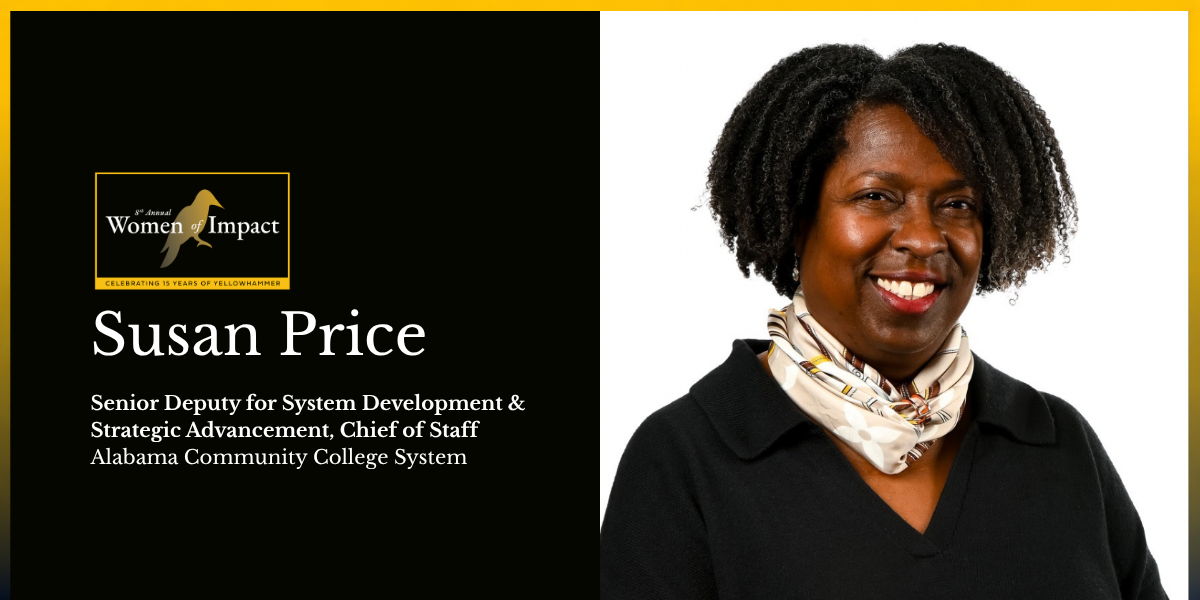
As Senior Vice Chancellor for System Development and Strategic Advancement and Chief of Staff for the Alabama Community College System, her work touches thousands of students across Alabama. Yet, ask Price about her greatest accomplishments, and she won’t begin with policy or titles. Instead, she’ll tell stories about people.
That commitment to serving others has defined Price’s career and reflects the qualities recognized by YHN Media Group in naming her one of its 2026 Women of Impact honorees, an annual recognition celebrating Alabama women whose leadership, service and professional accomplishments are making a lasting difference across the state.
A long and winding road
Price laughs when asked how she arrived at her current role.
“It’s been a long and winding road for me,” she said.
Growing up, she was pulled between two very different influences. Her mother was an English professor who nurtured a love of reading and learning, while her father—a lawyer and later a judge—introduced her to the courtroom long before she ever entered one herself.
“I also grew up with a prosecutor who practiced some of his oral argument while he was taking me to school,” she recalled with a smile.
Even during her senior year of college, she wasn’t sure whether her future belonged in law or academia. She loved history enough to consider becoming a medieval scholar and took a year away from school to teach at boarding schools in Connecticut and Massachusetts.
“I realized that there was this great affinity for education and what education can do,” she said.
Reality, however, eventually won out.
With student loans to repay, Price enrolled at the University of Virginia School of Law before beginning a successful legal career that included clerking for a federal judge in Montgomery, practicing with a major Seattle law firm and later joining the Washington State Attorney General’s Office, where she quickly found herself doing exactly what she loved—trying cases.
She eventually became chief administrative law judge, leading a division of 20 attorneys.
Still, education never stopped calling her.
After deciding it was time to move closer to home, Price accepted a position with the Alabama Community College System in 2004, finding the perfect opportunity to combine her legal background with her passion for education.
“I was able to combine my love for policy and how law works with policy and education,” she said.
She jokes that she quickly discovered her parents, whom she had hoped to be closer to, were doing just fine without her.
“They were having the time of their lives,” she said with a laugh. “From their perspective, I probably moved back almost 20 years too soon.”
One opportunity can change everything
For Price, the mission of Alabama’s community colleges extends far beyond classrooms.
“Alabama’s a very rural state,” she said. “I’m a believer that if you can raise the lowest boats, then everybody rises up and the state becomes an even better state for its citizens.”
She believes countless Alabamians simply need someone to help connect them with opportunity.
“There are so many people who need an opportunity, just an opportunity,” Price said. “There are so many people who have dreams, but they don’t know how to make those dreams come to reality.”
Helping people discover those opportunities creates a ripple effect that reaches far beyond individual success.
“If we can work to connect them to that opportunity and fulfill those dreams, then they become better and more informed citizens,” she said. “They can break the cycle of generational poverty. They can better support their communities. As communities grow, Alabama grows.”
Ultimately, she said, helping one person changes much more than a single life.
“You’re helping one person at a time, but as you’re helping one person at a time, you’re helping the state as a whole.”
One student, one life, one opportunity
Long before she helped shape education policy across Alabama, Price was helping one student learn the alphabet.
While living in Seattle, she volunteered with a literacy organization in Tacoma and was paired with a 23-year-old man who had graduated from high school and was a basketball star but was reading at roughly a second-grade level.
Looking at him, no one would have guessed.
“He didn’t even have a driver’s license because he couldn’t pass the written exam,” she said.
Rather than beginning with books, they started with letters.
“We first recognized our letters, then the sounds the letters make, and then we started reading.”
Over four years, Price watched him steadily progress despite moments of discouragement and frustration.
“He had been done a tremendous disservice,” she said. “He was a premier athlete, and they didn’t worry about his academics.”
Eventually another tutor helped carry him the rest of the way.
Years later, Price learned he had earned his GED, obtained his driver’s license, found a job and built a family.
“It was a heartbreaking experience,” she said, “but a wonderful experience to be a part of someone’s journey toward a better life.”
Today, while she no longer teaches individual students, she knows every policy she helps develop has the potential to change thousands of lives in much the same way.
Service beyond the office
Price’s commitment to helping others extends well beyond her professional responsibilities.
As president of the Montgomery Chapter of The Links, Incorporated, a national women’s service organization, she worked with fellow members to mentor a group of young girls facing overwhelming challenges.
Some were being raised by grandparents. Others had experienced abuse or family instability. Several had already been written off by adults around them.
The women committed to walking alongside those girls through high school.
“It wasn’t me,” Price insisted. “I just happened to be president. I was working with an amazing group of women.”
The results spoke for themselves.
Twelve young women graduated from high school, with each going on to either college or military service.
“To see where they had come from and to be a part of their journey—they now had lots of options in this world. And self-esteem as well. It was tremendous.”
Leadership begins with listening
Despite decades of leadership experience, Price admits there was a time she questioned whether she belonged.
When she became chief administrative law judge in Washington state, she was the only woman, the only person of color and roughly two decades younger than the next-youngest leader.
“I had no idea what I was doing,” she admitted.
Walking into that first leadership meeting was intimidating.
“I thought, ‘Oh goodness gracious, I don’t know that I can do this.’”
What she discovered changed the way she viewed leadership forever.
“It’s not about being a female. It’s not about being a person of color. It’s not even about being that much younger than the person closest to you,” she said.
“It’s about learning how to interact with people and respect people for the skills that they bring to the table. And as a leader, helping them hone those skills so they can be the very best they can be.”
By the time she left, the division had become a highly functioning team.
“I learned from them, and they learned from me.”
Never stop learning
Price continues to grow by surrounding herself with people who challenge her perspective.
She remains active with The Links, Incorporated, Delta Sigma Theta, the Alabama Humanities Alliance and the Montgomery Museum of Fine Arts.
Serving on the museum’s Collections and Acquisitions Subcommittee has even changed the way she looks at art.
“I’ll look at something and think, ‘Well, I’m not sure that’s art,’” she said with a laugh.
“But then I hear others talk about what they see in it, and it broadens my own perspective.”
The same principle applies to leadership.
“It’s so nice to work with people you respect who have very different skills from yours,” she said. “We end up with very rich conversations that help me grow as a professional.”
Staying the course
When asked what advice she would offer the next generation of women leaders, Price didn’t hesitate.
“Stay the course.”
She knows progress doesn’t happen overnight.
“When I was in my 20s and 30s, having a lot of women leaders was not common,” she said.
She also knows acceptance isn’t guaranteed.
“Not everyone is going to accept you initially. Not everyone is going to respect that you come to the table as an equal.”
But she wants young women to remember one thing.
“You’re there because you earned a place there.”
Then she repeats the words that have carried her throughout her career.
“Stay the course.”
A legacy of open doors
Asked what legacy she hopes to leave, Price doesn’t mention awards or promotions.
Instead, she returns to the idea that has guided her career from the beginning.
“I want to be able to leave an organization in better shape than it was when I got there,” she said.
Working from the Alabama Community College System office means she rarely sees students in classrooms, but she knows the decisions made there create opportunities across the state.
“If I helped create a policy that opens the doors even wider for people to come in and really achieve their dreams,” Price said, “that’s enough legacy for me.”
For Susan Price, success has never been measured by the office she holds.
It’s measured by the doors she opens—and by the lives forever changed when someone finally has the opportunity to walk through them.
Sherri Blevins is a staff writer for Yellowhammer News. You may contact her at [email protected].