The Alabama Supreme Court ruled 7-0 on Friday against the lawsuit seeking to disqualify U.S. Senator Tommy Tuberville (R-Auburn) from the governor’s race over his residency, 25 days out from the election.
It is the final ruling in a residency fight that has trailed him since 2020.
Chief Justice Sarah Stewart and Justices Kelli Wise, Tommy Bryan, Will Sellers, Brad Mendheim, Chris McCool and Will Parker joined the unsigned opinion. No justice dissented and none wrote separately. Justices Greg Shaw and Greg Cook recused.
The decision upholds the July order in which Montgomery County Circuit Judge Brooke Reid, a Democrat, dismissed the case.
Two Jefferson County residents filed it in June, claiming Tuberville has not lived in Alabama for the seven years the state constitution requires of a governor.
Tuberville’s legal team, led by Montgomery attorney Joe Espy and his son and co-counsel Bill Espy team moved promptly to dismiss, and his campaign has called the case a “residency hoax” driven by former U.S. Senator Doug Jones (D-Mountain Brook), the Democratic nominee, and his lawyers.
RELATED: Judge dismisses Tuberville residency case
Without weighing the evidence over where Tuberville lives, the justices ruled that Alabama law gives that question to the party before a general election, and that the Alabama Republican Party has answered it.
“Turning back to this case, Tuberville’s qualification to be the party nominee for the office of governor based on the duration of his residency in Alabama has been put before the executive committee of the Alabama Republican Party by way of a primary-election contest brought under the primary-election contest statutes and has been adjudicated in favor of Tuberville,” the court wrote.
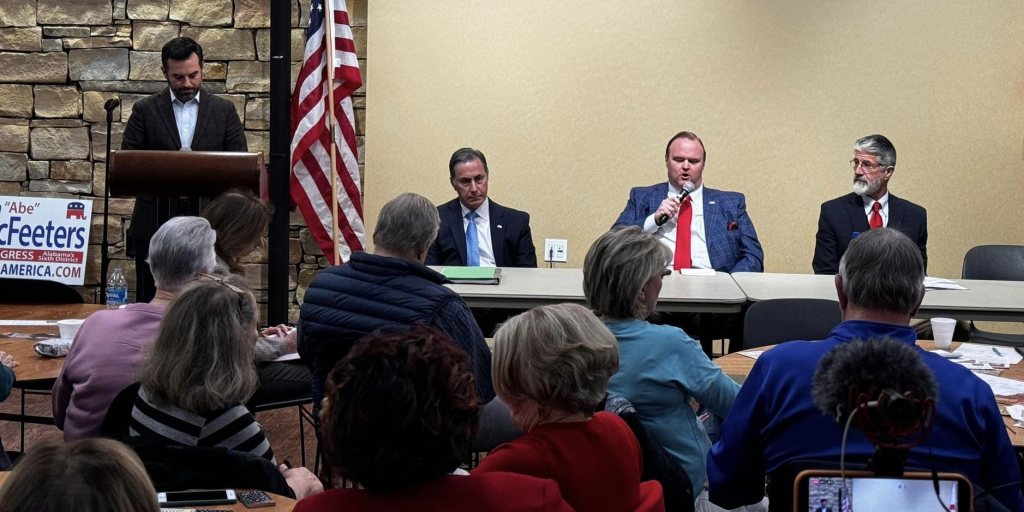
The party’s committee ruled unanimously for Tuberville in June on a contest brought by his primary opponent, Ken McFeeters.
“In light of the above, our decisions in such cases have generally adhered to the rule that a primary-election contest brought under the primary-election contest statutes is the exclusive method authorized by law to challenge a party nominee’s qualification for office before the general election,” the opinion states.
The court quoted its 1986 ruling from the Democratic primary fight for governor between Bill Baxley and Charles Graddick:
“For over 50 years, the courts in this state have adhered to the legislative mandate that political parties are empowered to settle their own disputes in primary elections.
The same rules apply regardless of the office involved. The statutory scheme was first enacted in 1931 and bestowed on political parties in primary election contests subpoena power and prehearing discovery authority which the circuit courts did not have for 40-odd years thereafter.
The legislature recognized that these disputes require an early resolution and it gave the political parties the tools to resolve them.
It vested in political parties in primary disputes quasi-judicial authority and such discretion as courts of limited jurisdiction exercise.”
The plaintiffs sued under quo warranto, the legal action used to remove a person who unlawfully holds public office. The justices held that a nominee holds none.
“Alabama law does not vest a party nominee ‘with some portion of the sovereign functions of the government,’” the court wrote. “Accordingly, we hold that a party’s nominee for election to public office does not exercise any public office. Thus, a quo warranto action is not authorized against a party nominee.”
Attorney General Steve Marshall and the Alabama Republican Party both filed briefs backing Tuberville, and Marshall argued a nominee is a public officer only if he can carry out the sovereign functions of the office.
The plaintiffs’ attorney, Barry Ragsdale of Birmingham, a Democrat and friend of Jones, and has denied that Jones, his campaign or the Alabama Democratic Party is paying for the suit.
Ragsdale predicted in June that a majority of the Supreme Court would step aside and leave the case to a specially appointed panel.
Tuberville’s team argued from the first hearing that a courtroom was the wrong place for the fight.
“We cannot have a circuit judge deciding who is going to be the governor of the state of Alabama,” Jon Gray, Tuberville’s general consultant, said after the June hearing in Montgomery. “Can you imagine if a circuit judge somewhere in Alabama could just decide to kick a governor off the ballot? What kind of chaos would we have?”
The campaign celebrated Reid’s dismissal in July and predicted the same result on appeal.
“They lost on the facts, they lost on the law, and now they are hoping a notice of appeal can breathe life into a political stunt Alabama voters already see through,” campaign chairman Jordan Doufexis said in July.
“The courts have rejected this nonsense once, and we are confident they will reject it again,” Doufexis said.
Tuberville and Jones are on the ballot November 3.
Grayson Everett is the editor in chief of Yellowhammer News. You can follow him on X @Grayson270.