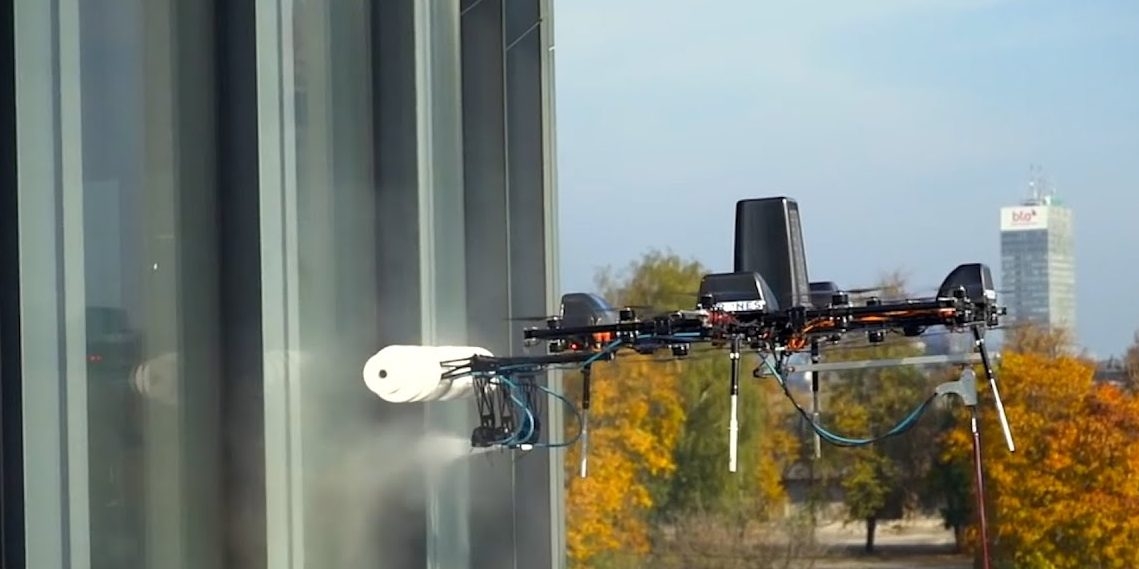
What began as a University of Alabama senior design project has transformed into a solution to a problem facing a Tuscaloosa business.
A team of UA aerospace engineering students spent the past year designing and building a power-washing drone for Tuscaloosa-based Coop’s Maintenance after company owners Nathan Cooper and Brody Barnett began looking for a safer and more efficient way to clean multi-story buildings.
According to local reports, the project grew out of challenges the company’s founders faced while cleaning apartment complexes and other large buildings.
“We were just getting rained down on, wet ladders, covered in bleach, having to move our equipment from one spot to the next,” Barnett said. “And we were just like, ‘man there has to be a better way to do this.’”
While pursuing an MBA at the University of Alabama, Barnett brought the idea to aerospace engineer Phillip Varnedoe, who helped turn the concept into a project for a team of UA engineering students. Over the course of a year, the students designed, built and tested the drone.
The finished product is a carbon-fiber aircraft weighing about 35 pounds that can carry up to 55 pounds, reach heights of nearly 10 stories and remain airborne for approximately 35 minutes on a single battery charge.
While the technology allows crews to clean taller structures more efficiently, its primary purpose is to reduce the risks associated with working at great heights.
“The biggest thing is safety,” Barnett said. “As soon as you get up past two stories, you have guys on ladders, and with this kind of job, they’re on wet ladders, so this completely eliminates that.”
Nathan Fisk, the project’s senior test pilot who holds a master’s degree in aerospace engineering, said drones are particularly useful when they can take people out of potentially dangerous situations.
“I think, when it’s used in a way to do something that might be dangerous or dirty, or in some way endangers human life, these kinds of drones are perfect for that,” Fisk said.
Fisk also explained that the drone “practically flies itself at this point,” reflecting the work completed by the student team.
For Coop’s Maintenance, the drone could create opportunities beyond the apartment complexes, condominiums and hotels that make up much of its current workload. The owners said the company is targeting hospitals, stadiums, water towers and university buildings as it begins bringing the technology to market. Barnett added that potential customers have already expressed interest in using the drone on future projects.
Although drone-powered building cleaning systems are already in use elsewhere in the country, the Tuscaloosa project offers an example of how Alabama students and businesses can work together to address a workplace challenge.
In this case, a classroom assignment became a practical tool that may help workers stay off ladders while allowing an Alabama company to take on jobs that were once difficult or impractical to reach.
Sherri Blevins is a staff writer for Yellowhammer News. You may contact her at [email protected].