After U.S. Rep. Dale Strong and Governor Kay Ivey entered Huntsville in the national competition for the United States Space Academy, the University of Alabama System is pointing to the scoreboard of how much of America’s space program relies on its campuses in Tuscaloosa, Birmingham and Huntsville.
The list includes trajectory software from the University of Alabama that NASA used on the Artemis I and Artemis II moon missions, a $37 million NASA contract for UAB to build the freezer that will carry lunar samples back to Earth, and nuclear thermal propulsion research at UAH that could significantly shorten the trip to Mars.
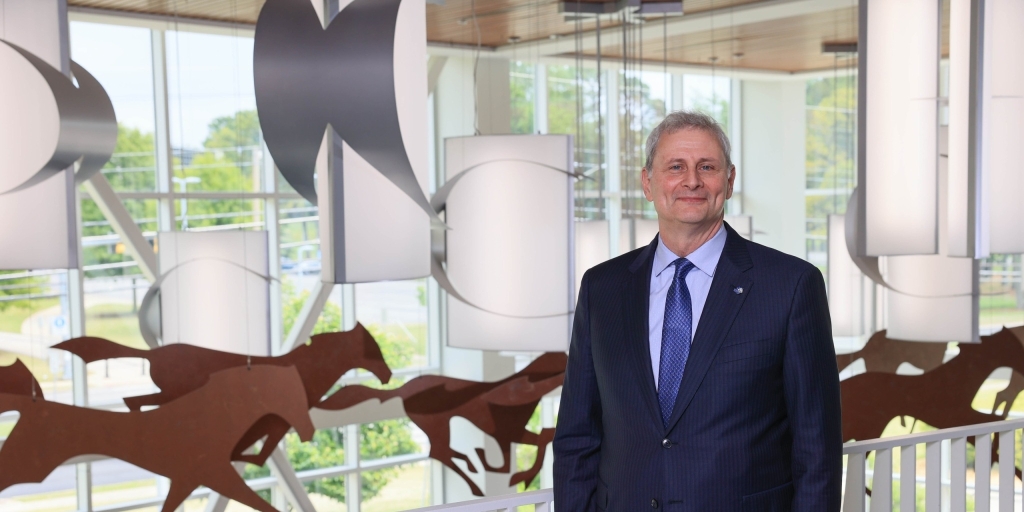
UA System Chancellor Sid J. Trant, who leads the state’s largest employer, connected that work to both U.S. Space Command and the academy bid.
“With U.S. Space Command coming to Huntsville and Alabama pursuing the United States Space Academy, our state has an extraordinary opportunity to play an even greater role in America’s space future,” Trant said.
“Across the University of Alabama System, our universities are already producing the discoveries, technologies and talent that this critical national mission will require.”
President Donald Trump created the Presidential Commission on the United States Space Academy by executive order in August, chaired by NASA Administrator Jared Isaacman.
RELATED: ‘All roads have led through Marshall’: Isaacman highlights Huntsville’s role in NASA’s future
Congressman Strong (R-Huntsville) led Alabama’s congressional delegation in a letter last month pitching North Alabama as the site. Florida, Texas and Ohio are competing for the same academy, and states’ proposals are due later this month.
UAH ranks in the top 10 nationally for aerospace, aeronautical and astronautical engineering research.
The campus sits inside Cummings Research Park, the nation’s second-largest research park, next to more than 300 aerospace, defense and technology companies, NASA’s Marshall Space Flight Center, Redstone Arsenal and the future Space Command headquarters.
The UAH Propulsion Research Center is working with Marshall on the nuclear thermal propulsion project. Earlier this year, a UAH engineering team won NASA’s Student Launch Initiative, finishing first among 23 university teams and ahead of Vanderbilt and North Carolina State.
In Tuscaloosa, the Artemis software is the Astrodynamics Software and Science Enabling Toolkit, or ASSET, developed by Dr. Rohan Sood, an associate professor of aerospace engineering and mechanics, and researchers in UA’s Astrodynamics and Space Research Laboratory.
NASA, federal laboratories, universities and private companies use the open-source toolkit to calculate spacecraft trajectories, and the system said it helped boost the Orion spacecraft toward the moon.
UA’s Alabama Materials Institute is leading a $6 million Air Force Research Laboratory project to develop a safer, cheaper satellite propellant. The student-built BAMA-2 satellite is expected to launch in late 2026.
In Birmingham, UAB’s Engineering and Innovative Technology Development group has worked alongside NASA for decades on hardware used aboard the International Space Station.
The group has had as many as 17 payloads operating in orbit at one time through a $500 million NASA contract.
NASA selected it last year for the lunar freezer, which will bring temperature-sensitive samples home from the moon and the Gateway space station.
UAB researchers are leading a separate $7.5 million Department of Defense program on advanced materials that could support future hypersonic vehicles.
The UA System educates more Alabamians than any other university system, and its overall economic impact exceeds $18 billion a year.
Grayson Everett is the editor in chief of Yellowhammer News. You can follow him on X @Grayson270.