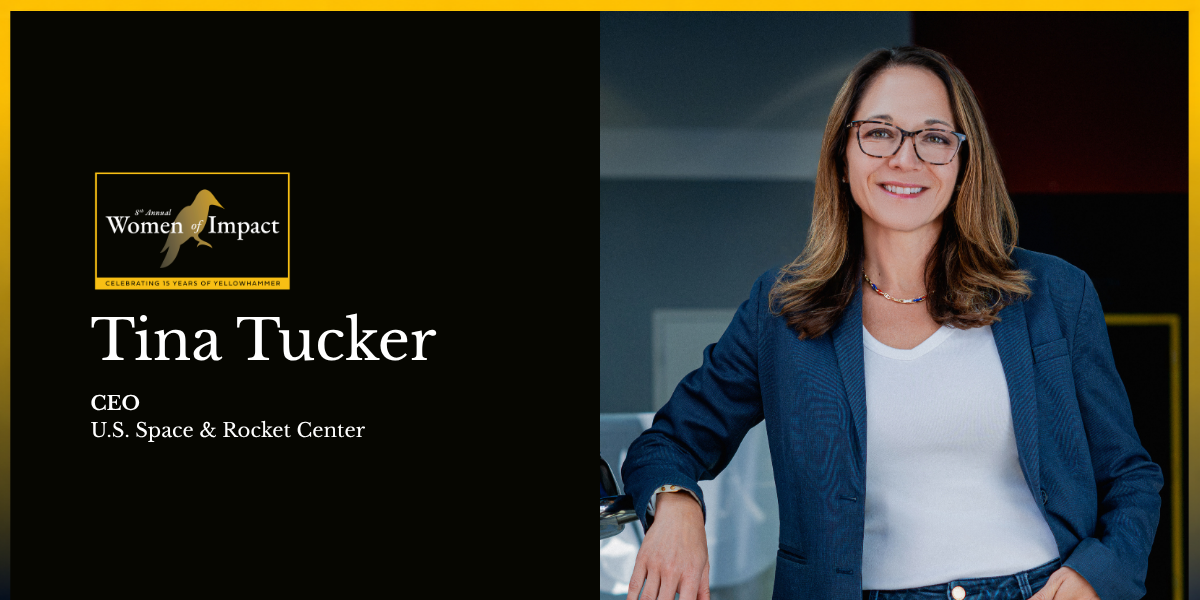
Tina Tucker doesn’t believe the person at the top has to be the person with all the answers.
In fact, after taking over as CEO of the U.S. Space & Rocket Center, Tucker has spent much of her first month doing something decidedly less flashy: listening.
“I really don’t think my job is to have all the big ideas,” Tucker said. “My job is to find those couple of ideas that are going to help propel us forward and find a way to make them happen.”
It is a leadership philosophy Tucker has developed over a career that began as a software engineer and eventually took her to the president’s office of a Huntsville defense company before bringing her to one of Alabama’s most recognizable institutions.
After taking the helm of the Space & Rocket Center, Tucker said she isn’t interested in walking in and assuming she already knows what the organization needs.
Instead, she has spent her first 30 days meeting with employees throughout the center.
“Just listen,” Tucker said. “Listen to what they love about being here and listen to the challenges they’re having so that then we can take all of that and create a strategy that makes sense for the organization.”
An unexpected start
Tucker has called Madison home since 1988, attending Madison City Schools and graduating from Bob Jones High School before heading to Austin Peay State University.
She initially planned to become a physical therapist.
Biology quickly changed her mind.
“I was always a very heavy math girl,” Tucker said.
Computer science proved a better fit, and a summer internship back home would ultimately change the course of her career.
Tucker and her father were playing adult league volleyball when he asked another player if his company could use an intern. Soon, Tucker was working as a software engineer at a small Huntsville office run by Mike Durant, the Army aviator known for surviving the 1993 Battle of Mogadishu after his Black Hawk helicopter was shot down.
After college, she returned to the company full time. When Durant later co-founded Pinnacle Solutions in 2008, 23-year-old Tucker joined as employee No. 4.
“Still had never interviewed for a job,” she laughed.
The startup had no paying customers at the time, and Tucker said she didn’t fully comprehend the risk she was taking.
“I trusted them so much that I genuinely loved going to work. It truly felt like a family, which was exactly the kind of environment I was looking for,” said Tucker. “I still wanted to keep building a future there because it never felt like just a job, it felt like working with family, where you actually have a stake in things and don’t get lost in the corporate noise.”
Pinnacle grew, and so did Tucker’s role. She eventually became president of the company.
But one of the most important things Durant ever told her had little to do with engineering or business.
“He always said I listened better than anyone that ever worked for him,” Tucker said. “When he spoke or when anyone spoke, I listened and I listened to understand, not to respond.”
That stuck.
Finding her own way to lead
Tucker said she was never naturally the loudest person in the room, even while building a career in the male-dominated aerospace and defense industry.
“I’m definitely a quiet-work kind of leader,” she said.
There were times, particularly with people outside her own organization, when she learned she had to be more forceful.
“If I don’t speak up and powerfully say what I’m thinking and what I’m feeling, they’re not going to listen,” Tucker recalled.
But she never came to believe leadership required becoming someone she wasn’t.
Instead, she learned that a leader has to understand the people around her.
“You have to lead different people differently,” Tucker said. “Not everybody responds the same way to leaders, to certain styles of leadership.”
Some of those lessons came long before her career.
Tucker grew up playing softball in Madison, eventually playing at Austin Peay and later coaching two state championship teams at Sparkman High School.
“My leadership journey started on the ball field,” she said.
For Tucker, sports taught her how to work within a team, how to lift up someone having a bad day and how to perform while uncomfortable.
Now, as younger women see her leading the Space & Rocket Center, Tucker said there is a responsibility that comes with being the example.
“It is a huge responsibility to continue to want to show the next generation of women that this is possible,” she said.
‘We are walking by astronauts every day’
That next generation is quite literally walking through Tucker’s new workplace.
The Space & Rocket Center has produced 21 Space Camp alumni who later traveled to space, a fact Tucker points to when talking about what drew her to the job.
“We absolutely are walking by future astronauts every day here,” Tucker said. “We are creating that inspiration for them.”
For someone who grew up watching Madison and Huntsville transform around her, Tucker said leading an institution so closely tied to the community carries a particular responsibility.
It also gives her the chance to do what she discovered she loved while helping build a company: developing people and organizations.
And she believes some of the best ideas for what comes next won’t come from her.
“Your best ideas come from your frontline workers that are on the ground working with your visitors, working with your campers,” Tucker said.
Her job, she said, is to make sure they are heard.
It’s fitting for someone who never actually planned on becoming a CEO.
“I was not one of those that had aspirations of being a CEO,” Tucker said.
When asked what a young Tina Tucker would have thought if someone told her she would one day become CEO of the U.S. Space & Rocket Center, Tucker laughed.
“She’d say, ‘No, you’re going to be a softball coach.’”
She wouldn’t be entirely wrong.
Tucker is still leading a team. The field just got considerably bigger.