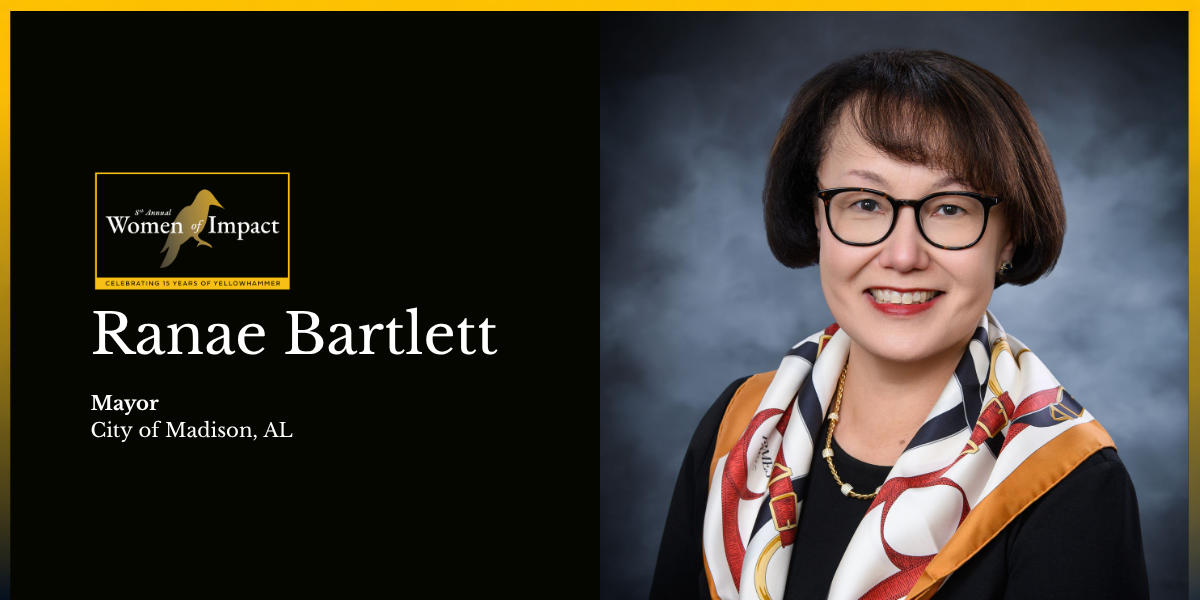
When Ranae Bartlett talks about leadership, she rarely begins with herself.
Instead, she talks about her father, a sharecropper’s son from Texas with only a seventh-grade education who taught himself international Morse code the night before a military placement exam during World War II. Learning that one skill landed him a communications assignment that likely saved his life.
She talks about her mother, who grew up in South Korea with limited educational opportunities.
Neither parent graduated from high school. Yet both believed education could change everything.
“They valued it so much,” Bartlett said. “They thought for me and my sister that having an education is just the most amazing thing that could happen because they were not afforded the same educational opportunities.”
That belief became the foundation of Bartlett’s life.
She became the first member of her family to graduate from high school, college and law school, earning degrees in mathematics and political science before graduating from the University of Arkansas School of Law. She clerked for the chief judge of the U.S. Court of Appeals for the Fifth Circuit, worked as corporate counsel for Walmart and later served as a federal judicial law clerk after moving to Alabama in 2003.
Today, she is the first Asian American mayor in Alabama.
But Bartlett does not view that milestone as the defining chapter of her story.
“When you run for office, even though you’re conscious that if you win you’ll be the first, that’s not the why,” she said. “You’re running because you’re passionate about something that you want to fix.”
That desire to fix things has guided nearly every chapter of her public life.
Service before politics
Long before she considered running for office, Bartlett volunteered.
She joined the Junior League, served in the PTA and looked for ways to strengthen the community around her.
Her first elected appointment came on the Madison City Schools Board of Education, where she would eventually spend nearly a decade before serving five years on the Madison City Council.
Her commitment to education also led to one of the most unexpected turns in her career.
What began as volunteering to help an elementary school chess club quickly snowballed into something much larger.
When Rainbow Elementary’s gifted teacher needed help with a small morning chess club, Bartlett volunteered because her son wanted to participate.
The following year, she suggested moving the club after school.
Participation exploded from about a dozen students to more than 100.
Soon she was organizing tournaments, building competitive programs and creating opportunities for girls to participate in a game traditionally dominated by boys.
Those efforts eventually earned national attention.
Years later, Bartlett became executive director of the U.S. Chess Federation, leading the national organization and representing the United States internationally.
“It was what I thought my path was supposed to be,” she said.
Then her phone started ringing.
From chess to Mayor
When then-current Madison Mayor Paul Finley announced he would not seek another term, community leaders began urging Bartlett to run.
She repeatedly declined.
She had just accepted what she considered her dream job leading U.S. Chess.
But the conversations continued.
People asked her to coffee. They invited her to lunch. They kept telling her Madison needed her.
“At some point you kind of have to pay attention,” Bartlett said. “You begin to realize, am I supposed to be the one stepping up to do this?”
She believes God often speaks through people. Eventually, she listened.
Mayor Bartlett won the election and was sworn in as mayor in November 2025.
“I had no idea how much I would enjoy the job,” she said. “What an impact I can make.”
Leadership looks like listening
Bartlett describes herself as an introvert, a trait that seems at odds with serving as the public face of one of Alabama’s fastest-growing cities.
Instead of retreating, she leaned into it.
She intentionally shops locally, attends concerts, visits restaurants and spends time throughout the community because she believes residents deserve direct access to their mayor.
Sometimes those conversations involve concerns about development projects.
Other times they are simply words of encouragement from strangers.
“Every time I’m out, somebody comes up to me,” she said. “It’s so heartwarming.”
Her leadership style is collaborative rather than directive.
She talks frequently about bringing people together, gathering perspectives and solving problems collectively.
That philosophy has already shaped her administration.
Among the initiatives she is most proud of is a neighborhood corridor revitalization effort focused on neglected properties and long-standing public safety concerns.
Rather than allowing blighted properties to remain untouched, Bartlett assembled department heads from across city government to examine how Madison could more aggressively address nuisance properties, improve code enforcement and revitalize aging commercial corridors.
“We’re going to revitalize areas that have just been ignored,” she said.
She believes the work will leave a lasting mark on Madison long after individual ribbon-cuttings are forgotten.
A city finding its next chapter
Bartlett inherited a city already known statewide for its nationally recognized schools, safe neighborhoods and proximity to Redstone Arsenal, NASA and Cummings Research Park.
She wants Madison’s next chapter to build on those strengths while creating a more vibrant city center.
Recent commercial growth, redevelopment along Madison Boulevard and continued investment around Town Madison all contribute to that vision.
She also sees tremendous value in relationships beyond Madison’s borders.
As the only woman currently serving among Alabama’s Big 10 Mayors, Bartlett admits she wasn’t sure what to expect.
Instead, she found encouragement.
“They have been so welcoming,” Bartlett said. “Mayor Tommy Battle has been especially kind. He’ll tell me, ‘You’ve got a good head on your shoulders. You’ve got a lot of energy. We’re listening to what you’re saying, too.’”
Representation matters
Although Bartlett says she never ran simply to become the first Asian American mayor in Alabama, she understands what that milestone means to others.
After public events, women, particularly women of color, often approach her.
“They’ll tell me how important it is that someone looks different up there on the dais,” she said.
For Bartlett, those conversations reinforce the importance of opening doors for others.
“I’d like to see more women step up to run for office,” she said. “The more women that realize they can make an impact, the more women we’re going to have who run.”
She believes women often bring a collaborative style of leadership that strengthens communities.
Just make it better
For someone who has practiced law, led a national nonprofit, served on a school board, city council and now as mayor, Bartlett’s advice is remarkably simple.
“When you see something that can be better, jump in and make it better,” she said.
She encourages residents not to wait for someone else to solve problems.
Instead, she asks them to become part of the solution.
When citizens email City Hall to complain about litter or neighborhood issues, Bartlett often responds with a question of her own.
“You’re absolutely right,” she tells them. “Would you like to help me lead and do that?”
It’s a philosophy rooted in the lessons her parents taught her decades ago: Opportunity is precious, education changes lives and ordinary people can accomplish extraordinary things when they’re willing to step forward.
Looking back, Bartlett’s career appears almost impossibly varied: corporate attorney, school board president, chess executive, city council president and now mayor.
Yet each chapter shares a common thread.
She never chased titles.
She simply kept saying yes when she believed she could make something better.
Mecca Musick is the CEO of 256 Today.