“I want someone to walk out of my office and say, ‘I feel better now.’”
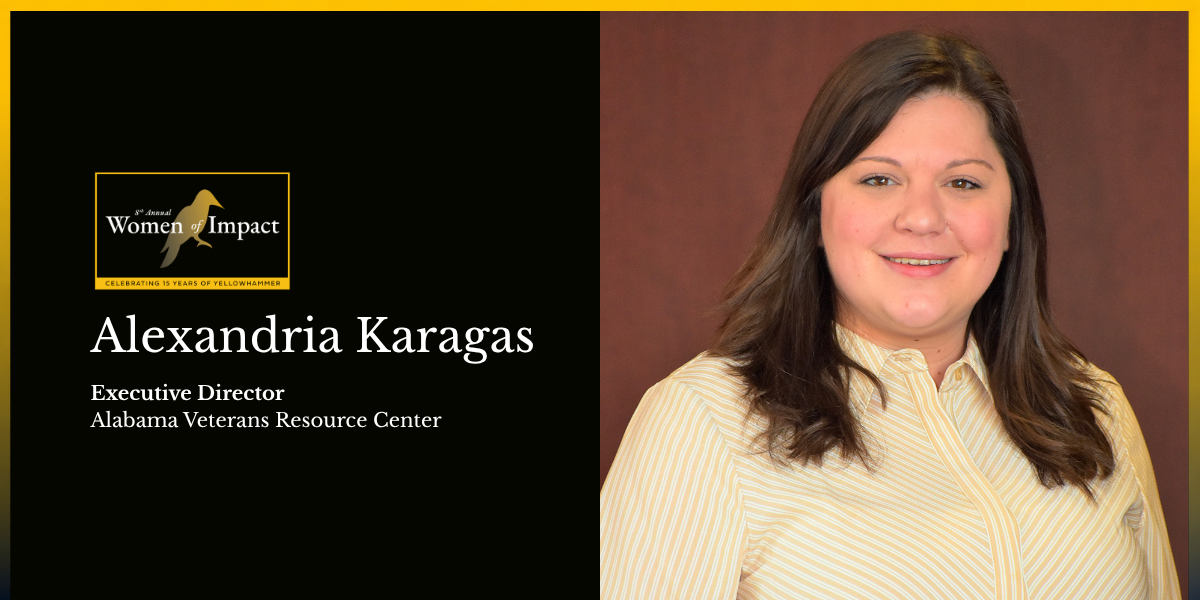
For Alexandria Karagas, that simple goal is the driving force behind her work — and the reason she was drawn to serve Alabama’s veterans and military families in the first place.
Karagas didn’t set out to build a career serving the military community. She enrolled at the University of Alabama planning to become a lawyer, only deciding against law school her senior year. It was around that same time she came across the Campus Veterans Association — her first real exposure to military life.
“I don’t come from a military family,” she said. “No one in my family had served.” But as she got to know veterans and heard about the barriers and boundaries they faced, something clicked. “It sparked this passion in me to help the military community,” she said.
That was 2008, and Karagas has worked with military members and their families ever since. Nearly two decades later, she stepped into her current role as the founding Executive Director of the Alabama Veterans Resource Center.
A brand-new organization, built from scratch
Since the Center opened its doors in February, Karagas and her team have served more than 800 veterans and their families — many of them walk-ins with nowhere else to turn.
Some of the moments that stand out most to her involve veterans who arrived with nothing. “We’ve helped several that have been homeless,” she said. “They didn’t have a cell phone. They didn’t have a place to live. They didn’t have food.” In a single day, her office was able to change that.
What Karagas has seen firsthand is the power of connection — linking veterans to the nonprofit, state and federal agencies already doing good work across Alabama. “We’ve been a great connector of making sure that the people who are already doing great work in Alabama are connected with the people who need it,” she said.
Leading a brand-new, statewide organization means wearing a lot of hats — and Karagas has embraced all of them. “I am HR. I am marketing. I am the report writer. I am the case manager,” she said. That kind of hands-on, do-it-all leadership is part of what it takes to build something from the ground up, and Karagas credits the support of her board and federal partners for helping her rise to the challenge — but says one voice in particular has shaped how she leads.
The influence of her mother
Karagas is the oldest of four girls. Her mother runs her own business in Birmingham, Stretch2Strength — a fitness studio specializing in TRX training and stretch therapy — and has long modeled what it looks like to grow something from nothing — including four daughters.
“Her famous saying is, ‘fake it till you make it,’” Karagas said. Watching her mother build a business after raising four children gave her the confidence to step into her own new, uncharted role. “If she can do that,” Karagas said, “then I can step into this new state-supported role.”
Her three sisters all work in helping fields as well — hospitality, education and refugee services. Karagas credits both of her parents, and her mother especially, with instilling a drive toward community impact.
“She was always in the Junior League and in helping fields, making sure that she impacted the community around her,” Karagas said. “That really set the example for me — no matter where I was, I definitely wanted to make sure I was impacting the community around me.”
Making room to recharge
Balancing a demanding, new role means Karagas leans on a strong personal support system, including a book club she’s kept with the same group of friends for more than a decade.
An avid reader, she aims for 50 books a year — and usually surpasses it. She’s currently reading ‘Unruly’ by David Mitchell, about the history of the English monarchy. Her all-time favorite, though not for everyone, is “Fight Club” by Chuck Palahniuk. “It was the first book that for me had an unreliable narrator,” she said. “It just blew my mind.”
Defining impact
Ask Karagas how she defines impact, and the answer isn’t about titles or accomplishments — it’s about relief.
“I want someone to walk out of my office and say, ‘I feel better now,’” she said. “The person can walk out feeling like that load is shared, it’s not just theirs to bear.”
That mission carries particular weight in the military community, which Karagas points out makes up only about 1% of the nation. “That very small community can feel very isolating,” she said, noting Alabama’s veteran suicide rate runs higher than the national average. Providing even a small amount of support, she said, can make the difference between life and death.
For Karagas, that means pushing past the phrase “thank you for your service” toward something more concrete. “There’s always something else you can add to that sentence,” she said — whether that’s a job lead, a connection, or simply following through. “That shows a veteran you care more than just making yourself feel good by saying thank you for your service.”
A different perspective in a male-dominated world
Karagas believes her outsider’s perspective — civilian and female, in a space often viewed as male-dominated — is part of what she brings to the table. “It’s not just up to the veterans to support each other,” she said. “We need to be paying attention to this.” Rather than leaving veterans to solve veteran issues alone, she sees her role as bringing the broader civilian population into that work.
Being the oldest of four sisters, she says, prepared her well for the job. Growing up, she remembers people often reacting with surprise that her parents had four daughters. “Everyone would be like, ‘Oh, four girls,’” Karagas said. “And my dad would always say, ‘No, I am so lucky.’”
That kind of affirmation shaped how she sees her sisters’ strengths. “I think that really showed me what women can do, and how powerful we are,” Karagas said — even if her sisters would say she spent years bossing them around. “I would now say I learn more from them because of just how much they’ve done in the world.”
A vision for Alabama
Looking ahead, Karagas hopes the Alabama Veterans Resource Center becomes a national model for what a public-private partnership can accomplish. “I think that Alabama can be the state that says, this is how we take care of this population,” she said — not just symbolically, on Veterans Day or the Fourth of July, but “every single day.”
She also hopes to see more women step into leadership roles across the state. “I’m a huge fan of the marketplace of ideas,” Karagas said. “If everybody is speaking and putting their ideas into a hat, the best ideas are going to float to the top.”
For the next generation of Alabama’s leaders, her hope is simple: more voices at the table, and more people willing to do more than just say thank you.
Evy Gallagher is the interim editor in chief of Yellowhammer News. You may contact her at [email protected].