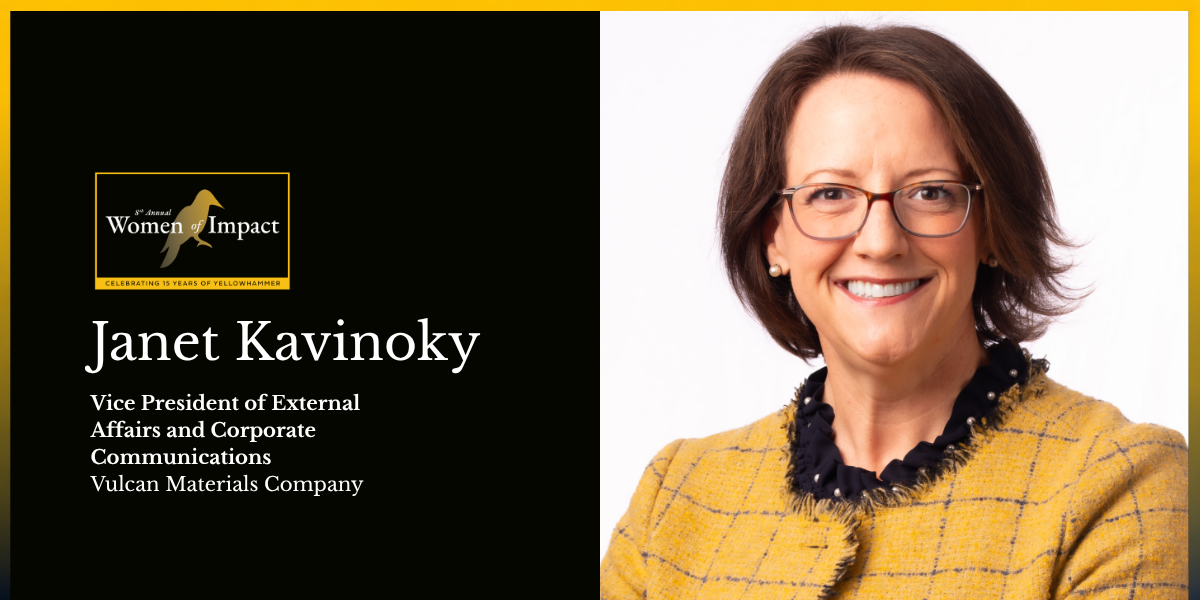
Janet Kavinoky grew up in a Wyoming town of about 3,500 people. She eventually found herself working in Washington, D.C., advising transportation leaders, lobbying on Capitol Hill and earning an MBA from Stanford.
Then, in 2015, Vulcan Materials asked her to move to Alabama.
Her reaction was simple.
“I live in Washington,” Kavinoky recalled thinking. “You want me to move to Alabama, and I’m still not entirely sure what you folks do.”
She came anyway.
More than a decade later, Kavinoky is vice president of external affairs and corporate communications for Vulcan Materials Company, where she oversees government affairs, community relations, corporate communications and sustainability. She also serves as chair of the Coalition for Regional Transportation, which is focused on construction of the Birmingham Northern Beltline.
But her career is not what Kavinoky talks about first when asked what she is most proud of.
She talks about people.
“I think I value the people part of it even more,” she said.
That philosophy has shaped a career that has taken her from rural Wyoming to the nation’s capital and ultimately, to Alabama, where she has built both a professional reputation and a community she calls home.
Taking the unexpected path
Kavinoky earned a degree in political economy from the University of Wyoming and was a Truman Scholar, which led her toward public service.
A fellowship placed her at the U.S. Department of Transportation, where she worked on rural issues. She eventually became a special assistant to the secretary of transportation.
After earning her MBA, Kavinoky returned to transportation policy, eventually working for the American Association of State Highway and Transportation Officials and the U.S. Chamber of Commerce.
It was at the Chamber that she first crossed paths with Vulcan Materials executives.
The company eventually offered her a position.
She was not immediately convinced.
But she and her husband visited Birmingham, attended a Red Mountain Theatre Company gala and saw something that made Alabama feel less unfamiliar.
Then came the neighbors.
After they moved into their new home, Kavinoky’s next-door neighbor burst through the back door, hugged her and said, “Oh, thank God you’re here. We’ve been waiting for you.”
Other neighbors showed up with brownies and introductions.
“It was a very Alabama thing to do,” Kavinoky said.
She never looked back.
“I love being part of a community where people are thoughtful and kind to one another,” she said.
Kavinoky has since become involved with organizations including Red Mountain Theatre Company, YouthServe and A+ Education Partnership, along with transportation and education-focused organizations.
The leaders who opened doors
Kavinoky’s own approach to leadership was shaped by people who recognized her potential early in her career.
One of them was Jack Basso, a transportation executive she worked with at AASHTO.
Basso challenged her, introduced her to people and gave her increasingly difficult assignments.
Eventually, he told her he had done everything he could to help her grow.
Kavinoky said he told her, “I don’t have any more growth opportunities here for you, so we’re going to go out and find you a great job.”
Kavinoky remembers it as a gift.
Years later, she found herself measuring her own success in much the same way.
She is particularly proud of people she hired and mentored early in their careers who have gone on to significant positions on Capitol Hill, in other companies and throughout public policy.
“I think that’s a pretty terrific accomplishment,” she said.
Her goal now is to be the kind of leader Basso was for her.
Do the work
Kavinoky’s advice to the next generation is not complicated.
“Come in early, stay late, be present, be visible and never say no to anything that you’re asked to do,” she said.
For Kavinoky, that does not mean simply working long hours. It means being willing to learn, taking on unfamiliar assignments and building relationships that last.
“Anybody you work with could be back in your life 10 years later,” she said. “You could be working for them. They could be working for you.”
That philosophy has served her well in an industry where she has spent much of her career working across traditionally male-dominated fields.
Kavinoky said she never set out to “conquer” those spaces.
She focused on becoming good at the work.
“For me, my success was about what I knew and how I could advocate for it,” she said.
When asked what she hopes people remember about her years from now, she does not mention a title or a major professional accomplishment.
“I hope they remember that I was generous with my time, with my thoughts, that I was kind to other people, that I tried to always try to help wherever I could,” she said.
Get out from behind the screen
Kavinoky believes one of the biggest challenges facing the next generation of leaders is maintaining genuine human connection.
Her advice is to put down the phone and step away from the screen. She wants young leaders to sit across from one another and learn how to disagree productively.
“There’s divisive politics. How do you overcome that? How do you productively disagree with one another?” she asked.
AI and other emerging technologies will create challenges for future leaders, she said, but technology should not replace relationships.
“It’s a lot harder to make yourself go out there and be present and make those real human connections,” she said.
That lesson runs through Kavinoky’s own story.
The girl from a small Wyoming town did not follow a predetermined path to Alabama. She took opportunities as they came, learned from people who invested in her and then invested in others herself.
Her definition of impact is simple: Do the work. Build relationships. Be present.
And when someone else is ready for the next opportunity, help them find it.
Mecca Musick is the CEO of 256 Today.