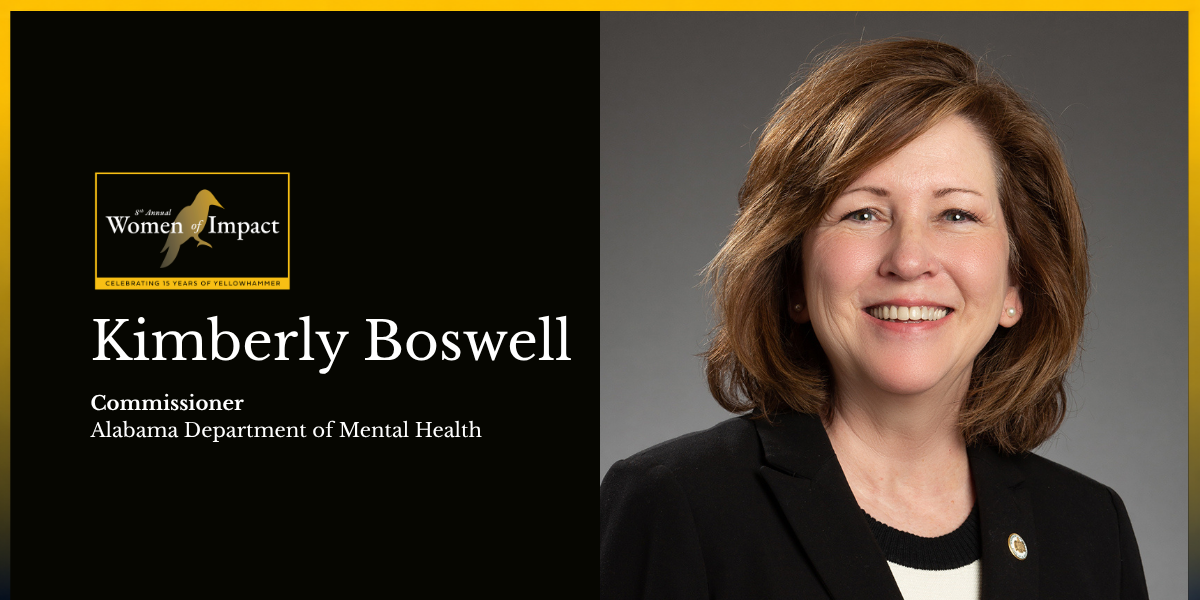
Kimberly Boswell began her career in social work with a simple goal: to help people. Over time, she came to understand that one of the most powerful ways to do that was to also improve the systems serving them.
That idea has shaped more than three decades of Boswell’s career in Alabama’s behavioral health system. Today, she serves as Commissioner of the Alabama Department of Mental Health, a position she has held since 2020 after years in human services, administration, program evaluation, rehabilitation services, and leadership within the department.
Her path to the commissioner’s office is one shaped by a career spent learning how people, organizations, and communities can work together to create meaningful change.
Seeing the bigger picture
Early in her career, Boswell worked directly with those she served before moving into roles focused more heavily on planning and administration. An early position with United Way in Birmingham gave her one of her first opportunities to look at human services from a broader perspective.
“It was such a great experience because there are multiple nonprofit organizations funded through United Way,” she said. “That was the first time I was exposed to strategic planning and identifying community needs on a broader scale.”
That experience helped shape the way she approached the rest of her career. Rather than focusing only on individual services, Boswell became interested in how organizations, policies, and systems could work together more effectively.
That perspective remains central to her leadership today. “I did some direct services early on in my career,” she said. “Today, it’s really just trying to remember to keep the focus on the people who are served.”
As she moved higher into leadership, she found that maintaining that focus required greater intention. “You’d think that would be an easy thing, but as you go up the chain of command, it gets harder,” she said. “It takes a concerted effort. How is this decision I’m making today going to affect people in the community? How is it going to affect the individual?”
Those questions have become some of the guiding principles of her work.
Relationships are the “secret sauce”
After more than 36 years in the field, Boswell says one of the biggest lessons she has learned is that successful systems depend on something that cannot be written into a policy manual: relationships.
“I thought early on that if you got the program right, the policies and procedures, you’re good,” she said. “But the truth is, at the end of the day, it’s about the relationships. You can have the best program in the world, but if the person implementing it doesn’t care about the individual they’re serving, then not a lot’s going to get done.”
That realization has influenced the way the Department of Mental Health works with organizations across the state. In recent years, Boswell has focused on building partnerships with organizations that might not traditionally have been viewed as part of the department’s network.
“Understanding that relationship building across many groups is the secret sauce,” she said. “You’ve got to have folks rowing in the same direction.”
That includes the state’s community mental health centers, which Boswell says have been asked to take on new challenges and try new approaches.
“We’re giving them resources to do things that we need to have done,” she said. “To ask them to be innovative and do new things and not just business as usual, to convince people to do that requires trust.”
Making crisis care easier to reach
That emphasis on collaboration has been especially important in the development of Alabama’s Crisis System of Care.
Boswell says the goal was not simply to create individual crisis services, but to build a more connected public mental health system for people experiencing mental illness, substance use disorders, and developmental disabilities.
One of the most visible pieces of that system is 988, the nationwide Suicide & Crisis Lifeline. Before 988, people seeking help in Alabama could face a confusing patchwork of phone numbers depending on where they lived.
“There used to be so many different numbers,” Boswell said. “Figuring out the number of your local mental health center, you might get someone on a call after hours. There were 20 or 30 numbers out there in the state to get into our system.”
The idea behind 988 was to create a simpler entry point.
“If you call this number, we’re going to help you navigate the system and help you figure out next steps,” she said. “When you’re in crisis, the last thing you need is the difficulty of figuring out how to get into the system. We’re wanting to make it easy.”
Building that system has required partnerships across Alabama, including efforts to connect people experiencing mental health crises with services rather than allowing them to cycle through emergency rooms or the criminal justice system without receiving appropriate care.
Through the department’s Stepping Up Alabama initiative, case managers work with individuals in jails and communities across the state to help connect people experiencing mental health challenges with treatment. The goal, Boswell said, is to help people get the care they need and avoid becoming trapped in a revolving door.
Leading through change
One of the accomplishments Boswell is most proud of is not a particular program or initiative, but the culture she has worked to create within the Department of Mental Health.
“I’m really proud of creating an environment in state government where change and innovation is supported,” she said.
That means encouraging her staff to challenge assumptions and move beyond established ways of doing things.
“We’re in this major transition to be innovative and not just do what we’ve always done,” she said.
Leadership development has become an important part of that process. “I love watching people grow professionally,” Boswell said. “For me, the biggest reward isn’t just seeing things accomplished, but seeing my staff grow and develop into a high-functioning team.”
A career with a sense of purpose
Boswell’s commitment to mental health is also personal.
Her mother experienced postpartum depression at a time when there was far less understanding of the condition. Her family has also been touched by addiction, and Boswell experienced trauma as a young person.
Those experiences, she says, shaped the direction of her career. “Without a doubt, those things affected what I wanted to do in my career,” she said.
They also contributed to the sense of purpose she brings to her work. “From a spiritual perspective, everything that was intended will be turned into good,” Boswell said. “If you use that to grow, then that becomes part of your purpose.”
She does not describe her position simply as a job.
“I definitely look at my job as a calling—and not just a job,” she said.
That sense of calling has helped her navigate the difficult moments that come with leading a statewide department responsible for some of Alabama’s most complex and consequential public services.
Staying grounded
Boswell jokes that she has never had trouble being in charge. But one of the hardest lessons she has learned, she says, is recognizing that she is not ultimately in control.
“Part of my testimony is that one of the hardest spiritual lessons for me is that there’s someone in charge, and it’s not really me.”
Her faith provides the foundation she returns to when the work becomes difficult.
“When I get up every day and acknowledge that, stay focused on God’s will and not mine, my day goes pretty well,” she said.
Maintaining that perspective is not always easy. “It’s a discipline that I still have trouble mastering,” she said. “The discipline of staying focused, centered, and grounded in the solid foundation that we all have.”
She also draws strength from a circle of women she has known through a Bible study for more than two decades. Those relationships, like so many others throughout her career, have reinforced one of the lessons she has come to understand most clearly: no one does meaningful work alone.
What women bring to leadership
Boswell believes one quality in particular is often underestimated when it comes to women in leadership.
“Grit,” she said.
“Most of the women I work with, you’re not going to scare them away from their goal,” Boswell said. “They’re tenacious about having a vision and sticking with it until that vision is accomplished.”
She sees that determination in the women she works with every day. “It’s that sticking with it even when things are difficult, but never giving up if you believe that it’s what needs to happen for the citizens of Alabama,” she said.
For Boswell, persistence is not simply a personality trait; it’s something that can be developed.
“There’s a science behind it as well,” she said. “Research shows it’s not your IQ score or other factors that you’d think make people successful. It’s their willingness to stick with it—their grit and determination.”
Take every opportunity to learn
If Boswell could give one piece of advice to a young woman hoping to make an impact in Alabama, she would start with these words: “Get your education.”
But she would also encourage young women not to become too attached to a particular idea of what their career is supposed to look like.
“Take every job as a learning opportunity, because you never really know where it’s going to lead,” she said.
Boswell admittedly notes that her own path wasn’t the one she originally planned. “I didn’t sit down one day and say, ‘I want to be commissioner,’” she said.
Instead, she looks back and sees a series of experiences that prepared her for the role: her work at United Way, time spent in a nursing home environment, and the many other positions and challenges she encountered along the way.
“Going into any situation asking the question, ‘What can I learn from this?’ Even if it feels like it’s not the right place or it’s really challenging, use it as an opportunity to learn and grow,” she said. “That’s the best.”
Some of the experiences she valued least at the time ended up teaching her the most. “Those difficult situations and how we handle them wind up shaping us more than when everything is okay,” she shared.
That may be one of the clearest reflections of Boswell’s own career: a path that was not mapped out from the beginning, but one shaped by every opportunity, challenge and relationship along the way.
More than three decades after entering the field of social work, she is still focused on the same fundamental question she began with: How can the systems built to serve people work better for the people who need them?
For Boswell, the answer continues to come back to people, and to the relationships, persistence, and sense of purpose required to serve them well.