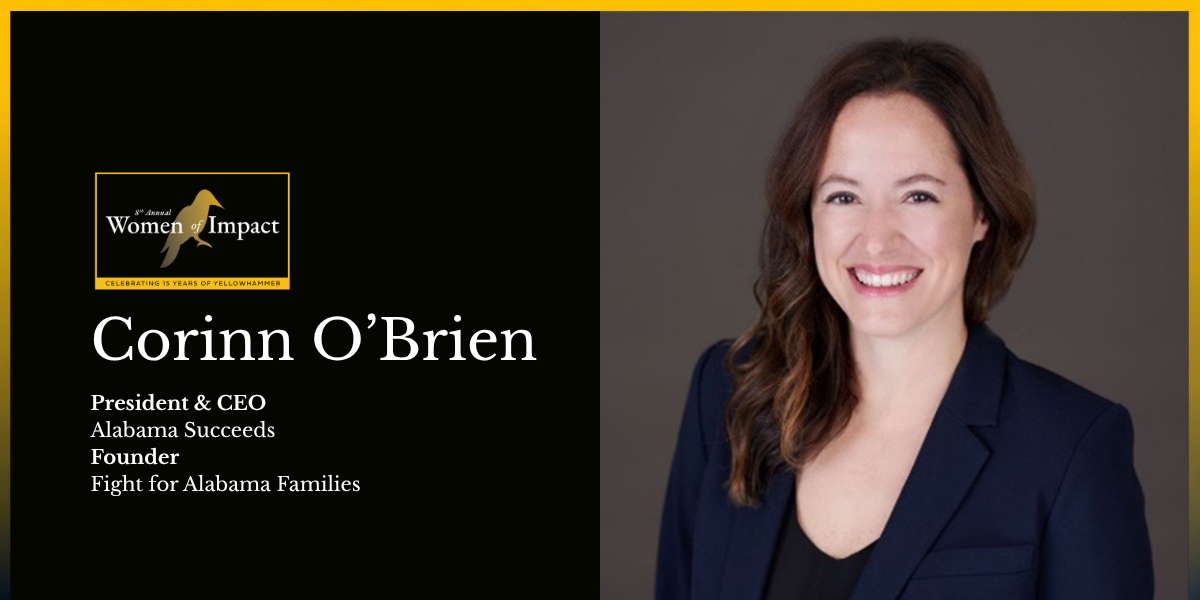
Corinn O’Brien has spent her career working toward a simple idea: Alabama families and children deserve access to the opportunities they need to thrive.
That work has taken her from a middle school classroom in New Orleans to education policy in Alabama and, most recently, to the launch of Alabama Succeeds, a new organization focused on building on the state’s progress in education. It has also taken her to the Alabama State House, where a deeply personal experience with infertility led her to found Fight for Alabama Families and become an advocate for permanent IVF protections.
Though the two organizations address very different issues, O’Brien sees a common thread in both: creating meaningful change requires people willing to step forward and do the work.
From the classroom to education policy
O’Brien grew up in Louisiana and attended Louisiana State University, where she began thinking about the role education could play in changing the trajectory of children’s lives.
“During my time at LSU, I realized I wanted to work on issues that would help improve our education in this country,” she said. “How important access was.”
That realization led her to Teach For America and, in 2008, to a middle school classroom in New Orleans. She spent seven years teaching in the city’s public schools before earning a master’s degree in education from Vanderbilt University and becoming an assistant principal at a middle school in Nashville.
When her husband decided to attend law school, the couple moved to Alabama. O’Brien eventually transitioned into public policy, joining A+ Education Partnership, which has spent more than three decades working to ensure Alabama children have access to quality education.
There, she worked alongside state leaders on legislation and funding, gaining a close view of how policy decisions translate into opportunities for students.
Building on Alabama’s momentum
O’Brien recently stepped away from A+ to launch Alabama Succeeds, a 501(c)(4) organization focused on continuing Alabama’s progress in education.
The numbers offer plenty of reason for optimism. In 2019, Alabama ranked 52nd nationally in fourth-grade math. Today, it ranks 32nd, and Alabama fourth graders posted the largest math gains in the country. The state was also the only one to surpass its pre-pandemic fourth-grade math achievement levels.
“We’ve made major progress over the last couple of years,” O’Brien said. “All of those things together have helped create this incredible momentum.”
She credits teachers and school leaders for those gains, while also pointing to Gov. Kay Ivey’s investments in education and the Alabama Legislature’s leadership on priorities that led to legislation including the Alabama Literacy Act and Alabama Numeracy Act, along with recent efforts to rethink how the state funds public education.
Now, O’Brien wants to help ensure that momentum continues.
“We think it’s possible to be in the top 10,” she said. “We have an incredible opportunity to make this happen in the next decade.”
Alabama Succeeds will work with the next administration to provide research and policy guidance, with O’Brien particularly interested in strengthening the middle and high school years and making sure those stages work together to prepare students for what comes next.
A fight born out of necessity
Her work with Fight for Alabama Families began under very different circumstances.
The coalition of IVF families, advocates and doctors was created to permanently protect IVF in Alabama. O’Brien never planned to become an IVF advocate; she became one while navigating infertility herself.
In April 2019, O’Brien lost her mother to pancreatic cancer while six months pregnant with her daughter, Louise. After her mother’s death, O’Brien knew she wanted Louise to have a sibling. The journey would take over four years.
After working with Alabama Fertility in Homewood and exhausting other options, O’Brien and her husband eventually began IVF.
Then, in February 2024, the Alabama Supreme Court issued a decision that prompted IVF clinics across the state to pause treatments. O’Brien was six weeks pregnant and had just learned at her first ultrasound that she would most likely lose the pregnancy.
“It was a terrible week,” she said. “I just felt like we’re going to lose this baby and then we won’t have another chance.”
As clinics began shutting down, O’Brien turned her attention to what she could do next. She opened a Google Doc, made a list of legislators to contact, and began building a plan. She sent her first email that day, and by the end of it, hundreds of people had joined the effort.
“That was the day Fight for Alabama Families was born,” she said.
From advocacy day to permanent protections
Within a week, the group had organized an advocacy day at the Alabama State House, bringing hundreds of people to Montgomery. The Legislature passed the IVF Immunity Act in five days, and Gov. Ivey signed it that evening.
“I remember sitting there, Governor Ivey signed the bill that night at 9 p.m.,” O’Brien said. “We had families who were able to get treatment the next day.”
The law was always intended to be temporary, so O’Brien and the coalition have continued working toward permanent protections for patients and physicians. That includes launching a campaign for a constitutional amendment protecting IVF access in the 2027 legislative session.
“This isn’t hypothetical. This isn’t abstract,” O’Brien said. “Infertility affects 1 in 6 families.”
She also points to the challenge of recruiting reproductive endocrinologists to Alabama, where only 14 currently practice and several are nearing retirement. Permanent protections, she argues, would provide greater certainty for both doctors and families.
Learning to use your voice
One of the most meaningful parts of the IVF advocacy work has been watching people who had never considered themselves advocates discover their ability to influence policy.
Many of the families who first came to the State House had never advocated for legislation before. They arrived nervous and uncertain, but they knew they needed to be there. Many have since become experienced advocates who now help others.
“They showed up scared,” O’Brien said. “And since then, they’re now seasoned advocates who are helping others.”
The experience has reinforced O’Brien’s belief that people do not have to wait until they feel qualified to make a difference.
“Anyone can make a difference,” she said. “No one is going to tap you on your shoulder. It’s up to all of us to stand up and just get started.”
The influence of her mother
The person O’Brien credits most with shaping her approach to leadership is her mother.
Renee O’Brien was her best friend, and O’Brien says she learned from her how to work hard, remain optimistic and treat people with dignity.
“She taught me how to be tough, how to work harder than anyone else and how to never give up,” O’Brien said.
Her mother maintained that optimism even after receiving a stage 4 pancreatic cancer diagnosis. O’Brien also watched the way she treated people, regardless of their position or role.
“She taught me how to love people well and show respect to everyone, no matter their role,” O’Brien said. “That has served me both personally and professionally.”
Her mother never graduated from college, something O’Brien thinks about often when she considers the opportunities available to children depending on where and when they grow up.
“I often wonder if she’d grown up in my era, what she would have been able to accomplish,” she said.
That belief in unrealized potential is central to O’Brien’s education work.
“Every kid, regardless of where they grow up, are capable of great things, and all of them deserve access to an opportunity-filled life,” she said.
Showing the next generation what leadership looks like
O’Brien is conscious of the example she is setting for her own daughters, and she regularly talks with them about the women leading Alabama and the ways those women are making an impact in their communities. For her, those conversations carry an especially personal weight after the journey that brought her family to where it is today.
After losing the pregnancy she was carrying during the IVF crisis, O’Brien and her husband eventually welcomed their second daughter, Margaret, who is now 14 months old.
“I love that I get to talk about these leaders with my daughter all the time,” she said. “There are so many incredible examples of leadership in our state.”
She admires women who lead with a servant’s heart, courage, tenacity and relentlessness, and sees their example as a source of hope for the generation coming behind them. For O’Brien, that next generation is not an abstract idea. She is raising it.
Making an impact by getting started
O’Brien describes herself as an optimist, a trait she inherited from her mother. When the work becomes difficult, she leans on the friends and colleagues around her who can remind her what is possible.
Her career has taken her through classrooms, policy meetings and the State House, but the lesson she has carried from each chapter is much the same: meaningful change begins when someone decides to show up.
“You might stumble in the beginning,” she said, “but you just have to get up and learn.”
For O’Brien, that willingness to begin—even without knowing exactly where the path will lead—is where impact starts.