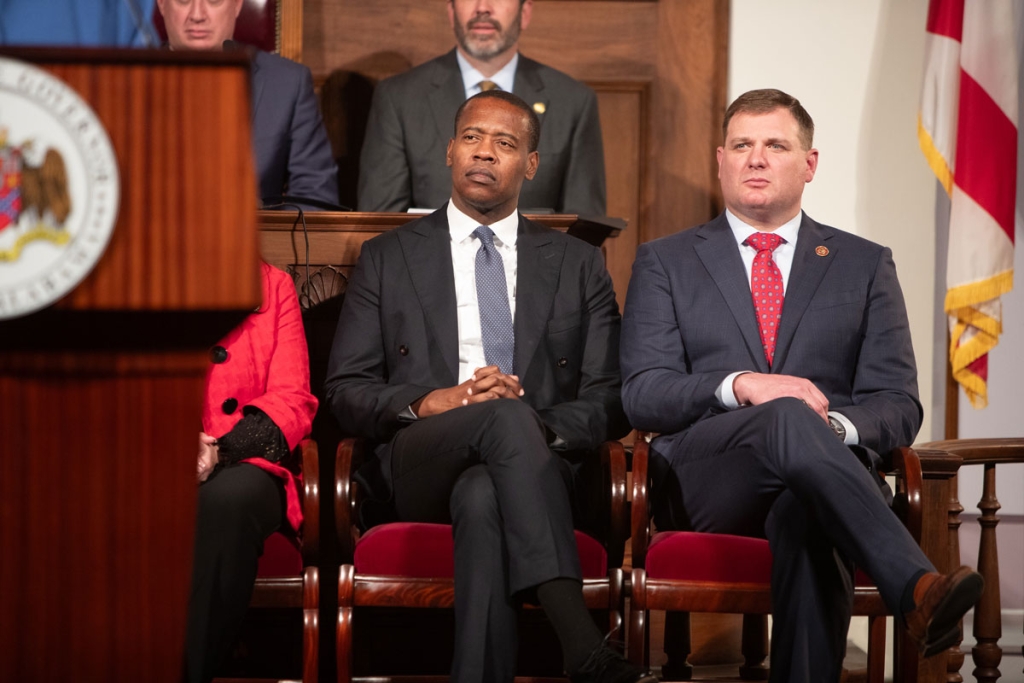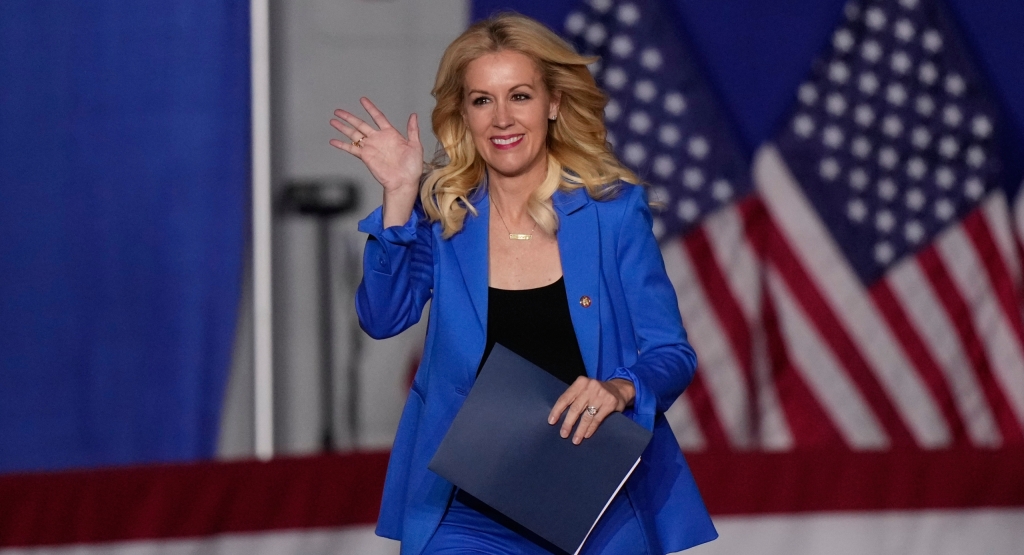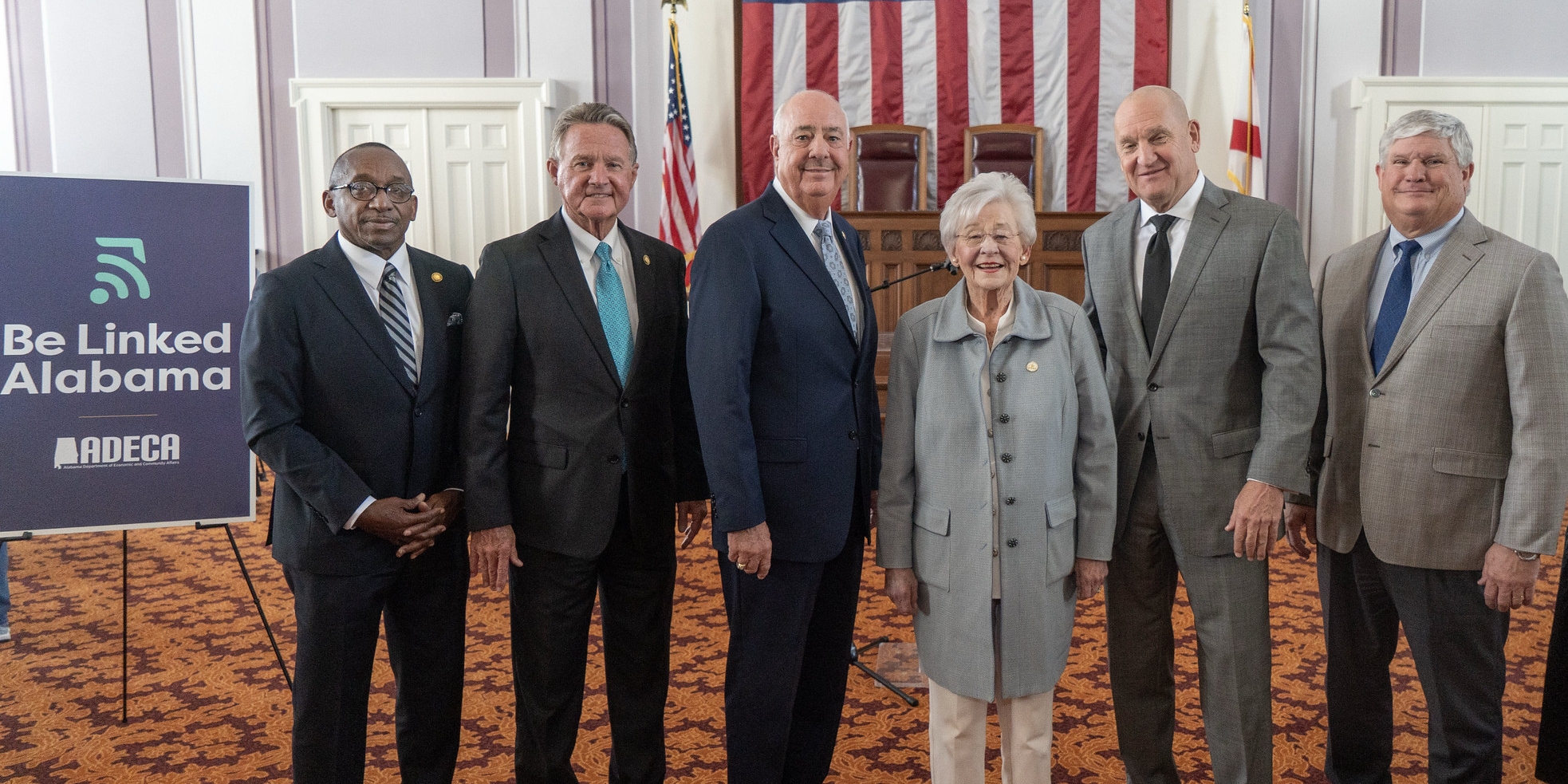
Governor Kay Ivey on Monday at the State Capitol joined legislative leaders, Alabama Department of Economic and Community Affairs (ADECA) Director Kenneth Boswell and the internet service providers and utilities building Alabama’s broadband capability to celebrate a decade of progress that has moved Alabama from near the bottom of the nation in broadband availability to the brink of statewide coverage.
When Governor Ivey took office in 2017, Alabama ranked near the bottom of the country in broadband access, especially in rural communities. Today, 90% of Alabama addresses can receive service at 100/100 Mbps, up from 25% in 2021. Fiber is now available at more than twice as many locations as it was five years ago, and residential broadband subscriptions have grown 40% since 2018, a larger increase than in almost any other state in the region.
RELATED: BroadbandNow ranking shows Alabama’s transformational leap in connectivity
The event in the Old House Chamber brought together the partners behind that progress: the Alabama Legislature, which appropriated the state’s first broadband dollars in 2018 and backed every program since; ADECA, which built the statewide plan and managed the grant programs; and the private providers, electric cooperatives and utilities that put more than 10,000 miles of new fiber in the ground.
“When I became governor, too many Alabamians, especially in our rural communities, were being left behind because they could not get a reliable internet connection. I said then that we were not going to wait on Washington to fix it, and we didn’t,” said Governor Ivey.
“We built our own map, we put our own money on the table and when federal dollars came, Alabama was ready to put every one of them to work. Today, nine out of ten addresses in our state can get world-class internet service. That means a student in Wilcox County can do her homework, a farmer in Geneva County can run his business and a grandmother in Jackson County can see her doctor without leaving home. This is one of the proudest accomplishments of my Administration, and it is going to serve Alabama for generations.”
Alabama’s push to bring high-speed internet to unserved communities began in 2017 under Governor Ivey’s leadership. ADECA worked with internet service providers to map broadband availability and develop a statewide plan. In 2018, the Legislature funded the Alabama Broadband Accessibility Fund to help providers reach the communities identified through that work. By the time American Rescue Plan Act (ARPA) funds became available in 2021, Alabama knew where the gaps were and had a plan to close them.
With the Legislature’s support, ADECA directed ARPA funds into three programs that work together to connect communities.
The Alabama Statewide Middle-Mile Network, launched with more than $80 million awarded in September 2022, now spans more than 7,000 miles across all 67 counties and connects more than 300 community anchor institutions.
The $245 million Alabama Anchor Institution/Middle-Mile (AIMM) Program is bringing fiber to schools, libraries, hospitals, public safety agencies and local governments. Through the Alabama Capital Projects Fund, ADECA awarded more than $150 million to providers for last-mile projects that build on those investments by extending service to nearby homes and businesses.
Governor Ivey traveled across Alabama throughout her Administration to break ground on broadband projects, announce new connections and visit schools, health care facilities and other community anchor institutions. Those visits showed what reliable high-speed internet can mean for rural communities, from giving students more ways to learn to helping patients connect with their doctors closer to home.
ADECA tracked every project and quickly redirected funding when a provider was unable to finish, moving those dollars to projects that could be completed. As a result, Alabama expects to use its full allocation of State and Local Fiscal Recovery Funds for broadband by the December 2026 closeout deadline; many other states will return unused funds.
Alabama broadband by the numbers, 2017 to today:
- More than half a billion dollars in state and federal funds invested in broadband infrastructure during Governor Ivey’s Administration, approaching $1 billion with Broadband Equity, Access and Deployment (BEAD) commitments
- Addresses with access to 100/100 Mbps service: 25% in 2021, 90% today
- Fiber broadband available at more than twice as many locations as in 2021
- Residential broadband subscriptions up 40% statewide from 2018 to 2025, a greater increase than in almost all neighboring states
- More than 10,000 miles of fiber added through ARPA-funded projects
- More than 55,000 homes and businesses and more than 1,000 community anchor institutions connected
- Statewide middle-mile network active in all 67 counties, spanning more than 7,000 miles
The work continues. ADECA is implementing the BEAD Program, which the state projects will bring high-speed broadband access to nearly 100% of Alabama within the next few years.
“Governor Ivey gave us a clear charge in 2017: Find out exactly where Alabama was unserved and go fix it. Everything we have accomplished since flows from that,” said ADECA Director Kenneth Boswell. “Because we did the mapping and planning early, and because the Legislature trusted us with state dollars before the federal money ever arrived, Alabama was able to move faster and stretch every dollar further than most states. We built a middle-mile backbone that reaches all 67 counties, connected more than a thousand schools, hospitals, libraries and first responders, and brought access to service to tens of thousands of homes and businesses that never had it. None of that happens without a governor who made broadband a priority and kept it there for nearly a decade.”
ADECA serves as the state’s lead agency for digital expansion and administers Alabama’s broadband grant programs through its Alabama Digital Expansion Division.
“The Legislature has worked hard to put real state dollars behind broadband, to get the federal money we were given out the door and into the ground, and to make sure rural Alabama was not left behind, because we know how critical this is,” said Speaker of the House Nathaniel Ledbetter (R-Rainsville).
“Broadband is not a luxury anymore. It is how our kids learn, how our small businesses compete and how folks in our rural counties see a doctor. When you connect a community, you change its future. The work we have done over the last several years is going to improve lives in this state for decades to come, and we are not done yet.”
“Alabama didn’t sit back and wait for someone else to solve this. Governor Ivey led, the Senate and House put state money behind her and ADECA executed,” said Senate President Pro Tem Garlan Gudger (R-Cullman).
“Going from 25% coverage to 90% in five years, while fully spending every federal dollar we were given when other states are sending theirs back, is a model for how government should work. Broadband is the infrastructure of this century, and thanks to Governor Ivey’s leadership, Alabama is ahead of the curve.”
RELATED: Be Linked Alabama: Interactive map lights up broadband growth
Clay Scofield, president of the Energy Institute of Alabama, carried the state’s first broadband legislation as a Republican state senator from Guntersville and served as Senate Majority Leader before leaving the Legislature in 2023 to lead the energy industry group, whose member companies include the utilities and cooperatives behind much of the fiber buildout.
“I’m proud to have been part of Alabama’s broadband journey from the very beginning, dating back to my time in the State Senate. I’m also proud of our member companies, who have been critical partners in expanding broadband access across our state,” Scofield said.
“Alabama’s progress is a testament to the strength and value of public-private partnerships and what we can accomplish when we work together.”
Monday’s program also featured remarks from Alabama Power Chairman, President and CEO Jeff Peoples and PowerSouth Energy Cooperative President and CEO Damon Morgan, whose companies’ infrastructure and partnerships have been central to the state’s middle-mile and last-mile build-out.
“What Alabama has accomplished on broadband is a result of Governor Ivey’s vision and proof of what happens when the public and private sectors work together,” Peoples said. “Fiber is an essential part of our infrastructure, and Alabama Power is proud to be part of helping grow our communities and expand broadband access across our state.”
Governor Ivey’s term ends January 18, 2027.
Grayson Everett is the editor in chief of Yellowhammer News. You can follow him on X @Grayson270.