Alabama is a forest state. Twenty-three million acres of productive timberland cover more than two-thirds of our land — more than almost any state in the nation. Our forests are heritage, livelihood, and economic engine. Generations of Alabama families have planted pines on marginal farmland, nurtured them for decades, and sold them at harvest to the mills that turned our trees into paper, lumber, and prosperity.
The system worked for a long time. It is not working now.
This past May, Domtar idled the Coosa Pines pulp mill in Talladega County. Two hundred eighty-five Alabamians lost their jobs. The facility had been running since 1950 — three generations of workers, now gone. Coosa Pines is one of ten pulp and paper mills shut down across the Southeast since 2023, erasing nearly six million tons of annual demand for Southern Pine fiber.
The damage goes far beyond the mill payroll. Alabama landowners who hold thousands of acres of maturing pine suddenly have no buyer. Pulpwood stumpage prices have fallen by more than half in real terms since 2016. A family with 500 acres of fifteen-year-old loblolly pine, which used to earn around $175,000 from a routine thinning operation, today earns essentially nothing. Loggers are selling their equipment. Rural counties are losing property tax revenue. An economic impact analysis by Alabama forester Tom Richardson and Birmingham financial planner Larry Wall estimates the Coosa Pines closure alone will cost the Alabama economy nearly seven billion dollars over the coming decade. Across the Southeast, the wealth transfer out of our rural communities approaches $134 billion.
Let us be clear about what is happening here. This is not the market working. This is foreign trade policy picking Alabama’s pockets.
While America has lost 5.8 million tons of Southeast pulp capacity since 2023, China, Brazil, Uruguay, and Indonesia have added 11.56 million tons — financed in large part by state subsidies and government-backed capital that no American company can match. China has banned American recycled paper, imposed retaliatory tariffs on American wood pulp, built 30 million tons of new domestic capacity backed by its government, and even financed competitor pulp mills in Brazil through Chinese development banks. Alabama’s landowners are not competing against Brazilian or Indonesian companies. They are competing against foreign treasuries.
And where has Washington been? The federal government has committed $369 billion to subsidize solar and renewable energy, $44 billion to traditional agriculture, and $22 billion to critical minerals processing. For timber — America’s most renewable resource, and the backbone of rural economies across Alabama and the South — the figure is zero.
Alabama families planted these pines because federal programs — the Conservation Reserve Program and various cost-share reforestation grants — asked them to. They held up their end of the bargain. Washington has not.
As a candidate for Secretary of State and as a Commissioner on the Alabama Forestry Commission, I believe the path forward is clear and achievable. It does not require inventing new programs. It requires enforcing the trade laws we already have and treating America’s domestic forest industry as the strategic asset it is.
At the federal level, Alabama’s voice must be heard on four priorities. First, American wood fiber must be on the agenda of every trade negotiation with China — not left out, as it was in the May framework. Second, our trade enforcement agencies must use the countervailing duty tools Congress has already given them to address foreign subsidies that have gutted our mill capacity. Third, any Chinese procurement commitment on American wood must specify processed products — lumber, pulp, paper — not raw logs that let foreign mills undercut American workers. Fourth, President Trump’s September 2025 Section 232 proclamation recognizing timber as a national security asset must be defended and enforced against industry pushback.
At the state level, Alabama can lead. We should give the state’s new Study Commission on Forest Products Retention and Pulp and Paper Mill Stability the resources and authority to produce actionable recommendations before the 2027 legislative session. We should use state tax credits, workforce development funds, and site-ready incentives to attract next-generation wood product manufacturers — cross-laminated timber facilities, dissolving pulp conversion plants, thermally modified wood operations, and biomass power plants that can supply the data centers now moving into our state. We should partner with Auburn University’s School of Forestry and Wildlife Sciences and Alabama A&M to accelerate research on advanced wood products that create new markets for Southern Yellow Pine. And we should work with the Alabama Forest Owners Association, our county Industrial Development Boards, and private landowners to secure the kind of independent, standards-based wood supply certifications that attract the capital we need.
Alabama’s forests are America’s most productive. Our timberland grows 84 percent faster than we are harvesting it. The wood is here. The workforce is here. The infrastructure, in many places, is still here. What has been missing is a policy response that matches the scale of the challenge and the opportunity.
Our landowners, loggers, mill workers, and rural communities have carried this industry on their backs for generations. They have earned a government — at every level — that fights for them with the same determination that foreign governments fight for their own.
Alabama should lead that fight. And I intend to help lead it.
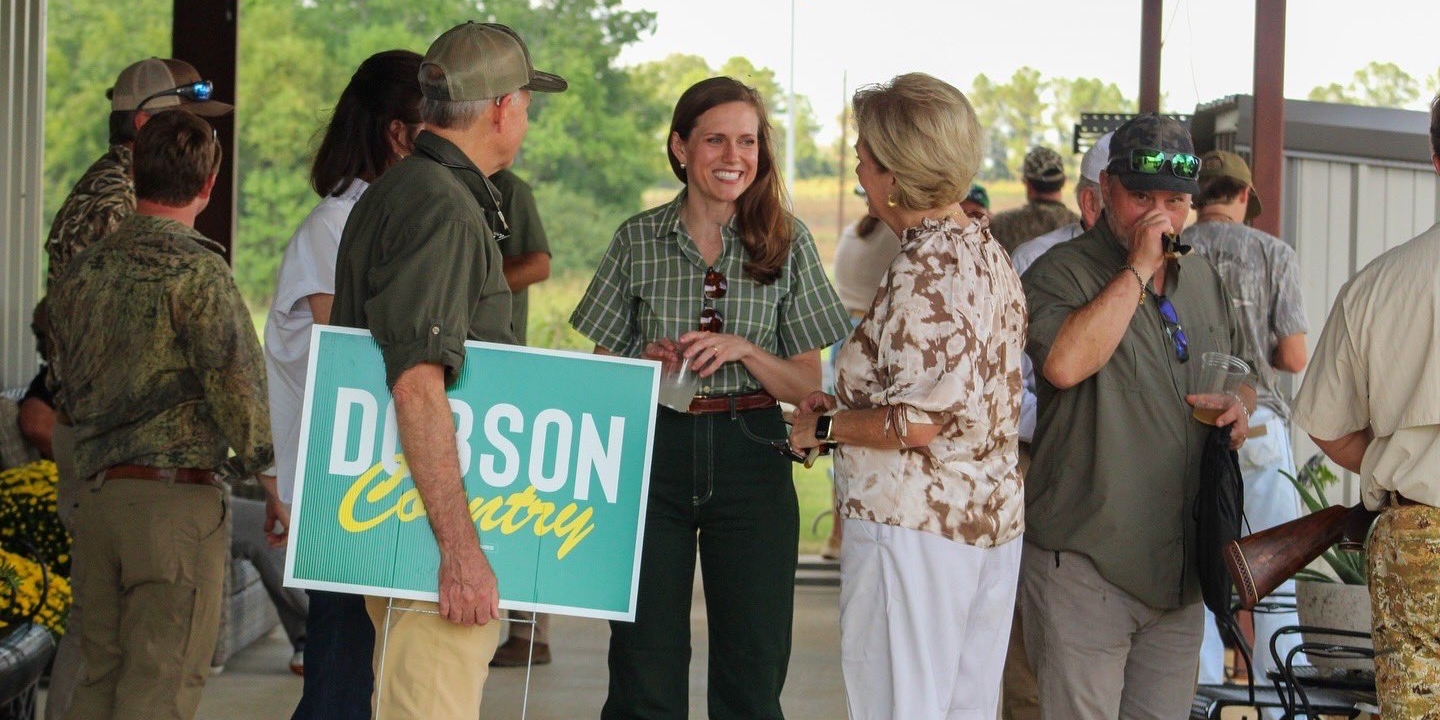
Caroleene Dobson is the Republican candidate for Alabama Secretary of State and a Commissioner on the Alabama Forestry Commission.