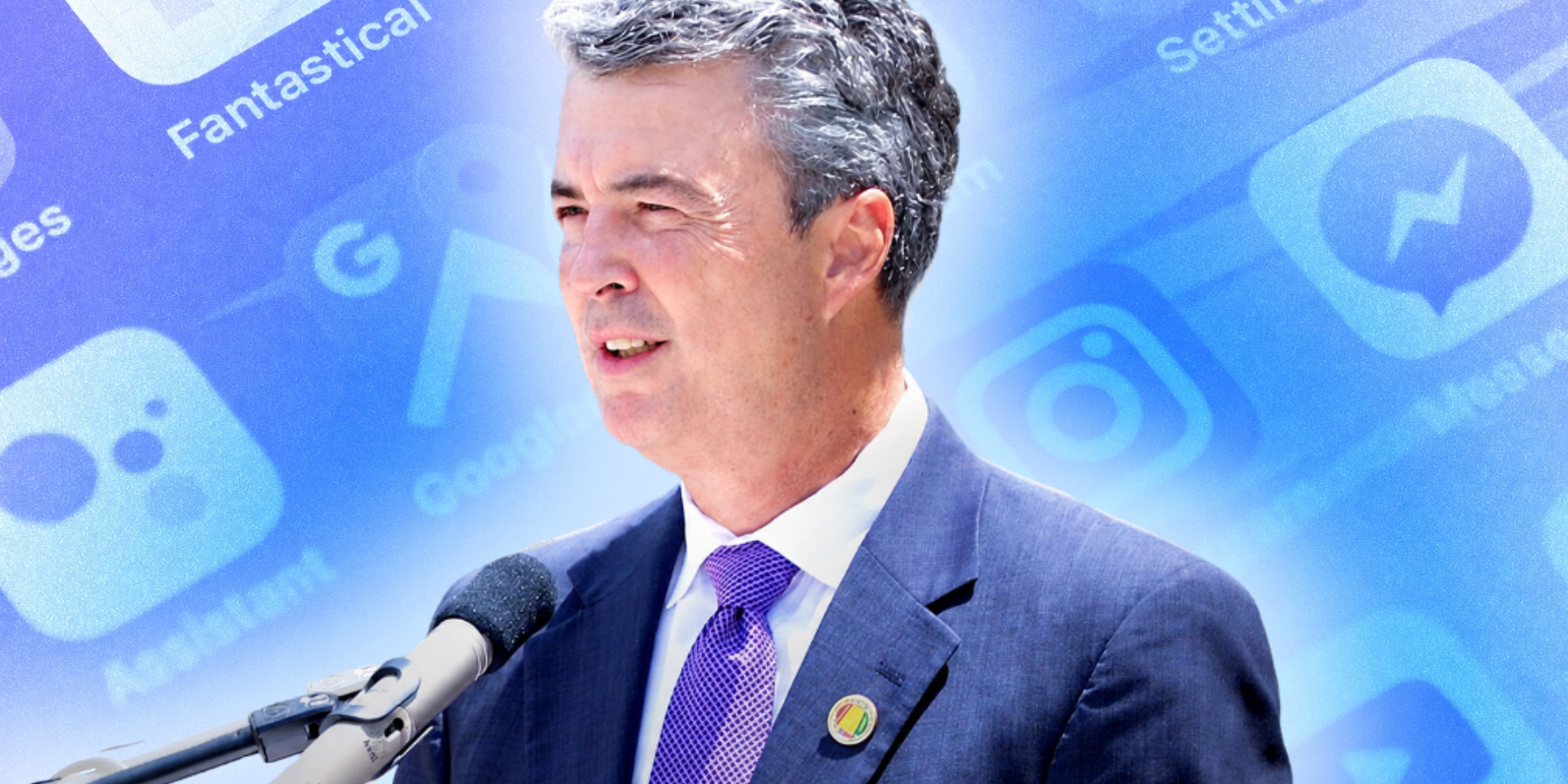
Alabama Attorney General Steve Marshall announced Wednesday that Meta Platforms Inc. will pay Alabama $117,345,409 and rebuild how Instagram and Facebook work for every user under 18.
Because his office tried the case in house, the attorney general said, 100% of the money goes to the State of Alabama.
But that dollar figure might be the smaller part of what Alabamians receive from the ruling.
The agreement’s exhibits detail a second Alabama payment worth roughly $50.6 million more, and a second, stricter tier of restrictions on teen accounts nationwide.
Both are locked behind the same condition: Snap, TikTok and YouTube have to be bound to the same rules Meta just accepted. Marshall takes TikTok to trial in September.
The agreement resolves claims brought by 47 states.
Those claims alleged the company designed Instagram with addictive features, knowingly exposed young users to serious mental harms and intentionally misled the public about the safety of its platforms, among other things.
At $17.1 billion nationwide, the office said, it is the largest state consumer protection settlement in history outside the Big Tobacco settlements of the 1990s.
“This settlement sends a clear message that Alabama will hold big tech accountable when it fails to protect our children online,” Alabama Attorney General Steve Marshall said Wednesday.
“Meta will pay millions of dollars to Alabama and has taken a critical step toward comprehensive reforms for youth safety. We will continue to monitor Meta to ensure compliance with the terms set forth in the settlement as well as to close off any loopholes predators and other bad actors might try to exploit,” Marshall said.
According to the AG’s office, the settlement requires Meta to implement a series of safety features on Instagram and Facebook, including:
- Hard cap daily time limits and “Productive Pauses” for children: for its two platforms, Instagram and Facebook, a combined two-hour daily time limit with mandatory pauses after 15 minutes of continuous use and again at 60 and 90 minutes to interrupt endless scrolling. These limits remain in effect for five years. If Snapchat, TikTok, and YouTube adopt comparable terms, the daily limit on each platform will drop to 60 minutes for 10 years.
- “Nighttime blocks” restricting children’s access from 12:00 a.m. to 6:00 a.m.
- Limited school-time access for children, eliminating push notifications on weekdays from 8:00 a.m. to 3:00 p.m. during the school year.
- Robust age assurance measures to more effectively verify the age of young users.
- Safer, age-appropriate content controls, including stronger safeguards against bullying, content promoting eating disorders, and content related to suicide and self-harm.
- Stronger, more user-friendly parental controls.
- Limits on social comparison features, including beauty filters and visible “like” counts, that have been linked to poor mental health outcomes in kids and teens.
- Both the implementation and efficacy of the features will be regularly assessed by an independent auditor and the settling states.
The office said the changes are more significant and comprehensive than any previously ordered by a court, and described the agreement as a down payment toward an industry-wide social media experience that allows kids to connect in a healthy way.
The settlement sets out what that money can be used for: Expanding the 988 Suicide & Crisis Lifeline and text-based youth crisis lines, after-school and summer programming, youth mental health services, hiring digital literacy counselors, standing up phone-free school zones, and grants directly to school districts.
Alabama’s guaranteed payment carries an additional contingency installment payment of $5,057,609.31, also payable ten times, worth roughly $50.6 million more.
The agreement puts Alabama’s maximum payment across all installments at $167,921,502.24.
Meta only owes that money under conditions that Snap, TikTok and YouTube, named in the document as “Core Industry Members,” must all become bound to substantively equivalent time-management and age-assurance obligations, whether through a binding settlement with the state, through state or federal law, or through voluntary adoption verified by an independent third-party auditor.
Those with annual profits above $10 billion must also carry a monetary obligation to the state at least equal to Alabama’s contingency amount.
Under the agreement’s first phase, teen accounts get a two-hour daily cap across Meta’s apps, a midnight-to-6 a.m. block, and push notifications shut off from 10 p.m. to 7 a.m.
Under the second phase, which applies only once that industry-wide adoption occurs, the cap drops to 60 minutes on each app and the nightly block widens to 10 p.m. through 7 a.m.
Meta has four months after the effective date to put the productive pauses in place, according to the agreement, and six months to comply with the rest.
Alabama already has a case pending against one of the three companies that has to fall in line.
Marshall sued TikTok last year, alleging it was designed to addict children and that the company misled parents about its safety.
That case is set for trial in September, putting Alabama first in line among states in the nation to take TikTok to trial.
Grayson Everett is the editor in chief of Yellowhammer News. You can follow him on X @Grayson270.