Alabama primary turnout told a more complicated story this year than the state has seen in two decades, with Democratic participation surging from historic lows while Republican vote totals pulled back from a banner 2022 cycle.
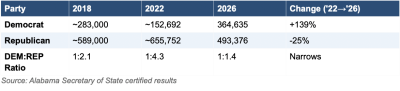
Democrats cast 364,635 votes in the governor’s primary, more than doubling their 2022 performance of 152,692 and surpassing even their post-Doug Jones energy from 2018. Republicans cast roughly 493,376 governor’s primary votes, down from the 655,752 who turned out in 2022.
The result narrowed the gap between the parties to its tightest point since 2006. Republicans still cast nearly 130,000 more primary votes than Democrats, and the party remains a heavy favorite to hold every statewide office in November. But the numbers point to an enthusiasm gap worth watching as the general election approaches.
Context matters in reading those figures. The 2022 Republican primary was an extraordinary high-water mark, driven by one of the most competitive and expensive Senate primaries in state history. Some of the 2026 decline reflects that 2022 was an unusually energetic year for the party rather than a collapse this cycle.
On the Democratic side, Doug Jones at the top of the ticket provided a name-recognition lift that may not carry into future cycles without a marquee candidate.
Much of the surge appears candidate-driven rather than a durable shift in the Alabama electorate.
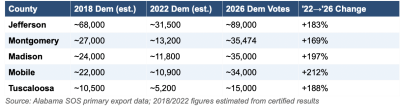
Democrats’ gains were heavily concentrated in the state’s major metro counties.
Jefferson County contributed roughly 89,000 Democratic votes, while Montgomery, Madison, and Mobile each cleared 34,000 to 35,000. In Montgomery County, Democrats cast 35,474 primary votes against 11,985 Republican votes, a nearly 3-to-1 margin in a county that still went for President Trump in the 2024 general election.
That gap between primary enthusiasm and general election outcomes has defined Alabama politics for years. Republicans continue to dominate where it counts.
North Alabama’s rural corridor and the suburban ring counties produce enormous Republican vote totals, with Cullman and Walker counties alone accounting for more than 53,000 Republican primary votes. Baldwin County on the Gulf Coast remains one of the fastest-growing Republican strongholds in the Southeast.
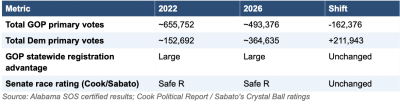
The general election map has not shifted in any meaningful structural way. Cook Political Report and Sabato’s Crystal Ball both continue to rate Alabama’s Senate race as Safe Republican, and the GOP holds a commanding statewide registration advantage.
National Democrats hold a generic ballot edge similar to where they stood ahead of their 2018 wave, a headwind Republicans will navigate in November. But Alabama has proven resistant to national Democratic waves even in favorable environments, and the party’s statewide infrastructure remains thin outside the Black Belt and the major metro areas.
For Republicans, the primary dip is a data point worth monitoring rather than a cause for alarm. For Democrats, the surge is encouraging but largely candidate-driven. November will determine which trend holds.
Sawyer Knowles is a capitol reporter for Yellowhammer News. You may contact him at [email protected].