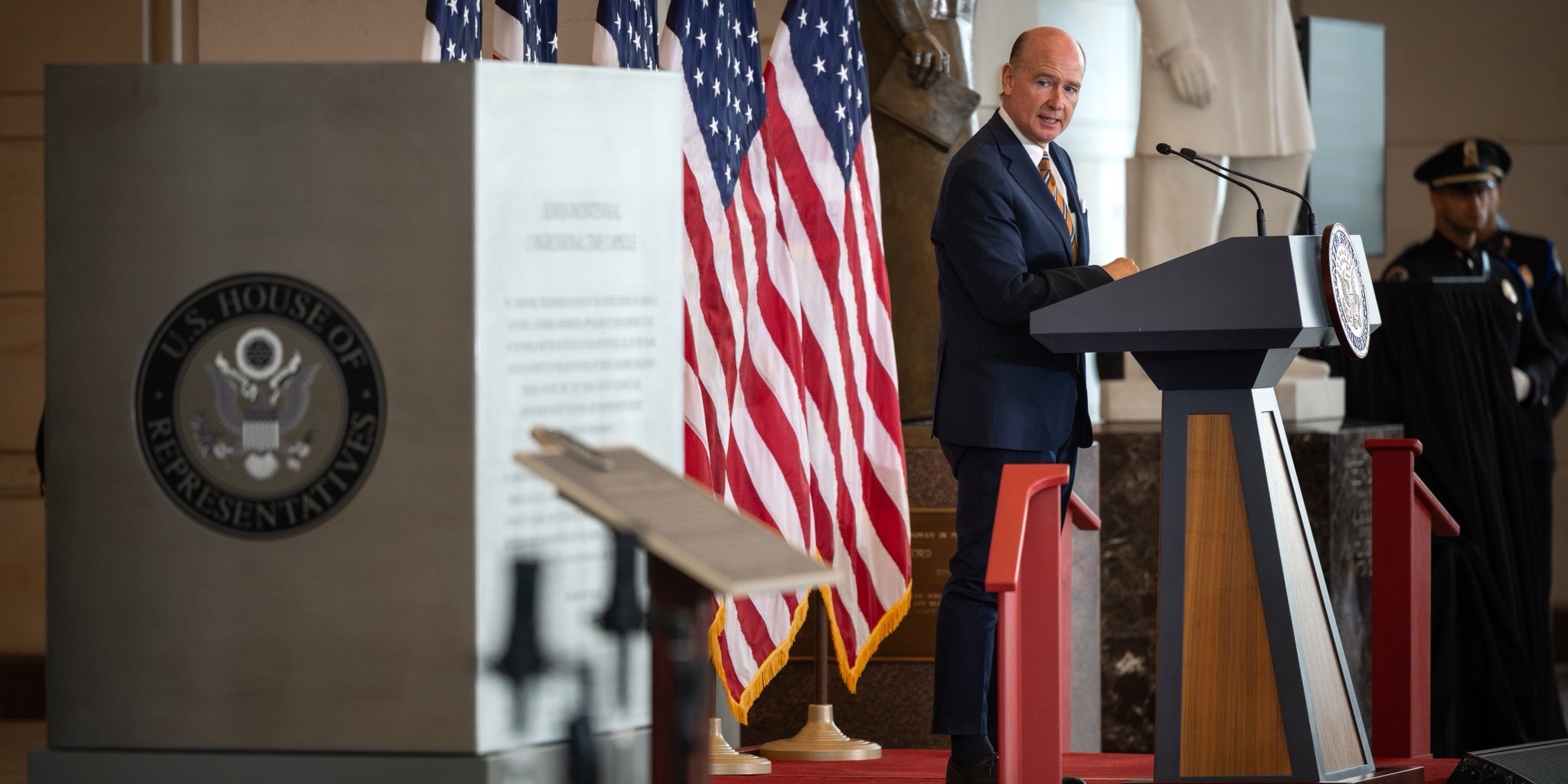
Alabama Congressman Robert Aderholt stood shoulder-to-shoulder with Speaker Mike Johnson and a crowd of lawmakers last week to unveil a time capsule that won’t see daylight again until the United States turns 500.
The Semiquincentennial Congressional Time Capsule, dedicated in a ceremony in the Capitol’s Emancipation Hall, will be sealed for the next 250 years and opened on July 4, 2276, the nation’s quincentennial. Aderholt, a co-founder and co-chair of the America 250 Caucus and a member of the U.S. Semiquincentennial Commission, was a lead sponsor of the legislation that made it happen.
For the Haleyville Republican, the moment was about handing something across the centuries.
“I hope that this time capsule will tell a story to Americans in the 23rd century about our nation’s strength, our accomplishments and our progress towards a more perfect union during our first 250 years,” Aderholt said when he introduced the measure. “And while I’m sure the artifacts they will find will seem ancient to them, I hope the items will inspire them to continue that progress and for America to continue to be that ‘shining city upon on a hill.’”
At this year’s unveiling, Aderholt framed the capsule as a message to a generation no one in the room will ever meet. Americans 250 years from now, he said, will get a glimpse into who Americans were, what they valued, and where the country stood — built from contributions from every state and territory.
The project is the product of the Semiquincentennial Congressional Time Capsule Act, bipartisan and bicameral legislation Aderholt sponsored alongside New Jersey Democrat U.S. Rep. Bonnie Watson Coleman. President Trump signed it into law in February. It directs the Architect of the Capitol to build the capsule, fill it with a representative record of America at 250, and bury it in the Capitol Visitor Center — where millions of visitors will walk past it for a quarter-millennium.
Aderholt and Watson Coleman pulled the cloth off the capsule together. Each state and territory delegation submitted a single item, joined by selections from congressional leadership, the Library of Congress, the Architect of the Capitol and officers of both chambers.
“This is our opportunity to share what America looks like today and what we hope the future holds for this great country that we are truly blessed to call home,” Speaker Johnson said. He called the capsule “a reflection of our faith in the future of this grand experiment of self-governing.”
House Minority Leader Hakeem Jeffries said the collection tells the story of the whole country — from the Statue of Liberty to the Golden Gate Bridge, the Great Lakes to the Rio Grande Valley.
Architect of the Capitol Thomas Austin said the front of the capsule carries the passage from the Declaration of Independence proclaiming the colonies free and independent states, along with a dedication from this Congress. “For those who have the privilege to work here at the Capitol, you get a sense that you are just one chapter of a long history book,” Austin said.
When the capsule is finally cracked open in 2276, the law tasks the Speaker of the House and the Senate Majority Leader with unsealing it and presenting its contents to the 244th Congress.
The congressional capsule is one of two tied to the 250th. A separate America250 time capsule — a 900-pound vessel packed with state submissions and a synthetic-DNA copy of Thomas Jefferson’s draft Declaration — is set to be buried at Independence National Historical Park in Philadelphia on July 4.
It’s a fitting bookend for a Congress that rarely agrees on anything: a quiet, bipartisan bet that there will still be an America in 2276 worth opening the box for. And it’s an Alabama congressman’s name on the legislation that buried it.
Grayson Everett is the editor in chief of Yellowhammer News. You can follow him on X @Grayson270.