2 years ago

Roy Moore warns Kavanaugh-type smear tactics could be used against GOP in 2020; Not ruling out future political run

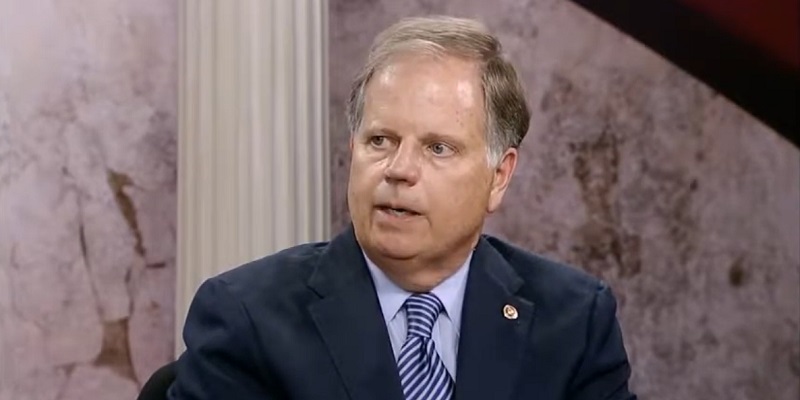
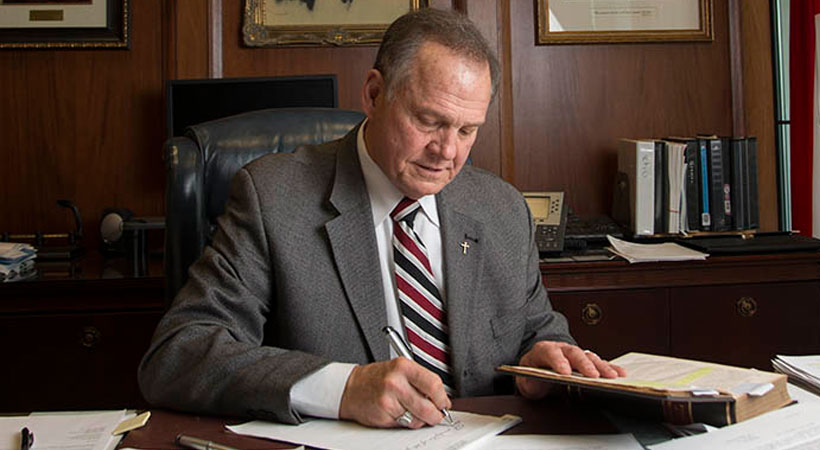
In an appearance on Huntsville radio’s WVNN on Tuesday, former Alabama Supreme Court Chief Justice Roy Moore discussed time since his December 2017 election loss to now-Sen. Doug Jones (D-Mountain Brook) and what the future could hold for him.

Moore looked back at the 2017 special election and pointed to inconsistencies, which he said might have been the difference in the race he lost by a 1.7-percent margin.

He also warned how the reported tactics used against him, like the so-called Project Birmingham, could be used against Republicans in future elections.

Moore discussed the inconsistencies and referenced the allegations of out-of-state voters participating in the 2017 election.

“There were a lot of things that were fraudulent about this race,” Moore said on “The Jeff Poor Show.” “There was a lot of out-of-state voting that came in. Straight-voting didn’t appear normal in a lot of counties. There were a lot of things to call this election into question.”

Recently, Moore released the results of a polygraph test he took days after the 2017 special election and explained as to why he did not do so sooner as to help his chances in the 2017 election possibly.

“I’ve been in the campaigns and the political eye for over 40 years,” he said. “I’ve run approximately eight times in the state, counting primaries and general elections, and several times in the county. People know what I stand for and when you’re telling the truth, you don’t need a polygraph examination to defend against false allegations. I think a lot of people recognize they were false. We got some 650,000 votes – that’s a lot of votes. I don’t think that necessarily was – but I did take one. I put that in an affidavit challenging the election. That’s where that came out.”

“The important thing is I did take one,” he added. “I haven’t seen anybody else take one. You don’t need that to prove your innocence when you’re telling the truth.”

Moore likened his situation to Supreme Court Associate Justice Brett Kavanaugh’s confirmation process and added if he had been given the opportunity, he would have voted to confirm Kavanaugh.

“I think people see in Brett Kavanaugh what they did to me,” Moore said. “I think they saw it had some effect on my election. And they did it again on Brett Kavanaugh, and he survived it. I’m glad he did. I think he’s conservative. He’ll do a good job. I would have voted for him. I won’t say anything about my [2017] opponent. He didn’t vote for him. I think it is important to recognize that justices on the Supreme Court have an influence for many, many years. I think it’s a very important vote and people of Alabama want a conservative.”

Moore warned that this line of attack can be used again in 2020 and advised President Donald Trump to get out in front of it.

“I have no doubt that disinformation on social media is going to be played out again in the 2020 election,” he added. “I think when they see it works, they’re going to try it again in 2020 and I think the president ought to do something now to protect himself and I think that Democrats and Republicans should recognize the immorality of disinformation. People putting out false stories on social media and I think that’s exactly what they did to me, then they merchandise it.”

Moore would not rule out a 2020 run, but said his current focus has been to clear his name coming out of the 2017 special election loss.

“As far as politics go, I haven’t done anything, run anything,” he said. “If I do, I’ll let people know. I haven’t ruled it out, and I haven’t made plans yet.”

“Right now, I’m busy with the fraudulent accusations and trying to clear up what happened in the last election,” Moore added. “That’s kept me pretty busy, so I haven’t made any plans yet.”

@Jeff_Poor is a graduate of Auburn University, the editor of Breitbart TV and host of “The Jeff Poor Show” from 2-5 p.m. on WVNN in Huntsville.
7 hours ago

Ivey awards recovery funds to Chilton, Dale, Henry and Winston Counties

Four Alabama counties will receive a total of $1.4 million under the Coronavirus Aid, Relief and Economic Security (CARES) Act.

Gov. Kay Ivey announced the award to Chilton, Dale, Henry and Winston Counties on Tuesday. The grants are administered through the Alabama Department of Economic and Community Affairs (ADECA). More than $40 million has been allocated to Alabama under a special Community Development Block Grant program.

Ivey has now awarded more than 50 grants to Alabama cities and counties through the fund. Funds are required to be spent on projects relating to pandemic recovery or virus and disease prevention. In addition to testing and vaccinations, funds may be allocated toward job creation and business assistance, rental, mortgage and utility assistance, as well as food banks.

As unemployment in Alabama has dipped to pre-pandemic levels, Ivey noted the progress which has been made at the local level.

“Alabama is making great strides in overcoming the COVID-19 pandemic and setting our course on normal again,” she said in a release from her administration. “I am hopeful these funds will further assist those efforts on the local level in these counties.”

190

Kenneth Boswell, ADECA director, credited the cooperative effort from cities and counties in ensuring the funds were spent in accordance with the mission of the program.

“Alabama cities and counties, which all benefit from these grants, have shown tremendous cooperation in determining how these funds are to be expended,” ADECA Director Kenneth Boswell said.

This latest rounds of grants were awarded as follows:

Chilton County: $400,000 for the construction of a testing, diagnostic and treatment facility.

Dale County: $400,000 to purchase personal protection and health equipment.

Henry County: $300,000 to purchase personal protection equipment for fire and rescue departments and provide a centralized location for dispatch services and provide assistance with school services.

Winston County: $300,000 to purchase a portable shelter to serve the public.

News of the award drew an immediately favorable reaction from one county official. Henry County Commission Chairman David Money took to social media to praise ADECA’s work.

ADECA expects to make additional awards as grant applications are processed.

Tim Howe is an owner of Yellowhammer Multimedia

7 hours ago

The media hates that Mountain Brooks’ parents won, and they fear others are paying attention

People want to have a say in their children’s education, and the elites and the wanna-be elites hate that. They want you placated at home and leaving the child-rearing to the pros.

How else do you explain this avalanche of scolding from al(dot)com?

441

“Buy our thrice-weekly paper, guys!”

Apparently, the media giant was unable to find anyone with a differing opinion about Mountain Brook being so racist that it spawned one of these writers. But what can you expect from an outlet so out of touch with its potential customers that the only conservative voices it can pay to write for them would fit in better on a CNN panel than at a Mountain Brook school board meeting.

So, what did these terrible apparent racists in Mountain Brook do?

They won.

They addressed the school board and city council and demanded that the school system not engage in racial training associated with Critical Race Theory and the overarching premise of the American elite that America has, is and will always be a racist nation. Parents rejected the idea that all white Americans are oppressors and all non-white Americans are oppressed.

Nobody wants racism in their life, which is why when it is found it is punished and marginalized. What is happening here is indoctrination and, much to the chagrin of Alabama’s least influential people, parents do not want it in their schools or government.

No one wants their child to be told their nation is racist, their families are racist, they themselves are racist or that their race will keep them from succeeding.

This type of training and curriculum is happening across the state and across the country and school board members would be wise to listen to these parents when they say they do not want it in their schools.

Now, I think we all understand that is it amazing and telling that the media is scolding us rubes for not wanting this training that they have deemed necessary for our racist nation to reckon with our terrible past while also assuring us that it is not happening anywhere.

Parents don’t want this, which is the point of having elected officials to bring their issues to.

The media and their Democrats, and some educators, want parents to pay taxes and butt out.

The National Education Association wants stuff like this in the schools. They just have to play word games to make it happen.

That’s why al(dot)com is acting as if these parents are out of control monsters burning down stores and calling for violence. Oh wait, they support those actions, don’t they?

Alabama’s self-marginalized media outlets can complain about that all day, but they don’t really have a say anymore, and that’s why they are so impotently angry and calling their readership racist and stupid.

Dale Jackson is a contributing writer to Yellowhammer News and hosts a talk show from 7-11 AM weekdays on WVNN and on Talk 99.5 from 10AM to noon.

8 hours ago

Audit: Madison County Commission earns clean bill of health for financial operations

If the Madison County Commission was given a grade for the management of its finances, it would have earned a grade point average of 4.0.

According to the most recent Department of Examiners of Public Accounts summary report, the examiners did not turn up any weaknesses or deficiencies in the county commission’s internal controls over financial reporting, and no problems with noncompliance materials in its financial statements. The summary of the examiner’s report also did not report any internal control weaknesses of federal awards awarded to the Madison County Commission. Under the schedule of findings and questioned costs, the examiner also found no issues.

“The outstanding result from this audit clearly shows that the commission is very serious about how we manage the money entrusted to us by the taxpayers of Madison County,” said Chairman Dale Strong. “This also demonstrates the hard work and diligence in which our employees carry out their responsibilities in our financial operations.”

246

The most recent audit was conducted on the Madison County Commission’s finances for fiscal year 2019 by the State of Alabama Examiners of Public Accounts. The results of that audit were filed by the agency on May 28, 2021.

The report reviews the results of an audit to determine whether the commission’s financial statements objectively convey the financial position and results of financial operation of the county commission in addition to whether the commission complied with applicable laws and regulations, including those that apply to major federal financial assistance programs.

Financial highlights from the audit for fiscal year 2019:

  • The commission’s net position increased $32.87 million during the fiscal year. Of that increase revenues for governmental activities jumped $24.75 million while business-type activities generated an additional $8.12 million.
  • During this same period of time, the governmental operating expenses of the Madison County Commission were reduced $12.51 million while operating expenses of the business-type activities decreased $760,000.
  • The commission’s general fund increased reserves $7.26 million while other governmental fund reserves increased $1.49 million.

Government activities includes the commission’s basic services, such as public safety, highways and roads, and general administration. Property taxes, state and federal grants finance most of these activities. Business-type activities include fees charged to customers to cover certain services provided by the county commission, such as waste control, building inspection and the water system.

The Madison County Commission’s finances are subject to review annually, according to finance director Carol Long.

Ray Garner is a contributing writer for Yellowhammer News.

8 hours ago

Guest: Fewer people went to prison, crime dropped — Let’s build on our success

Something just short of miraculous is happening in Alabama’s prisons. The number of incarcerated young people has been cut in half since 2005. Buried within statistical reports on the Alabama Department of Corrections, the numbers are clear: In 2005, prisons housed 9,827 people ages 15 to 30, or 36% of the ADOC population. By March 2021, that number was 4,537, or 18%. That this decline has impacted people ages 15 to 30, by all counts the age groups most likely to be arrested, is jaw-dropping.

These dramatic declines are largely the result of the Alabama Legislature passing significant sentencing reforms in 2006, 2013 and 2015. The new laws are working. Fewer young people are sent to prison, sentences are shorter, the Habitual Felony Offender Act is used less.

And crime is down.

1033

According to crime.alabama.gov, a collaborative effort between the Alabama Law Enforcement Agency and the Institute of Business Analytics at the University of Alabama’s Culverhouse College of Business, Alabama’s overall crime rate declined by 17% from 2005 to 2019, the most recent year data is available. Robbery, the most common violent crime, sunk by 48%.

Let that sink in: Alabama cut incarceration in half for the age cohort most likely to be involved in criminal activity and crime fell.

The specter of expensive new prison buildings dominates discussions about responses to the U.S. Department of Justice lawsuit against the State over unconstitutional prison conditions. But as elected leaders from across the political spectrum have acknowledged, Alabama cannot build its way out of the prison crisis.

Also, let’s remember what the U.S. Department of Justice stated in its 2019 report: “[W]hile new facilities might cure some of these physical plant issues, it is important to note that new facilities alone will not resolve the contributing factors to the overall unconstitutional condition of ADOC prisons, such as understaffing, culture, management deficiencies, corruption, policies, training, non-existent investigations, violence, illicit drugs, and sexual abuse. And new facilities would quickly fall into a state of disrepair if prisoners are unsupervised and largely left to their own devices, as is currently the case.”

So, what might a solution look like that relied on data and evidence rather than the emotional politics of fear? How might Alabama move beyond its outdated “tough on crime” mentality and again be “smart on crime” as occurred in 2006, 2013, and 2015? What if we trusted the evidence produced by our own law enforcement agency? We have tools to mitigate this crisis at our disposal — and we have already begun to use them, with great effect.

Based on the trends cited above, solutions are within reach – smart, conservative solutions that will not waste scarce tax dollars. No compassion is even necessary, though it never hurts. Folks who feel people who do the crime should do the time need not worry. All that’s necessary is that we bring “the time” in line with what evidence tells us is already working.

First, though the numbers of incarcerated young people are at 20-year lows, the numbers of incarcerated older people, ages 51 and above, are at record highs. There are now 6,190 prisoners in this older demographic, a 115% increase since 2005. Alabama’s unconstitutional prisons are quickly becoming unconstitutional nursing homes.

If you’re wondering how you missed Alabama’s senior crime spree, worry not. There was not one. The Bureau of Justice Statistics has thoroughly documented how arrests peak at age 20 and drop to the lowest rates for people 50 and older.

The reason so many grandparents remain behind razor wire is that reforms that drove down the numbers of people entering prison are not retroactive. Therefore, we punish our elders more harshly than any other age group. They are stuck with life sentences at vastly disproportionate rates.

This is unfair and expensive.

Chief among the culprits for the Alabama Department of Corrections’ soaring budget is health care costs, which will only continue to grow. Between the aging population and the federal Braggs v. Dunn litigation over unconstitutional mental health care in the prisons, future prison expenditures must take into account enormous, expensive needs of these fragile populations. Otherwise, our state can expect the endless cycle of federal lawsuits and receiverships that began in the 1970s to continue.

“Prison has become an old folks’ home and a mental institution,” according to Ronald McKeithen. He should know, having spent 37 years incarcerated for a convenience store robbery with no injuries.

Mr. McKeithen is home now, after the victims, Jefferson County District Attorney Danny Carr, and Circuit Judge Shanta Owens recognized constitutional concerns as to the injustice of his sentence. Six months after release, he is employed at a drug treatment facility, a licensed driver, and a registered voter. At 59, he’s applied to become a Certified Recovery Support Specialist so he can use his experiences to help others overcome drug problems.

(Alabama Appleseed Center for Law and Justice/Contributed)


(Alabama Appleseed Center for Law and Justice/Contributed)

Mr. McKeithen is not an anomaly. Alvin Kennard spent 36 years in prison for a $50 robbery at a bakery before Bessemer Judge David Carpenter and District Attorney Lynneice Washington agreed he deserved freedom and ended his life without parole sentence in 2019. Mr. Kennard, 60, now works repairing damaged cars at a Ford dealership. His bosses have requested more workers like him.
Alabama needs workers, not prisons filled with old people.

Yet when additional reforms arise that would give more elders a chance – not a guarantee, just an opportunity – for the very same sentences now available to 20-year-olds, opponents invoke the most sensational of crimes. Alabama Sentencing Commission data tell a different story about who would be eligible to petition for a second chance if lawmakers passed sensible reforms. More people are serving enhanced sentences under the HFOA for robbery – 1,029 people – than for rape, kidnapping, child sex abuse and sodomy combined. Also, most robbery convictions do not involve physical injuries.

Alabama has a chance to respond to the prison crisis and the looming federal intervention with integrity, evidence, and truth. With hope rather than hype. Our lawmakers made bold decisions when they passed the previously mentioned reforms in 2006, 2013 and 2015. Fewer people went to prison. Crime dropped. We could multiply those promising results by making these reforms available retroactively in cases where resentencing would not be detrimental to public safety. We could create justice for our elders.

This would free up dollars that otherwise will be spent on very secure nursing facilities for elderly prisoners for use in crime prevention, drug treatment, and prisoner re-entry.

Looming decisions about prison construction and criminal justice policy will affect Alabama for generations. Let’s build on the success of 16 years of sentencing reforms rather than take the easy – and very expensive way out – and just build more prisons.

Carla Crowder J.D., is executive director of Alabama Appleseed Center for Law & Justice, a nonprofit, nonpartisan research and advocacy organization based in Montgomery.

12 hours ago

Carl: Democrats’ infrastructure deal is bad for Alabama

This past weekend as we celebrated Independence Day, many of you likely traveled to visit friends and family, or maybe even spent a relaxing day at the beach. If you traveled any distance, whether short or far, you probably noticed we have significant infrastructure needs as our region continues to grow and tourism traffic increases.

As a former county commissioner, I know firsthand how important it is to continually invest in real infrastructure – things like roads, bridges, airports, ports and waterways, and especially rural broadband. Unfortunately, Democrats’ misplaced infrastructure priorities were on full display last week as they rammed through their “My Way or the Highway” bill. I voted no on this bill because it has very little to do with infrastructure and had no money for infrastructure projects in south Alabama.

This legislation is a bad deal for south Alabama and the entire nation. It creates 41 new government programs, ties up half of the money meeting Green New Deal mandates, green lights the use of federal transit money on art or non-functional landscape, funnels even more of our tax dollars to a failed California High Speed Rail project, and removes bipartisan measures to prevent billions of tax dollars from being wasted on bureaucratic red tape.

242

Even worse, this deal provides $4 billion for electric vehicle (EV) charging deployment, which will mostly flow to the Chinese government. Ironically, China is the world’s worst emissions producer, and the Chinese-controlled EV mineral chain is well-known for the use of child and slave labor. Republicans offered an amendment to ensure none of our tax dollars go to support these practices, but the Democrats immediately rejected it.

These policies and priorities obviously favor big cities in liberal states like New York and California, while leaving smaller, more rural states like Alabama in the dust. Hidden deep in this legislation is a terrible provision prohibiting states from building new roads or bridges until they first focus on what the federal government defines as good repair projects. The last thing we need in Alabama is the federal government telling us which local projects we are allowed to spend our money on.

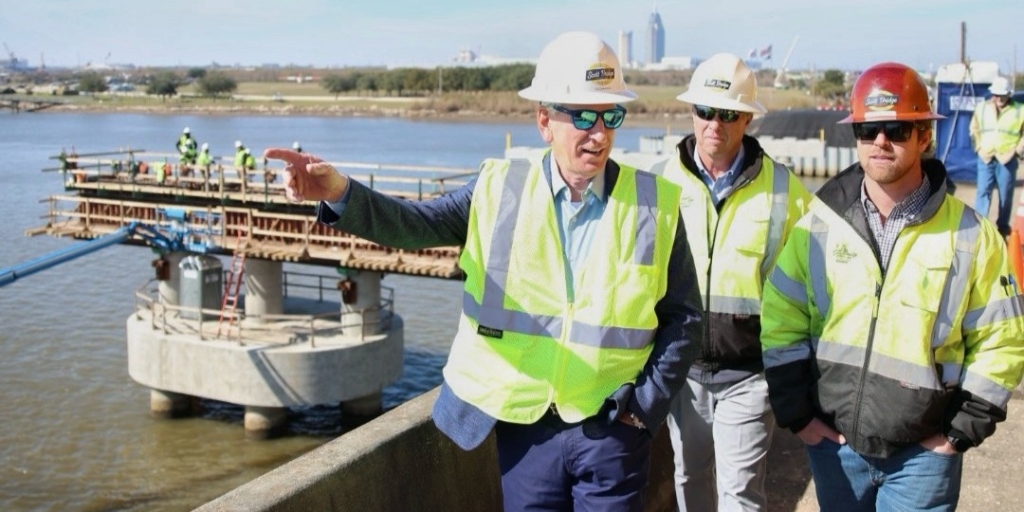
Keeping up with population growth and economic growth are critical to the future of south Alabama, and we desperately need funding for projects such as increased access to rural broadband and a new bridge over the Mobile River. South Alabama is a great place to live, work, and raise a family, but we do have some real needs. Despite all the nonsense in Washington, I remain focused and committed on fighting for increased funding for actual infrastructure projects in south Alabama.

Jerry Carl represents Alabama’s First Congressional District. He lives in Mobile with his wife Tina.