10 months ago

Mazda-Toyota plant set to begin hiring bulk of workforce

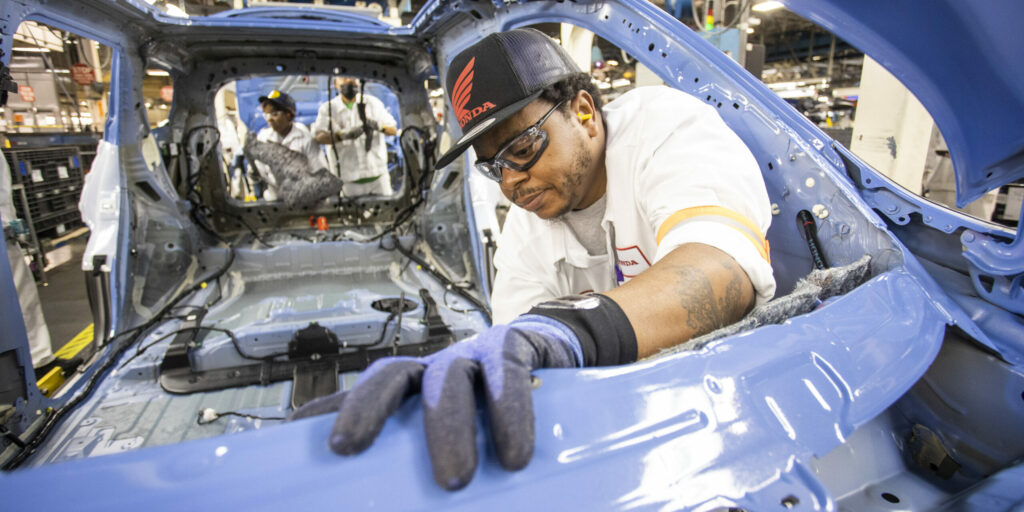
TANNER — The Mazda-Toyota plant in the Huntsville-annexed portion of Limestone county will begin the hiring process for production workers on January 13, 2020. The facility and Alabama Industrial Development Training announced the news jointly on Tuesday.

The 3.7 million-square-foot plant is expected to be responsible for the yearly manufacturing of 300,000 vehicles. The hiring will continue on a rolling basis from January 13, 2020, until full production begins in 2022. The facility is aiming to begin manufacturing vehicles in 2021. Workers hired will be part of a facility headcount that is projected to total around 4,000 when the plant is fully operational.

The company has previously released to media that the jobs will pay an average salary of $50,000 per year before benefits. The group expects to make about 50 hires per week starting quickly after opening up for applications on January 13.

In a nod to Huntsville’s identity as The Rocket City, the two main production lines on which the hired employees will work are to be named Apollo and Discovery.

Mazda Toyota Manufacturing (MTM) told the Decatur Daily in October that they will most likely need 40,000 applicants to fill the 3,000 production positions at the plant.

“Why? Because we are projecting 7 to 10 percent that will actually pass our process.” Jamie Hall, a project manager and advisor for production hiring told the Daily.

Tom Korona, a general manager at the plant, added about hiring, “Our focus at first will be major cities within a 25-mile radius, including Huntsville, Madison, Decatur and Athens, expanding to major cities 50 miles out, then 75 miles out.”

The facility’s construction is proceeding apace. In December the facility’s Twitter account posted, “Our future home is coming right along… Membrane Roofing – 60% complete, Concrete Floors – 40% complete, Fire Protection Piping – 60% complete, & Underground utility piping – 75% complete.”

Interested applicants for the production jobs should begin their applications on Mazda-Toyota’s website where they will enter basic information for screening. The site also details the specifications and qualifications desired for the floor jobs.

Henry Thornton is a staff writer for Yellowhammer News. You can contact him by email: henry@yellowhammernews.com or on Twitter @HenryThornton95.

3 hours ago

UAB expert Dr. Paul Goepfert: Pfizer vaccine report is ‘tremendous news’

Pharmaceutical giant Pfizer released on Monday some preliminary findings that its COVID-19 vaccine candidate appears to be 90% effective, a development that UAB vaccine expert Dr. Paul Goepfert, M.D., called “tremendous news.”

“The most optimistic of us were thinking about 70% effective, so 90% effectiveness is fantastic,” remarked Goepfert on a press briefing held via videoconference on Monday afternoon.

Goepfert’s remarks were a reference to the long-held belief among many researchers that a COVID-19 vaccine developed so quickly might only be able to prevent infection among 60%-70% of people who took it, a benchmark the initial Pfizer results seem to have far exceeded.

780

Goepfert is a professor of medicine at UAB and has served as the director of the Alabama Vaccine Research Clinic since 2004. He is a highly cited vaccine researcher in scientific journals, a key indicator of respect and accomplishment in the scientific community.

Pfizer’s vaccine is given in two doses, via injection, taken three weeks apart, and it was developed in partnership with the company BioNTech.

As part of Operation Warp Speed, the Trump administration agreed to buy 100 million doses of the Pfizer vaccine in July at the cost of $1.95 billion, allowing the company to finance its large scale development and manufacturing capacity.

Unlike other leading vaccine candidates, Pfizer did not use Warp Speed money to finance the development or early-stage trials for their vaccine candidate, leading to some now cleared up confusion on Monday about whether it was part of Operation Warp Speed at all.

Pfizer has said it will apply to the FDA for the vaccine to be used by the public once half the patients in the current vaccine trial phase have gone two months since their second dose with no issues.

The company expects to pass that mark in late November, which could pave the way for doses to be sent to the public before the end of the year; a result many health experts, including Alabama State Health Officer Dr. Scott Harris, have been expecting.

Pfizer’s CEO confirmed Monday that it would be free for every American if approved for use.

Another drugmaker, Moderna, began its trials only shortly after Pfizer. Both companies are using a very similar chemical structure to make their vaccines. Medical news site STAT reported Monday that Pfizer’s results “likely have sparked celebrations” in Moderna’s offices due to the similarities of the products.

Goepfert advised Monday that, if the Pfizer vaccine is indeed 90% effective, around 60% of the population would need to take the vaccine to achieve herd immunity.

He explained that the percentage of the population that must get the vaccine drops for every increase in the vaccine’s effectiveness, and vice versa.

While discussing Pfizer’s 90% reported effectiveness rate, Goepfert offered for the sake of comparison that in the best of years, a flu vaccine is about 60% effective, and some years flu vaccines are 30% or less effective.

He also noted that “COVID strains by and large are not like flu; in fact, COVID-19 is not going to change like flu changes. … This is much, much better than a flu vaccine.”

Though largely positive, Goepfert also brought up several reasons to be cautious with the optimism around the newly announced Pfizer results.

For one, he warned that Pfizer’s vaccine must be stored at -8 degrees celsius (around 18 degrees Fahrenheit) between when it is manufactured and injected. He mentioned this could cause problems with distribution because relatively few locations are equipped with large scale storage capable of maintaining that temperature.

Goepfert also pointed out that the Pfizer vaccine reportedly causing local reactions is not ideal. He pointed those interested to a paper published in the scientific journal Nature that showed large majorities of those in the early trials of the vaccine reported pain at the injection site. The paper reports that “all local reactions were mild or moderate in severity except for one report of severe pain.”

Goepfert also pointed out that the information made available by Pfizer is still relatively limited and said it should prompt caution that he and the other scientists and journalists discussing the topic are currently working off a press release from Pfizer. Goepfert believes that it is possible some complicating pieces of evidence may become public in the future that could diminish the current excitement around the Pfizer vaccine. He said multiple times on Monday that he wants to see more data.

“I think it is going to be accurate, but it is a limited data set,” he said in summation about the Pfizer release.

The vaccine expert also mentioned that the Pfizer vaccine is only on track to be approved for use among adults, and adults are typically less prone to getting vaccines than children. Goepfert believes a “herculean effort” will be necessary over the next year to achieve the needed number of vaccinated adults.

Goepfert continued to urge mask-wearing and social distancing, for the time being, saying that keeping infections down in the interim is helpful to the overall pandemic efforts.

“Now we have an endpoint. Now we see there is a vaccine that could work. You want to prevent as much death as you can, at which time you can get the vaccine,” he remarked about the upcoming months.

Henry Thornton is a staff writer for Yellowhammer News. You can contact him by email: henry@yellowhammernews.com or on Twitter @HenryThornton95

4 hours ago

Alabama secretary of state offering assistance to Georgia officials amid election turmoil

Georgia Secretary of State Brad Raffensperger is under increased pressure as national scrutiny continues over the Peach State’s elections process.

On Monday, U.S. Senators Kelly Loeffler (R-GA) and David Perdue (R-GA) issued a joint statement strongly calling on Raffensperger, a fellow Republican, to resign. Both senators appear set to be candidates in separate January 5 runoff contests.

“The management of Georgia elections has become an embarrassment for our state. Georgians are outraged, and rightly so,” stated Loeffler and Perdue. “We have been clear from the beginning: every legal vote cast should be counted. Any illegal vote must not. And there must be transparency and uniformity in the counting process. This isn’t hard. This isn’t partisan. This is American. We believe when there are failures, they need to be called out — even when it’s in your own party.”

“There have been too many failures in Georgia elections this year and the most recent election has shined a national light on the problems,” they wrote. “The Secretary of State has failed to deliver honest and transparent elections. He has failed the people of Georgia, and he should step down immediately.”

423

Reacting to the Georgia senators’ statement, Alabama Secretary of State John H. Merrill released a statement of his own to Yellowhammer News. He referenced not only his counterpart in Georgia but also Governor Brian Kemp (R-GA), who served as secretary of state of Georgia from 2010 to 2018.

“Governor Kemp is a close personal friend of mine and Secretary Raffensperger and I have a great professional relationship,” advised Merrill.

“We reached out to both of them last week to express our interest and enthusiasm in providing assistance, if necessary, with the closing of their General Election or upcoming Runoff Election scheduled for January 5,” he continued. “That offer for assistance remains for them to consider, and we wish them the best in the execution of their Runoff and look forward to a successful result.”

Raffensperger has subsequently announced that he will not be resigning.

Of Georgia’s November 3 general election, Raffensperger acknowledged, “Was there illegal voting? I am sure that there was. And my office is investigating all of it.”

“Does it rise to the numbers or margin necessary to change the outcome to where President Trump is given Georgia’s electoral votes? That is unlikely,” he added.

As of Monday at 3:45 p.m. CT, former Vice President Joe Biden was leading President Donald Trump in Georgia by more than 11,000 votes. President Trump and his campaign team are fighting legal battles on this front, as well as in states such as Pennsylvania, Nevada, Arizona, Michigan and Wisconsin.

“Georgia will be a big presidential win, as it was the night of the Election,” Trump tweeted on Monday afternoon.

Merrill on Friday released a statement outlining his thoughts on the uncertainty surrounding the presidential election results in certain states. He also commented further in a radio interview.

U.S. Senator-elect Tommy Tuberville (R-AL), Governor Kay Ivey (R-AL), Lt. Governor Will Ainsworth (R-AL), PSC President Twinkle Andress Cavanaugh (R-AL) and Congressmen Bradley Byrne (AL-01), Mike Rogers (AL-03), Robert Aderholt (AL-04), Mo Brooks (AL-05) and Gary Palmer (AL-06) have also weighed in on the election turmoil.

RELATED: Alabama AG Marshall joins national fight for integrity of 2020 presidential election

Sean Ross is the editor of Yellowhammer News. You can follow him on Twitter @sean_yhn

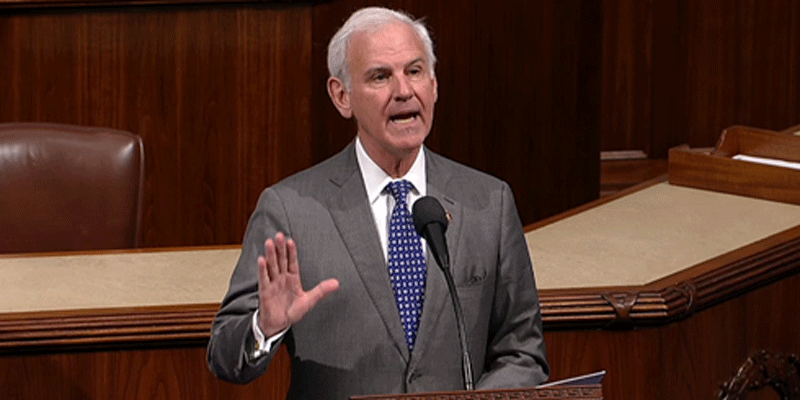
Byrne: What America said

Election Day has come and gone. Despite the fact that multiple national news sites have “called” the presidential election, court cases and recounts are going forward in several states where the margin is less than 1%, and we don’t yet “know” who was elected president. By federal law, all election disputes must be resolved by December 8 and presidential electors must meet and cast their votes for president on December 14. The ballots will be counted in Congress on January 6. These are the key dates when we will “know” who will become president on Inauguration Day, January 20. So, let’s not jump to a conclusion about who won this very close presidential election just yet.

But, we already know some important things about America from the votes last week.

Perhaps the most important thing we witnessed was a free and open democracy working. We take for granted our system for choosing our leaders, but if you look around the world, we shouldn’t. Even in a very politically divided nation, we held peaceful elections, and even where there are election disputes, we have legal processes for resolving them. For the most part, things have been handled peacefully, except in a few places like Oregon where they apparently don’t need an excuse to riot.

615

And, while we are divided for sure, there are some things we have agreement on. Despite the now predictable assurances from media “analysts” and other so-called “experts,” there was no blue wave, no generational realignment of our body politic. The media discovered what the rest of us knew: America is not a left-leaning nation. And demographics aren’t destiny. That’s why an increasing proportion of blacks and Hispanics are voting their relatively conservative beliefs. As a nation, we don’t want a Green New Deal, Medicare for All or defunded law enforcement agencies. We aren’t socialists or even socialist leaning.

The elections for the two houses of Congress showed a narrowing majority in each. With two special elections for Senate pending in Georgia on January 5, it looks likely that Republicans will hold a very narrow majority in the upper body. That alone guarantees that tax increases, court packing, climate change, government ordered health care, and other far left proposals of a potential Biden-Harris administration would go nowhere, an accurate reflection of the national mood.

In the House, the Democrats apparently held their majority, but it will be much reduced as Republicans flipped as many as 15 seats and have net gains of 8 to 12. During a post-election conference call last week with her members, Speaker Nancy Pelosi proclaimed that the shrunken Democrat conference had a “mandate” even as Democrats on the call excoriated their party’s policies and messages of the last two years. Don’t let the national media fool you. This isn’t a struggle between moderate Democrats and liberals because there aren’t any moderate Democrats left in Congress after this year’s primaries. This is a fight between liberals and socialists, the two groups that now make up congressional Democrats.

The Republican side is a very different story. Though disappointed that we didn’t retake the majority, we are heartened by our gains and believe we will succeed in the 2022 midterms. Many governorships and state houses were also elected last week, and they will reapportion their states next year with the census numbers from this year, thus determining the makeup of House districts for a decade. Even though President Obama’s attorney general, Eric Holder, spent enormous amounts of money to get Democrat control of these state houses nationally, his effort failed and Republicans will be in control of states with far more House seats than the Democrats will. By Election Day 2022, the map for House elections will be more favorable to Republican candidates than was the case last week. That blue wave is actually a firmly rising red sea in the House.

I woke up the day after the election both pleased and disappointed. I wish Republicans had taken the House and had a larger majority in the Senate. And I truly wish we had a clear victory for President Trump, who may still win in the states with recounts and lawsuits. But, America once again proved the experts wrong by saying loudly who we are and who we aren’t.

We aren’t socialists or even liberals. We don’t want massive change to our Republic. We won’t let gender, race, religion or any other demographic category define us, because we are a people free to decide for ourselves what we believe and who we will vote for. We have spoken as a people and we don’t need the news media and entertainment industry to act as if they speak for us.

And it’s the job of those who are elected to listen to the people of this country and not the out of touch elites on TV and the internet. Once again, they were wrong. By their votes the people of America said so.

U.S. Rep. Bradley Byrne is a Republican from Fairhope.

5 hours ago

The Supreme Court will not pick the president, but it could have a role

The specter of dimpled chads has emerged to haunt American politics. Twenty years after the contested presidential election of George W. Bush against Al Gore made punch lines out of certain ambiguous ballots in Florida, allegations of election irregularities again are causing worry that the Supreme Court of the United States might select the next President of the United States. Those fears are unwarranted.

Part of the blame for those fears rests with politicians and pundits who trade on notions of federal judicial supremacy with phrases such as “all the way to the Supreme Court.” If the U.S. Supreme Court gets involved at all, its role will be limited to ensuring that the states have complied with the minimal requirements of the Constitution of the United States and federal election laws. The Court does not exercise a general supervision over federal elections.

561

The U.S. Constitution does not tell states how to run elections, not even elections for offices in the United States government. State legislatures are responsible for promulgating election rules. State election officials are responsible for administering elections in compliance with those rules, usually under the supervision of a secretary of state or some other official who is accountable to the people.

State courts are responsible for adjudicating any legal disputes arising out of the administration of state election laws. But their decisions mostly concern whether officials adhered to lawful procedures. Election lawsuits seldom concern whose votes count.

If a candidate were to produce evidence of fraud or illegal conduct, that evidence would be considered and assessed by state election officials and, if necessary, state courts. And even if polling officials have violated some election rules, there remains the question what remedies are appropriate. Like the rules themselves, the remedies and sanctions for violating the rules are usually matters of state, not federal, law.

Where the law allows judicial discretion, reasonable judges will tailor the remedy to the nature of the wrong. Judges are rightly loath to throw out ballots cast legally and in good faith by qualified voters, even if officials behaved badly. For example, assuming that poll watchers have been illegally excluded from rooms where ballots are being interpreted and counted, as some allege, that does not entail that the ballots themselves should be discounted.

If someone has committed a state or federal crime then the evidence should be delivered to prosecutors. But any prosecutions for election fraud are unlikely to change the outcomes of any elections.

One legal dispute that might reach the U.S. Supreme Court concerns a decision by the Supreme Court of Pennsylvania to extend the time for counting certain ballots. Republicans alleged in a petition to the U.S. Supreme Court that the Pennsylvania court’s decision “rewrote the state’s law governing federal elections and violated the United States Constitution, sowing chaos into the electoral process mere weeks before the already intricate November General Election.”

If that allegation is true then the Pennsylvania high court violated Article I, section 4 of the Constitution of the United States, which provides, “The Times, Places and Manner of holding Elections for Senators and Representatives, shall be prescribed in each State by the Legislature thereof.” Notice that the power to change election rules belongs to state legislatures, rather than state courts.

The U.S. Supreme Court has twice declined to hear the case in recent days. And the controversy might become moot. So, it is far from certain that Court will hear the case at all.

If the Court decides to hear the case, the issues will be confined to technical legal questions, such as the meaning of the word “prescribed,” and interesting (for law geeks like me) jurisprudential questions concerning separation of powers. The case will not be about who should be declared President.

In any event, this is all speculative at present. Lawyers might help decide the election, but they might not. If they do, their role will properly be limited to ensuring that rules governing the election process are clear, constitutional, and consistent.

Adam J. MacLeod is Professorial Fellow of the Alabama Policy Institute and Professor of Law at Faulkner University, Jones School of Law. He is a prolific writer and his latest book, The Age of Selfies: Reasoning About Rights When the Stakes Are Personal, is available on Amazon.

5 hours ago

Alabama AG Marshall joins national fight for integrity of 2020 presidential election

Alabama Attorney General Steve Marshall on Monday announced he has joined nine other attorneys general in filing an amicus brief in support of two lawsuits asking the Supreme Court of the United States to review the constitutionality of the Pennsylvania Supreme Court’s decision to extend the statutory deadline for mail-in ballots in that state.

The amicus brief was filed by the State of Missouri and joined by the States of Alabama, Arkansas, Florida, Kentucky, Louisiana, Mississippi, South Carolina, South Dakota and Texas in support of Republican Party of Pennsylvania v. Boockvar, and Scarnati v. Boockvar.

“Judges are supposed to be servants of the law, not the makers of it,” Marshall, a Republican, said in a statement. “Those sitting on the Pennsylvania Supreme Court apparently think different, handing down an eleventh-hour decree that contravened our constitutional order and invited possible fraud. This cannot stand.”

456

The brief comes as President Donald J. Trump and his campaign team fights a legal battle that they say will still result in his reelection. National media outlets, including the Associated Press, have called the race in favor of the Democratic presidential ticket of Joe Biden and Kamala Harris.

“Presidential Elections are over when the votes are certified, and the Electoral College meets, and only then,” Congressman Robert Aderholt (AL-04) stated over the weekend. “President Trump has every right to legally challenge any state results and to seek a recount where appropriate.”

On Monday, Marshall stressed that the issues addressed by the amicus brief are of national concern.

“I join my fellow attorneys general in calling upon the Supreme Court to rule on the decision by the Pennsylvania Supreme Court to rewrite state law by arbitrarily extending the deadline for Pennsylvania’s mail-in voting and ordering that ballots showing up after Election Day with no postmark be assumed to have been mailed before Election Day,” Alabama’s attorney general outlined. “The court’s action defied state law, ignored the constitutional command that legislatures—not judges—set the manner of presidential elections, and made Pennsylvania’s election less secure.”

He continued, “The result of this illegal action is the creation of opportunities for fraud, especially given the susceptibility of mail-in ballots to fraud. The Pennsylvania Supreme Court’s decision creates a clear opportunity for fraud by both extending the deadline for ballot receipt and ordering that ballot counters presume that ballots without any postmark were sent by Election Day. This is not just an issue of importance to the state of Pennsylvania, but for the entire country. Election laws should not be changed by judges on the eve of an election, and certainly not in a way that opens the door to potential fraud.”

The amicus brief explains both the alleged constitutional problems with the Pennsylvania Supreme Court’s decision and its troubling, practical consequences.

“The Pennsylvania Supreme Court’s decision overstepped its constitutional responsibility, encroached on the authority of the Pennsylvania legislature, and violated the plain language of the Election Clauses,” Marshall decried.

“Worse still, the decision exacerbated the risk for mail-in ballot fraud by permitting mail-in ballots that are not postmarked or have no legible postmark to be received and counted several days after the election. The decision provided a window of time after Election Day, when the preliminary results were announced, in which unscrupulous actors could attempt to influence a close Presidential election in Pennsylvania and elsewhere. And it enhanced the opportunities for fraud by requiring boards of elections to count late-received ballots even if there is no evidence that those ballots were case before Election Day, because they have no legible postmark,” he concluded.

Sean Ross is the editor of Yellowhammer News. You can follow him on Twitter @sean_yhn