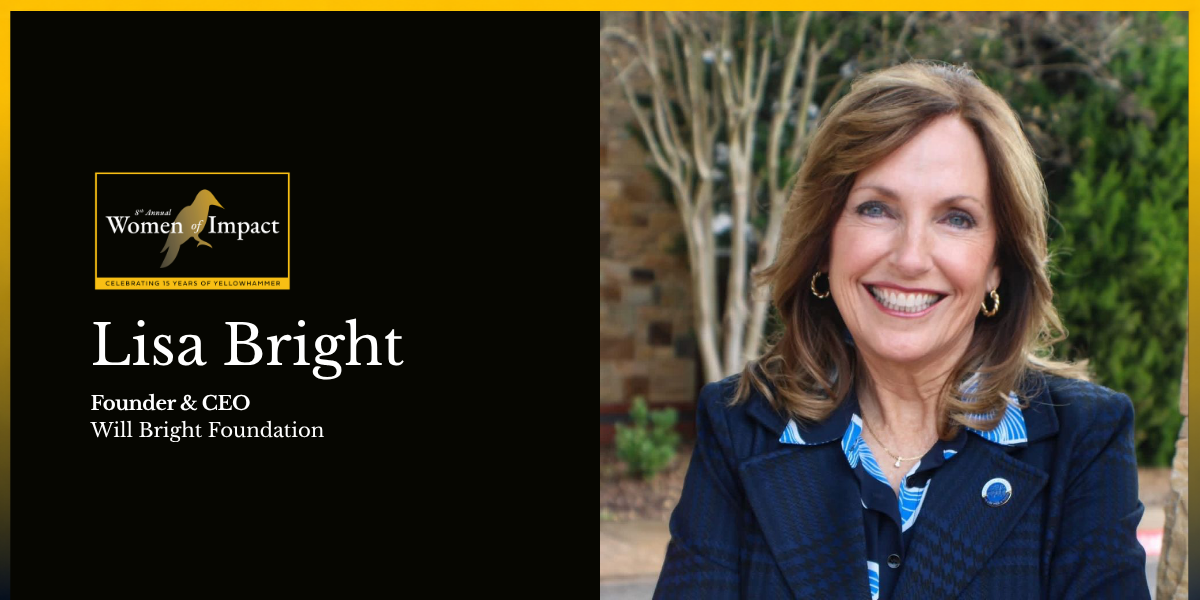
When Lisa Bright thinks about the work she has spent the past several years building, she does not think about awards or recognition. She thinks about her son.
Will Bright was 25 when he died of an overdose in November 2012. He had spent years struggling with addiction, cycling through counseling, medical and psychological treatment and rehabilitation programs across the country. What his family could not find was a place for him to go after rehab — somewhere he could learn how to build a life beyond addiction.
That gap became the foundation for the Will Bright Foundation, which Lisa and her husband, Bill, founded in 2014 to help people in recovery take what she calls the most important step: figuring out what comes next.
“We don’t do the work for accolades,” Bright said. “We do it because we know what it’s like to lose someone.”
Finding a purpose in the aftermath
Will had been a typical kid growing up in Trussville. He was involved in Cub Scouts and school, and his parents had no reason to believe his life would take the turn it eventually did. When he reached middle school, however, his demeanor began to change. He began to get into trouble at school, and his family found themselves navigating a world they knew very little about.
“At that time, no one was talking about addiction,” Bright said. “If your kid got in trouble, you were just a bad parent.”
The family pursued every avenue they could find, from counseling and medical care to psychological treatment and rehabilitation. Will graduated from high school and attended Auburn University, but his struggles intensified. Even after completing rehabilitation programs, he often returned to the same question: What comes next?
On Nov. 27, 2012, Will tragically passed away. “Our lives stopped,” Bright said.
Eventually, the Brights began asking a different question: What could they do to make sure another family did not find itself in the same place?
Bill, an attorney, helped establish the nonprofit, and they decided to focus on the point in recovery where Will had struggled most — the transition back into everyday life.
They initially imagined buying a house where people could live safely while taking those next steps. Then, through Micah Andrews of The Foundry, they learned about a property in Fayette that had been built with the hope that it would someday serve a faith-based mission.
The property included three cabins and a pavilion. The Brights assumed it was beyond what they could afford.
Then, the owner offered to donate it.
“God’s timing,” Bright said.
Creating a place for the next step
That property became Restoration Springs, the foundation’s transitional recovery center in Fayette.
The program is designed for men who have achieved a period of sobriety but still need the practical support required to build a stable life. Residents can receive peer support, transportation, workforce development, vocational training, recovery meetings and other wraparound services while working toward employment and independent living.
Bright and her team have learned that recovery does not end when someone leaves a rehabilitation facility. In many cases, that is when another kind of work begins.
“We realized how long it takes to reprogram that brain,” she said.
The program can last as long as 18 months, allowing residents time to establish routines, build relationships and develop the skills needed to sustain recovery. Since opening, Restoration Springs has grown to include a dormitory, and the former pavilion has been transformed into a community center with offices and a workout space.
The goal extends beyond sobriety. “We want them to have a purpose,” Bright said.
For residents, that can mean finding a job, learning a trade, securing transportation or simply building relationships with people who understand what they are going through. Several residents who completed the program have chosen to remain in Fayette because they found employment and established roots in the community.
What recovery can look like
Some of Bright’s most meaningful moments come during graduations at Restoration Springs, when residents stand before their peers and tell the stories that brought them there.
One resident named John remains especially vivid in her mind. He had cycled in and out of recovery programs and at one point was living under a bridge. When he arrived at Restoration Springs, Bright said, he was completely broken.
He stayed for about 16 months.
By the time he graduated, he had a full-time job and was participating in a peer support group through the University of Alabama. He eventually became an ordained minister, remarried his wife and continued building a life that once seemed out of reach.
Those are the moments that make the work worth returning to, even when the work itself brings Bright back to the worst day of her life.
“It can be challenging because it constantly exposes the worst day of our life,” she said. “But when you see someone come through and make it — their success — that’s the reward.”
Changing the way we understand addiction
Bright also wants to change the way Alabama talks about addiction.
Too often, she said, addiction is treated as a choice rather than a disease that can fundamentally alter the brain. The availability of drugs and the relationship between addiction and mental health make the issue even more complicated.
“I wish more people understood the medical and mental health side of it,” she said.
Education has become an important part of the foundation’s work, including seminars and efforts to help communities better understand addiction and recovery. Bright hopes that as researchers continue learning about the biological factors involved in addiction, society will become better equipped to identify risk and intervene earlier.
The foundation also offers scholarships to people who cannot afford the intake fees associated with recovery programs, recognizing that financial barriers can prevent people from getting help in the first place.
Taking the fight to Washington
The foundation’s work extends beyond Fayette.
Bright is a charter member and board member of Voices for Non-Opioid Choices, a coalition of parents and advocates working to expand access to non-opioid approaches to pain management. The group has spent years advocating in Washington, D.C., for legislation that gives patients more choices in how they manage pain.
The effort culminated in the NOPAIN Act, which was enacted in 2025 and expands Medicare coverage for certain non-opioid pain management options.
Bright is now particularly interested in expanding those alternatives for veterans through the Department of Veterans Affairs, where addiction and suicide remain significant concerns.
For her, the advocacy work is another way of addressing the problem upstream — giving people more options before prescription pain management can become part of a much larger struggle.
Learning leadership later in life
Bright did not begin her career in the nonprofit world. Before founding the Will Bright Foundation, she owned a drapery design business and raised her family. She later served five years on the Trussville City Council, an experience she credits with helping her understand legislation and prepare for the advocacy work that would become part of her life.
When she began the foundation, she knew she had a lot to learn. She spent years educating herself about the nonprofit sector, seeking advice from mentors and learning from people who had been doing the work longer than she had.
Her husband remains her biggest supporter, while friends, mentors and the communities of Trussville and Fayette have become an important part of the foundation’s story.
“You can’t do it without that,” she said.
That experience has also shaped the way she thinks about women in leadership.
“We need more of them,” Bright said. “Most women see things from a different lens.”
She has spent much of her nonprofit career working with men and has seen firsthand how differently women and men can approach a project. She believes women bring particular strengths to leadership, from communication and storytelling to the ability to manage competing demands.
She also wishes more women would recognize that leadership does not have an expiration date.
“I was a late bloomer,” she said. “It’s never too late. So what if you’re in your 50s? You can still make an impact.”
Looking toward the next generation
Bright sees reasons to be hopeful when she looks at the young women coming behind her, particularly her granddaughters and their friends.
She sees a generation that is eager to learn, interested in working and, in her experience, grounded in faith and community. At a time when technology and artificial intelligence are increasingly woven into everyday life, she hopes young people will continue to develop connections and convictions that exist beyond a screen.
“You’ve got to put your faith in something besides that screen,” she said.
For Bright, that faith has helped carry her through a journey she never expected to take. Losing a child can leave a family with the choice to retreat from the world or find a way to turn the loss into something that might help someone else.
She chose the latter.
The Will Bright Foundation cannot change what happened to her son. But every person who finds a job, builds a sober life, reconnects with family or discovers a sense of purpose at Restoration Springs represents something Will never had: another chance.
And for Bright, that is enough reason to keep going.