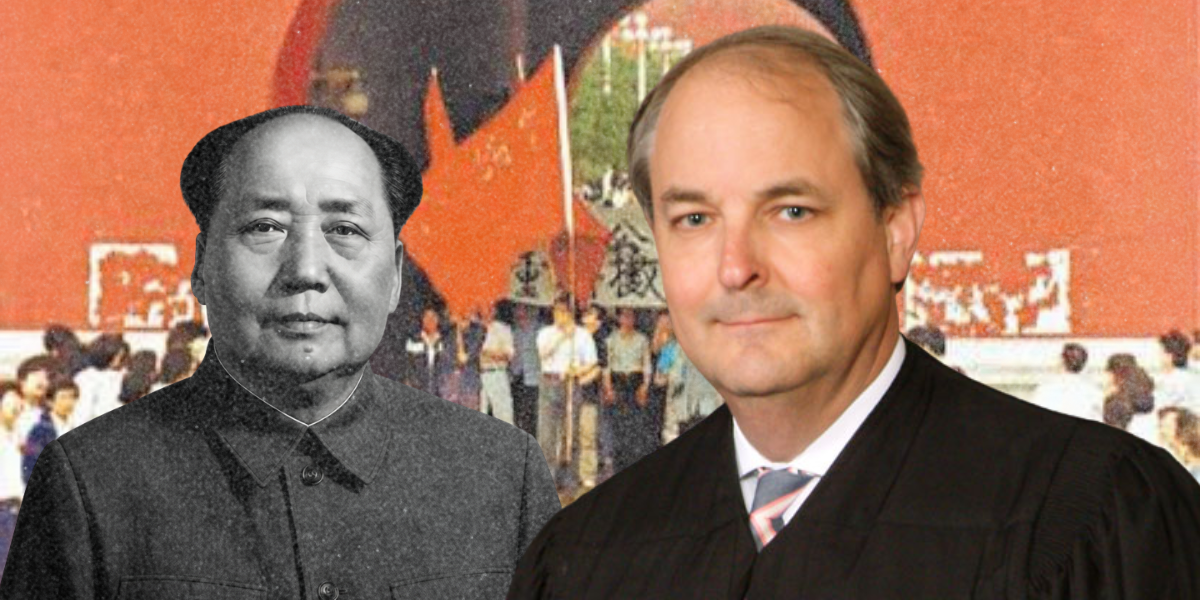
Mao Zedong died fifty years ago this month.
His portrait still dominates Tiananmen Square and the Communist Party continues to honor the man who founded the People’s Republic of China.
Mao’s legacy is an extraordinary contradiction. He unified a country shattered by invasion, civil war, and political fragmentation, but his achievement inflicted unimaginable suffering on his own people.
China had endured decades of turmoil. The Qing dynasty collapsed in 1911. Warlords divided the country. Japan invaded and occupied vast territories. Nationalists and Communists fought a prolonged civil war.
While he violently unified the country, removed foreign influence, and gave China a government capable of exercising authority throughout its territory, Mao did not regard victory as the end of the revolution, but, rather, its beginning.
Land reform brought executions and persecution of those classified as class enemies. Intellectuals encouraged to criticize the government during the Hundred Flowers Campaign soon discovered the danger of candor when Mao persecuted them in the Anti-Rightist Campaign.
Then came the Great Leap Forward.
Mao attempted to transform China rapidly from an agricultural society into an industrial communist power. Farms were collectivized, rural populations organized into communes, and production targets became increasingly detached from reality. Afraid to report failure, officials exaggerated harvests, prompting the state to requisition grain based upon fictional production figures; Chinese citizens starved as a result.
The ensuing famine killed tens of millions.
When more pragmatic Communist leaders tried to repair the economy, Mao increasingly feared that stability would threaten the revolution.
The result was the Cultural Revolution.
Mao encouraged young Red Guards to attack established authority to purge supposedly bourgeois influences. Teachers and intellectuals were persecuted. Officials were sacked. Families were torn apart by denunciations. Schools and universities were disrupted. Historic and religious sites were destroyed. Countless Chinese were beaten, imprisoned, displaced, or killed.
Mao successfully and deliberately transformed instability into an instrument of government.
He believed successful revolutions inevitably create establishments. Governments produce bureaucracies; bureaucracies acquire privileges; and privileged officials eventually become interested in preserving their positions rather than advancing the revolution.
That philosophy profoundly affected China’s legal system.
Mao was not opposed to courts. He established a judicial hierarchy culminating in the Supreme People’s Court, adopted a constitution, and enacted laws governing crime, marriage, property and administration. All of which, Mao understood, produced order in society.
But China’s Supreme People’s Court was not a constitutional court comparable to the U.S. Supreme Court. It could not invalidate Party policy. Constitutional supervision belonged to political institutions while the courts operated under the political system the Communist Party controlled.
Under Mao’s system, citizens, businesses, and lower government officials operate according to established rules. Courts resolve disputes, punish crimes, and enforce obligations.
But the ultimate political authority of the Party remained above the law because the Revolution remained above the Party.
Mao effectively reversed the traditional Anglo-American rule-of-law of government being under the law.
In China, the law was under the Revolution.
Law could discipline citizens, regulate economic relationships, and preserve order, but when it impeded what the Party considered necessary for the Revolution, law was forced to yield.
Legal institutions deteriorated precisely when protection against arbitrary political power was most desperately needed. There was no independent constitutional tribunal capable of telling Mao that revolutionary necessity did not authorize persecution, confiscation, or imprisonment.
But China could not develop economically amid the instability of permanent revolution.
Modern commerce requires stability. Investors need predictable rules. Businesses need enforceable contracts. Banks need reliable obligations. Economic development becomes difficult if every relationship depends upon tomorrow’s political winds.
To be prosperous, China had to rebuild its legal institutions to open its economy.
The Party needed law because economic progress requires predictability. A business must have reasonable confidence that contracts will be enforced. Citizens must know that ordinary rules will generally operate tomorrow as they do today.
A legal system sufficiently independent to tell government that it cannot disregard a commercial obligation might eventually claim authority to tell government that it cannot disregard a constitutional one.
China desired enough legal stability to protect commerce, investment, and social order; but not necessarily an independent judiciary to restrain the Party itself.
This illuminates the profound difference between Mao’s revolutionary theory and the constitutional tradition that developed from Magna Carta through the common law.
Both recognize that institutions establish stability.
Mao regarded that fact with suspicion. Stable institutions might entrench bureaucracy, privilege, and political relationships that obstruct revolutionary change. The revolution, therefore, had to retain the ability to break through them.
Constitutionalism reaches almost the opposite conclusion.
It deliberately creates stable institutions precisely because they make it difficult for those temporarily possessing political power to alter fundamental rights and relationships simply because they believe doing so is necessary.
What Mao perceived as a weakness is the rule of law’s greatest strength.
Viewed through a contemporary prism, China’s historical achievements must be measured and judged by the millions who suffered and died under policies made possible by virtually unconstrained political authority.
That contradiction may be Mao’s most enduring lesson to consider.
A country can possess constitutions, statutes, judges, lawyers, and courts without embracing the rule of law in its fullest sense. The decisive test is whether some institution, independent of political power, can enforce the law against the government itself.
Mao’s China had courts. What it lacked was a court with jurisdiction to tell the supreme political power that revolutionary necessity had reached a legal boundary.
Mao feared that stable institutions could restrain revolution.
The Cultural Revolution demonstrated what can happen when political leaders are above the law with no independent institution to constrain their actions.
A half-century removed from Mao’s death, that exemplifies the most important distinction of government by law of the party from the rule of law by the people.
The ultimate test of a legal system is not whether the government can use law to govern the people. It is whether the law can govern those who govern. Passing this test is the challenge of constitutional government.
Will Sellers is an Associate Justice on the Supreme Court of Alabama. He is best reached at [email protected].