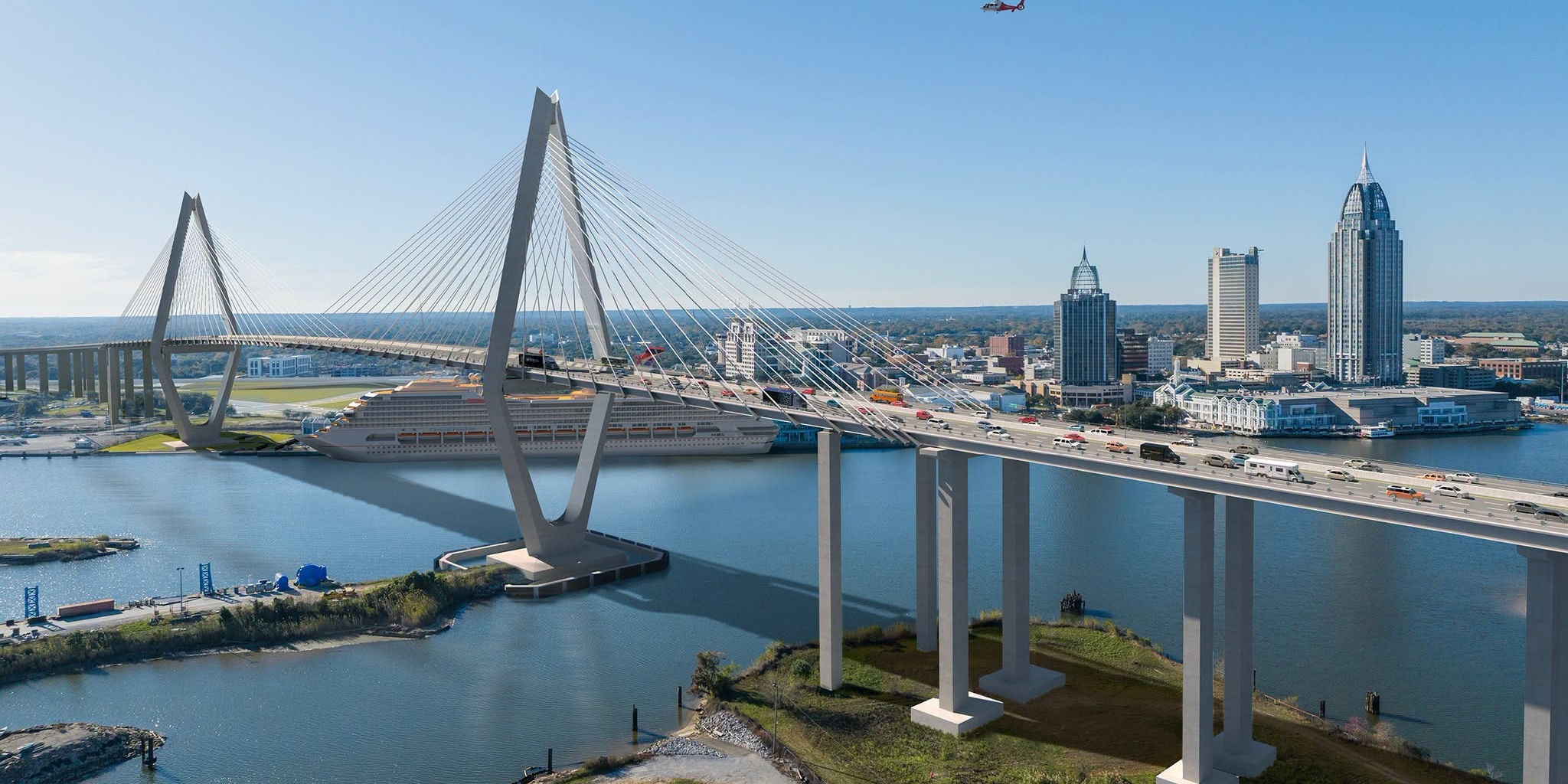
Construction on Alabama’s long-awaited Mobile River Bridge and Bayway Project could begin in early October as state transportation officials work to finalize financing for what is expected to become the largest transportation infrastructure project in Alabama history.
Speaking Wednesday during a meeting of the Alabama Joint Legislative Transportation Oversight Committee, ALDOT spokesman Tony Harris said the department expects to reach financial close on a federal Transportation Infrastructure Finance and Innovation Act (TIFIA) loan and bond financing by mid-September.
“We’re now working toward financial close on the TIFIA loan and the bond financing by the end of September, by the middle of September, actually,” Harris told lawmakers. “That would put us at a place where we could authorize full construction in early October.”
Harris said ALDOT expects to announce a groundbreaking date within the next few weeks and anticipates participation from federal officials. Construction is expected to take approximately five years.
Even before full construction is authorized, Harris said the design-build contractor is preparing for mobilization activities, including site preparation, establishing a material lay-down yard and field offices, and procuring long-lead construction materials.
The update provides the clearest timeline yet for a project that has spent decades in planning and has faced repeated delays as costs climbed and financing evolved.
“So for a project whose life has been hurry up and wait, hurry up and wait, we believe we’re at a place we have a path forward and we can actually begin soon,” Harris said.
Alabama elected officials weighed in on the project in a video message.
A feasibility study completed in 1997 first recommended constructing a new Interstate 10 bridge across the Mobile River. Harris said Federal Highway Administration data showed roughly 60% construction inflation between 2020 and late 2023, helping drive the decision to revise the project and build it in phases.
Earlier this month, the Alabama Department of Transportation announced a revised approach that reduces the initial project from more than $5 billion to approximately $3.2 billion by dividing construction into two phases.
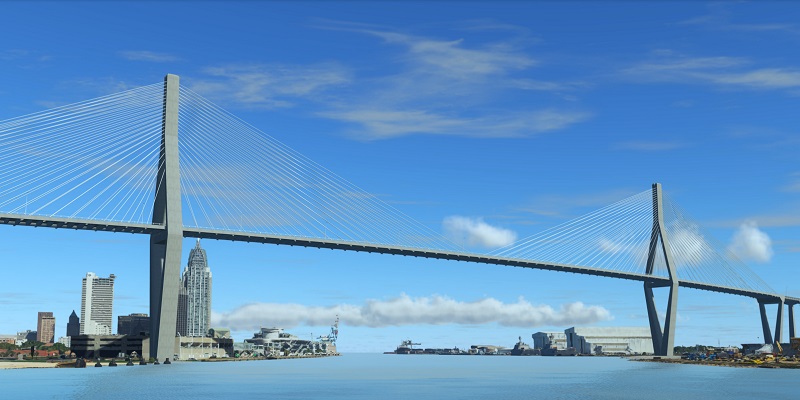
Under the revised plan, Phase One includes construction of a new six-lane cable-stayed Mobile River Bridge, restriping the existing Bayway to provide six lanes of traffic between downtown Mobile and the Eastern Shore, and improvements to key interchanges and traffic flow throughout the corridor. A new Bayway structure will be built later as additional funding becomes available.
“The U.S. DOT has not released us from the original federal requirement to replace the Bayway,” Harris said. “They’ve simply allowed us to phase the work so we can build what is financially achievable today and complete the remainder later. And quite frankly, that’s becoming the new reality for transportation mega projects around the country.”
Harris said the revised approach was approved after months of coordination involving the U.S. Department of Transportation, Alabama’s congressional delegation, Gov. Kay Ivey, ALDOT and local metropolitan planning organizations. He said the phased approach allows the state to move forward with the portion of the project that is financially achievable while preserving the long-term plan to construct a new Bayway.
The funding package for Phase One includes approximately 49% financing through a federal TIFIA loan, a $550 million Bridge Investment Program grant, a $125 million INFRA grant, at least $250 million in state funding and bond financing coordinated with the U.S. Department of Transportation.
Earlier this month, ALDOT also announced the framework for tolling once the project is complete. Harris told lawmakers no tolls will be collected until construction is finished and the new project is fully open to traffic.
Frequent users will pay $3 per trip with an ALGO Pass or $60 for an unlimited monthly commuter pass. Drivers using compatible interoperable transponders will pay $7.70 per trip, while motorists without a transponder will be billed through a pay-by-plate system. Existing toll-free routes — including the Causeway, Wallace Tunnel, Bankhead Tunnel and Africatown Bridge — will remain free.
Once complete, the project is expected to improve traffic flow along Interstate 10, strengthen freight movement through the Port of Mobile, enhance regional connectivity and improve hurricane evacuation along one of the nation’s busiest interstate corridors.
Harris called the Mobile River Bridge and Bayway Project “the largest transportation infrastructure project ever undertaken by the department and in the state.”
If financing closes on schedule in September, construction could begin in October, marking the project’s most significant step toward reality after decades of planning.
Sherri Blevins is a staff writer for Yellowhammer News. You may contact her at [email protected].