Contrary to what Democrats are saying, the current version of redistricting for partisan political advantage did not begin in Texas in 2025.
Drawing congressional district lines favoring one political party over another is almost as old as America itself.
In 1788, the same year the U.S. Constitution was ratified, Patrick Henry attempted to draw the lines of a Virginia congressional district to prevent James Madison from being elected to Congress.
The designation “gerrymandered” was first used in 1812 in Massachusetts because of Gov. Elbridge Gerry signing a bill for a state senate district that favored his Democratic-Republican Party so distorted that it resembled a salamander.
A major change in redistricting occurred in 1990 when the U.S. Department of Justice forced states to draw congressional districts to create districts with majority Black populations. This was in response to a 1982 amendment to the Voting Rights Act and a 1986 U.S. Supreme Court decision in Thornburg v. Gingles that set the stage for forcing the creation of “majority-minority” districts.
As a result, 13 new majority Black districts were created.
Since then, Democrats have taken full advantage of this, most recently after the 2016 election of President Donald Trump.
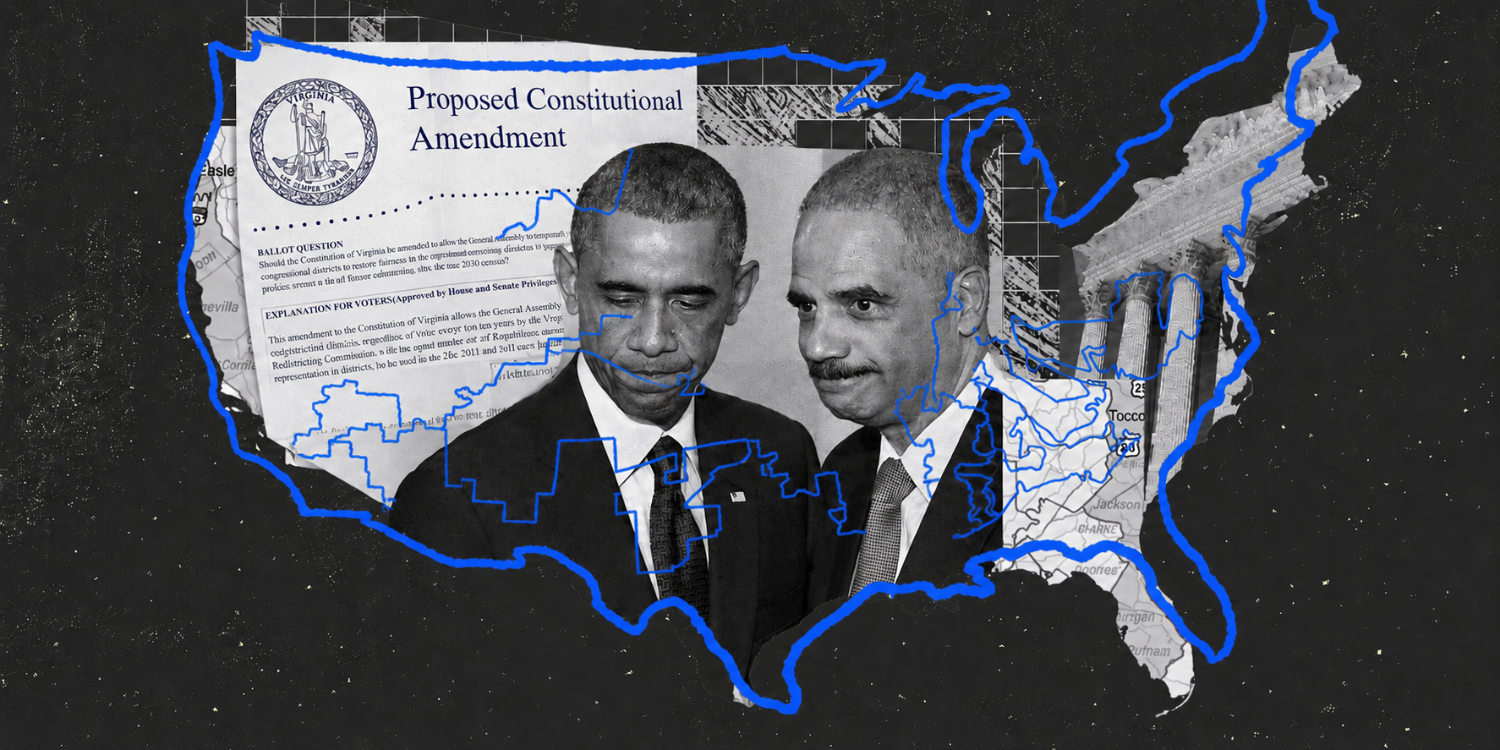
Former Obama Administration U.S. Attorney General Eric Holder founded the National Democratic Redistricting Committee (NDRC) with financial backing from a host of Democrat leftist groups and individuals as well as former President Obama.
The NDRC launched a series of lawsuits across multiple states to force them to redraw their congressional districts and create new “majority-minority” districts that would assure a Democrat would be elected. Lawsuits were filed against Alabama and Louisiana forcing them to accept district maps drawn by the courts resulting in the addition of two more Black Democrat districts.
When that occurred, no one in the leftist media raised any concerns about a threat to democracy or raised any concerns about depriving the state legislatures of their rights to draw their own congressional district maps. Democrats saw an opening by misinterpreting Section 2 of the Voting Rights Act and attempted to take full advantage of it through the courts.
In addition to redistricting by lawsuit, Democrat controlled states were also busy redrawing congressional districts to eliminate as many Republican districts as possible.
Literally, the Democrats were trying to regain the majority by drawing districts that Republicans would have no chance to win. Loss of population in California, New York, and Illinois required those states to redraw districts resulting in Republicans losing seven seats.
For the most part, Republicans sat back and did next to nothing in response until Texas decided to do a mid-decadal redistricting session in 2025 adding what could be five Republican districts.
In retaliation, California initiated a redistricting effort that will create five Democratic districts. The actions of those two states launched the latest redistricting war in multiple states with an unprecedented number redrawing their congressional districts in advance of the 2030 census.
But the redistricting battle has taken a whole new turn with the Supreme Court’s recent decision in Callais v. Louisiana asserting that drawing congressional districts based on race is unconstitutional. Alabama, Louisiana, Mississippi, Florida, and Tennessee have called or already completed special legislative sessions to redraw their congressional maps.
The net result of all this is that the United States is becoming more divided, not just by congressional districts, but by regions of the country, and most notably by values.
While the redistricting fight is not over, what can be determined is that Republicans have not only made gains, they have also been able to draw a sharp contrast between the traditional values of Republicans and the lurch to the hard left by Democrats to socialism and Marxism.
Ultimately, that contrast is what will make the biggest difference in the midterm elections.
Gary Palmer represents Alabama’s 6th Congressional District in the United States House of Representatives.