Work developed to serve Alabama students and educators is now reaching classrooms, conferences, and communities across the country.
The introduction began in New York, more than 900 miles from the Alabama School of Cyber Technology and Engineering.
A former ASCTE faculty member had moved to the city and joined Dwight School, where a conversation about his previous work reached Jeremy Deutsch, CEO of Digital Pocket, and a parent at the school. Deutsch wanted to know more. When ASCTE President Matt Massey and ASCTE Foundation Executive Director PeggyLee Wright were in New York for a conference, he asked to meet with them.
At that point, Deutsch had never been to ASCTE. He had not visited a classroom, talked with students or seen the Huntsville campus. He chose to invest anyway.
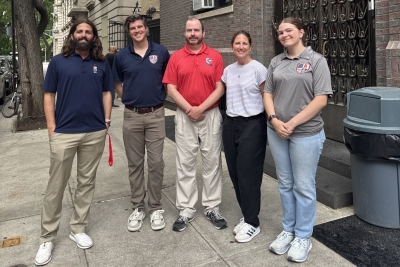
A few months later, he traveled to Alabama, toured the school, met the students, and made an additional investment. Then the relationship took another turn: Deutsch funded a team of ASCTE faculty and staff to return to New York and lead an educational camp for students at Dwight School.
The sequence offers a window into how a school created to serve Alabama students and educators is beginning to attract attention far beyond the state. ASCTE’s location in Huntsville places it near a concentration of aerospace, defense, and technology employers, but the school is not a Huntsville initiative. It is a statewide public school established by the Alabama Legislature to serve students from communities across the state and to contribute to the state’s education and workforce needs.
Increasingly, the work growing from that mission is prompting people elsewhere to take a closer look.
That interest is not based on a single program that ASCTE expects other schools to copy. It comes from the way the school brings cyber technology and engineering into students’ broader academic experience, works with industry partners, and shares resources with educators who can adapt them for their own classrooms.
Deutsch did not see ASCTE as a program every community should copy line for line. He was struck by the larger idea behind it: state government and private industry investing together in a public school built around future workforce needs. “It really is a model for what should happen everywhere else,” he said.
Mary Clair Wright leads ACCEL (Advancing Cyber Concepts and Engineering Learning) ASCTE’s outreach initiative for students and educators beyond the school’s campus. Much of that work begins in Alabama, where teachers and school systems are responding to rapid changes in computer science, cybersecurity, and artificial intelligence while preparing students for jobs that continue to evolve.
“Every week, if you look at our calendar, we are doing something outward facing to support what the incredible teachers of Alabama are already trying to do,” Wright said.
The wording matters. ASCTE is not approaching experienced educators and handing them a rigid program. Teachers know their students and communities. ASCTE’s role is to make its people, classrooms and resources available, then give educators room and support to determine what is most impactful in their own schools.
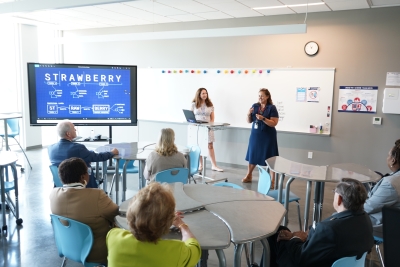
One professional learning model brings educators to ASCTE while classes are in session. They can observe instruction, talk through what they saw, and consider how an idea might translate to their own students. The setting gives visiting teachers access to a working classroom rather than a presentation built around a hypothetical one.
“We bring teachers from all over the state, and they spend the day with us, going into classrooms and seeing live instruction with real students,” Wright said. “In the afternoon, we break down what they’ve seen and give them time to design something just for their kids based on what they’ve seen.”
The same emphasis on adapting to local needs has shaped work outside Alabama. ASCTE educators have delivered ACCEL camps in Alaska, including programs in Bethel and Kipnuk. The communities, geography, and daily lives of the students were far removed from either Huntsville or New York City, which made listening locally as important as the technical content the team brought with it.
During the Alaska work, Wright recalled a village elder describing the knowledge young people would need to carry forward. They needed to understand the river, traditional skills and life along the Bering Sea, he told her, while also gaining experience with cybersecurity and engineering. The two were not in conflict. Both would be part of how the next generation addressed challenges in its own community.
Alaska is one example of the distance ASCTE’s outreach has traveled, but it is not the center of the school’s national story. The more telling pattern is that very different communities have found something in the innovative educational experience that began in Alabama, then shaped it around their own students.
ASCTE faculty members and former students have also been invited to speak at national conferences about their work. Those appearances give national audiences an opportunity to hear directly from the teachers and students doing the work, including what they have learned and how their approaches continue to change.
For ASCTE, national attention is not the mission. It is a result of the mission.
The school’s first responsibility remains in Alabama: educating students from across the state, supporting teachers in ways that respect their expertise, and helping prepare a statewide workforce ready for emerging fields. But the connections forming in New York, Alaska, and at national gatherings suggest that the work has relevance beyond state lines.
In Deutsch’s case, that relevance was strong enough to prompt an investment before he had ever set foot on campus. What began as a conversation in New York eventually brought him to Alabama and sent a team of Alabama educators back to New York. It is an unlikely route for a school relationship, and a useful measure of how far ASCTE’s story is beginning to travel.