Garrett Anders spent years trying to get someone to give him a chance.
As a teenager, he emailed college football programs. During the pandemic, he reached out to people connected to Justin Bieber and reality television. He sent messages, made connections and kept looking for a way forward.
Then he found Washington D.C.
“My name is Garrett D. Anders, and I am a 22-year-old, four-time congressional intern who currently goes to the University of Alabama,” Anders wrote in an account of his journey. “I am also disabled.”
Anders said he suffered a Bilateral Basal Ganglia Infarct, a rare type of stroke, as an infant. He said its effects will remain with him throughout his life, affecting both his speech and his ability to walk.
Growing up with those differences was not easy.
Anders describes a supportive family, but he also remembers struggling to feel like other children. At school, he worried that people saw him differently because of his disability. Eventually, he became reluctant to invite new friends home or spend time with them outside school.
“I always felt like a charity case of someone’s,” he wrote.
By high school, Anders had reached a conclusion that would shape much of what came next.
He didn’t think simply trying to fit in would be enough. If he wanted the life he imagined for himself, he believed he would have to find another way.
So he started asking.
Beginning in November 2019, at age 15, Anders emailed college football programs across the country, including Arkansas, Duke, Washington, Colorado, Nebraska, Florida State and Oregon State. A sports fan, he hoped to work with a team or perhaps find a platform such as ESPN’s “College GameDay” where he could share his story.
When the pandemic arrived, his efforts took a different direction. He began contacting people connected to Justin Bieber and later reached out to personalities in the reality television world.
Behind the unconventional outreach was something more basic: Anders was searching for connection.
For several years, nothing quite became the opportunity he was looking for.
Then politics did.
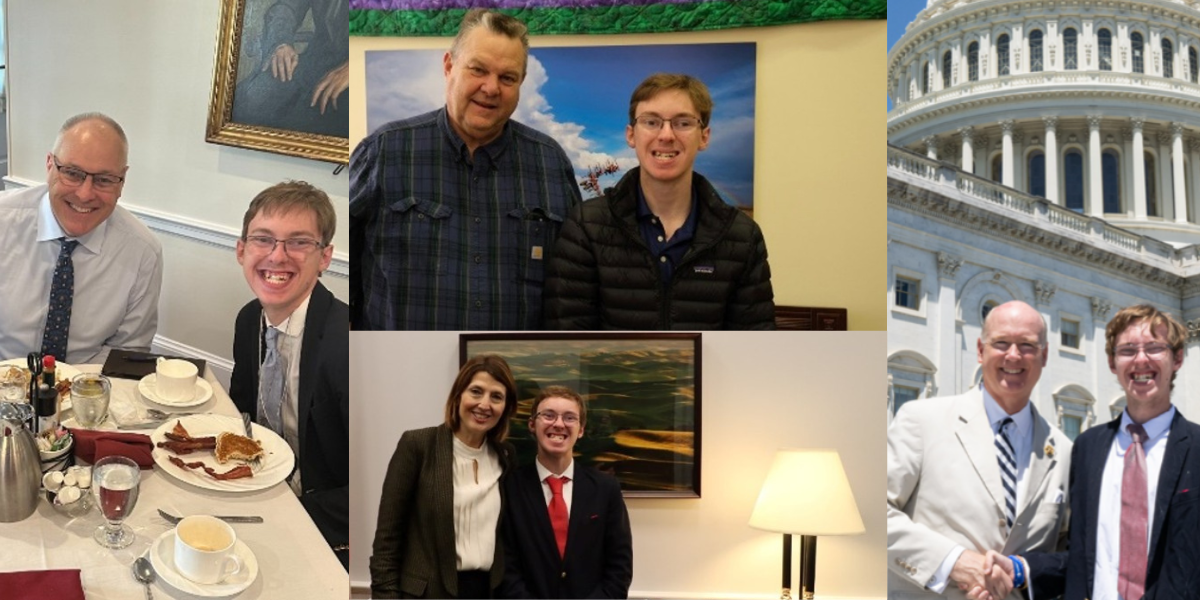
In early 2023, Anders began contacting congressional staffers. He said he reached out to staff connected to senators from both parties, including Katie Britt (R-Montgomery), Tommy Tuberville (R-Auburn), Roger Wicker (R-MS), Cindy Hyde-Smith (R-MS), Elizabeth Warren (D-MA), and then-Sen. Jon Tester (D-MT).
A meeting with a member of Tuberville’s staff helped change his approach. Rather than continuing to pursue a broader initiative he had been pitching, Anders decided to try for a congressional internship.
He contacted the office of U.S. Rep. Pete Stauber, (R-Minn).
“I was reluctant but I decided to reach out for my first internship later that month with Congressman Stauber of Minnesota,” Anders wrote. “This was purely for test reasons and wasn’t expecting anything serious back.”
He got an answer.
“By miracle I got my first internship offer from Congressman Stauber’s office on my second day of college,” he wrote.
By January 2024, Anders was in Washington.
An entry on Tester’s official Senate schedule from that period lists a 9:30 a.m. meeting with “Garrett Anders, intern for Representative Pete Stauber,” providing a glimpse of the access and experience Anders was gaining on Capitol Hill.
For Anders, however, the experience meant much more than adding a congressional internship to his résumé.
“When I got in there in January of 2024 in Washington D.C., I finally felt free,” he wrote. “Like I could have a life, a life like I had always craved.”
One internship soon became four.
After working for Stauber, Anders secured a second internship with U.S. Rep. Robert Aderholt, (R-Haleyville). Through a full-time staff member he met during that period, Anders was introduced to King’s Church in Washington.
He says the church strengthened his Christian faith and introduced him to people who became lasting friends.
“This is the first time I ever felt true hope I could have any meaning in my life, which is the only thing I ever wanted in life,” he wrote.
Washington also changed what Anders thought he needed to find the life he wanted.
“I found what I was looking for in DC without fame or fortune; it felt amazing,” he wrote. “Honestly, I can say I was genuinely happy for the first sustained period in my life.”
Anders went on to secure a third congressional internship with former U.S. Rep. Cathy McMorris Rodgers, (R-Wash.), the first woman to chair the House Energy and Commerce Committee, followed by a fourth with U.S. Rep. Brad Finstad, (R-Minn).
His work went beyond watching Congress from the sidelines.
An “Intern Spotlight” from a congressional office described Anders as an asset to the team and said he assisted legislative staff with research projects and helped communications staff draft speeches. The spotlight also discussed his childhood stroke and described him as an advocate for the disabled community.
The experience also helped solidify Anders’ political beliefs.
All of his congressional internships were with Republicans, something he considers significant after years of reaching out to organizations and people across politics, sports and entertainment.
Anders says his experiences living with a disability helped shape his belief in individual choice, limited government and parental rights. He is also a strong critic of diversity, equity and inclusion programs, arguing that broad policies do not always account for an individual’s particular needs.
He points to something as simple as answering a telephone. Because his disability affects his speech, a job centered on answering phones may not be a good fit. For Anders, that illustrates why employers should consider an individual’s abilities and limitations rather than assume one policy addresses everyone’s needs.
Now he wants to turn that experience into a career.
Anders has developed ideas for helping Republicans reach voters who may not traditionally identify with the party, particularly younger and suburban voters. In his broader personal account, he also writes about expanding Republican support in urban communities.
The Pacific Northwest is one place he sees opportunity.
In a proposal titled “Washington State GOP Plan,” Anders outlined a strategy for building a Republican brand in Washington and elsewhere in the region. He identified Washington’s 3rd and 8th Congressional Districts as potential opportunities and proposed community outreach aimed at young and suburban voters.
His approach also reflects some political pragmatism. Anders is an admirer of President Donald Trump and says Republicans should tap into Trump’s energy and political base, but he argues that candidates in competitive Washington districts should lead with policy rather than Trump’s name.
“I want to focus on the policy first and then mention how that might tie into Trump,” he wrote.
Anders has proposed working in community outreach, helping connect volunteers with competitive congressional districts and reaching out to students about elections and involvement in politics.
Ultimately, his ambitions remain rooted in the same search that began when he was a teenager sending emails to football programs.
He wanted an opportunity.
Eventually, four congressional offices gave him one.
Now Anders hopes to turn those opportunities into a full-time career on Capitol Hill — and eventually help open doors for others.
Sherri Blevins is a staff writer for Yellowhammer News. You may contact her at [email protected].