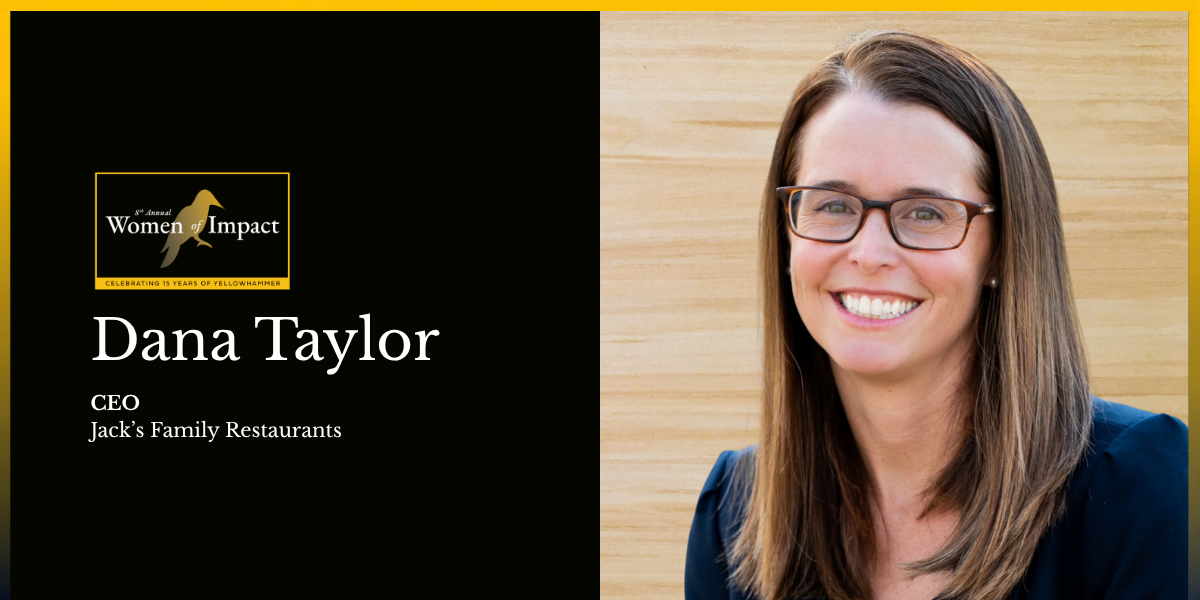
At Jack’s Family Restaurants, Dana Taylor has found a way to bring together two parts of herself that might seem, at first, to belong to different worlds.
Her background is rooted in chemical engineering, strategy and finance—fields that demand precision, analysis, and an instinct for solving problems. But over the course of her career, Taylor found herself increasingly interested in what happened after the numbers were calculated and the problem was identified: what the solution meant for the people involved.
“I studied chemical engineering, which at its core is about solving problems,” Taylor said. “What I gradually realized was that I was drawn to two things at once: the problem and the people.”
That combination has followed Taylor throughout her career and into her role as CEO of Jack’s, where she has spent years thinking about the relationship between business performance, employees and the communities the company serves.
“Business let me put those together in a way that engineering alone didn’t allow me to do early in my career,” Taylor said. “Solving problems can change someone’s life for the better.”
Taylor’s approach to leadership has earned her recognition as one of YHN Media Group’s 2026 Women of Impact.
From engineering to leadership
Taylor came into business with a mind trained to look for answers. Her early work in strategy and finance gave her another way to approach that instinct, teaching her to question what sits underneath a result rather than simply taking it at face value.
“I came up through strategy and finance long before I led operations, and that background taught me to dig until I understand what’s actually driving a number instead of accepting the headline,” Taylor said.
That experience also changed the way she thinks about data. A spreadsheet can reveal a trend or identify a problem, but it cannot always explain what caused it. For Taylor, that missing piece is often found by looking beyond the numbers.
“It also taught me the limits of data,” she said. “The numbers tell you what’s happening, but not why, and the why almost always leads back to people.”
That distinction has become a defining part of how she makes decisions. “I lead with heart and decide with facts,” Taylor said.
Learning to lead her own way
Like many people early in their careers, Taylor once had a fairly specific picture of what a leader was supposed to look like. It was a picture that left little room for quietness or introspection.
“I thought leadership had to look a certain way,” she said. “It needed to be loud, out front, and commanding the room.”
Taylor eventually realized that trying to fit that image came at the expense of understanding what she naturally did well.
“I’m an introvert; my strength is the one-on-one conversation, digging in and earning trust,” she said.
That realization changed the way she thought about leadership. Rather than trying to adopt someone else’s presence, she began paying more attention to the ways she could build trust and influence that felt natural to her.
“What I’ve learned is that there isn’t one way to lead, and the moment you try to copy someone else’s style, you lose the very thing that made you effective in the first place,” Taylor said. “My job is to build presence in a way that’s authentically mine.”
The people behind the results
For Taylor, the most meaningful measure of her career has little to do with the traditional markers of professional success. When asked what accomplishment makes her proudest, she immediately turns her attention away from herself.
“The accomplishment I’m proudest of isn’t a number; it’s the team,” Taylor said.
Her promotion to CEO was significant, but not simply because of what it represented for her own career. Taylor saw it as an opportunity to create more opportunities for the people coming behind her.
“When I was promoted to CEO, the title didn’t make it special,” she said. “It was that it opened a path for others to move up and reach their goals.”
That perspective has shaped the kind of moments Taylor considers meaningful. She pays attention to the people who take on a new responsibility, discover a talent they did not know they had or move toward a goal that once seemed out of reach.
“The real reward is when someone on our team grows into more than they thought they could be,” Taylor said. “Those are my greatest moments.”
Why Jack’s
Taylor’s connection to Jack’s goes beyond the restaurant business itself. The company’s history stretches back to 1960, when its first location opened as a small walk-up hamburger stand in Homewood. More than six decades later, Jack’s has grown to more than 250 locations across the region, but its restaurants remain closely tied to the communities where they operate.
That local connection was one of the things that first attracted Taylor to the company, and it remains one of the reasons she has stayed.
“What drew me to Jack’s Family Restaurants is the role we play in our communities,” Taylor said. “We want our local leaders to be a real part of the towns they serve.”
For Taylor, that role is visible in the ordinary moments that happen inside a restaurant — the relationships that develop between employees and regular customers, the familiarity of seeing the same faces and the feeling that a restaurant can become part of someone’s routine.
“There’s nothing like watching someone walk into one of our restaurants and feel like family,” Taylor said. “It’s who we are, and it’s what’s kept me here.”
The same philosophy shapes how Taylor thinks about the people who work for Jack’s. She sees responsibility as something that should be shared, with employees given room to make decisions and contribute perspectives that might not otherwise make their way into the conversation.
“Building a strong team starts with building people up: investing in them, giving them real ownership, and trusting them with it,” Taylor said. “It means hiring people who are different from you and listening to them, not just hiring people who agree with you.”
There is one expectation she believes should apply regardless of someone’s position or experience.
“The one standard I won’t compromise on is caring enough to do the work right,” Taylor said. “It doesn’t take talent or a title to hold yourself to a high bar, so that’s the one thing I expect from everyone, starting with myself.”
What great leadership looks like
Taylor can trace much of her leadership philosophy to Megan Mikolaichik, whom she worked for earlier in her career.
What stayed with Taylor was not a particular management strategy or piece of professional advice. It was the way Mikolaichik treated the people who worked around her, especially when things did not go according to plan.
“What makes Megan such an exceptional leader wasn’t anything she said, it was what she did,” Taylor said. “She built up everyone on her team publicly, gave them the credit, and then protected them when they made a mistake.”
That combination left an impression on Taylor because it created something that cannot be mandated in a job description: genuine loyalty.
“She made every person in her circle feel important and valued, and you’d run through a wall for a leader like that,” Taylor said.
It is an example Taylor still carries with her.
“A lot of how I try to lead traces straight back to her, especially the belief that your job is to make the people around you bigger, not yourself,” she said.
Compassion and hard decisions
Taylor also pushes back on the idea that women have to choose between being compassionate leaders and being decisive ones.
“People say women bring compassion to leadership,” she said. “That’s true, but what’s overlooked is that compassion and hard decisions aren’t opposites.”
For Taylor, the two qualities can exist together without one diminishing the other. She has never viewed empathy as a reason to avoid difficult decisions, or decisiveness as an excuse to lose sight of the people affected by them.
“The assumption that caring about people makes you soft, or that rigor makes you cold, is exactly backwards,” Taylor said. “I lead with heart, and I decide with data.”
That philosophy is reflected in the leaders Taylor admires throughout Jack’s, particularly those who understand that their responsibility extends beyond the operational demands of running a restaurant.
“At Jack’s, the leaders I admire know their teams as people, inside and outside of our restaurants,” Taylor said. “They’re spotting talent at 4 a.m. when the biscuits go in the oven. They’re celebrating what their teams accomplished.”
For Taylor, those are the moments that reveal whether a culture is working—not just whether a business is performing.
A career that matters
When Taylor talks about the future, she returns to the qualities she believes make Alabama a meaningful place to build a career: curiosity, relationships and a willingness to invest in the communities around you.
“In Alabama, there’s a deep level of care—for each other and for our communities—and that’s a real strength,” she said.
Her advice to young women is to pay attention to the people they meet along the way, particularly those who are willing to teach them something. She also encourages them not to become too confined by the boundaries of their job title.
“My advice: find leaders around who can teach you something, and hold onto them,” Taylor said. “Also, be curious.”
Taylor knows from experience that some of the most important opportunities in a career can come from asking a question that technically belongs to someone else, volunteering for something outside your role or simply being willing to understand how another part of an organization works.
“I wouldn’t be where I am if I hadn’t asked questions outside my lane, gotten involved, and worked to solve problems that weren’t strictly mine to solve,” she said.
It is an approach that has taken Taylor from engineering into strategy and finance, from the numbers into operations and ultimately to the CEO’s office at a company that now has hundreds of restaurants across the South.
“If you lean into that care and stay relentlessly curious, you’ll build something that matters,” Taylor said.