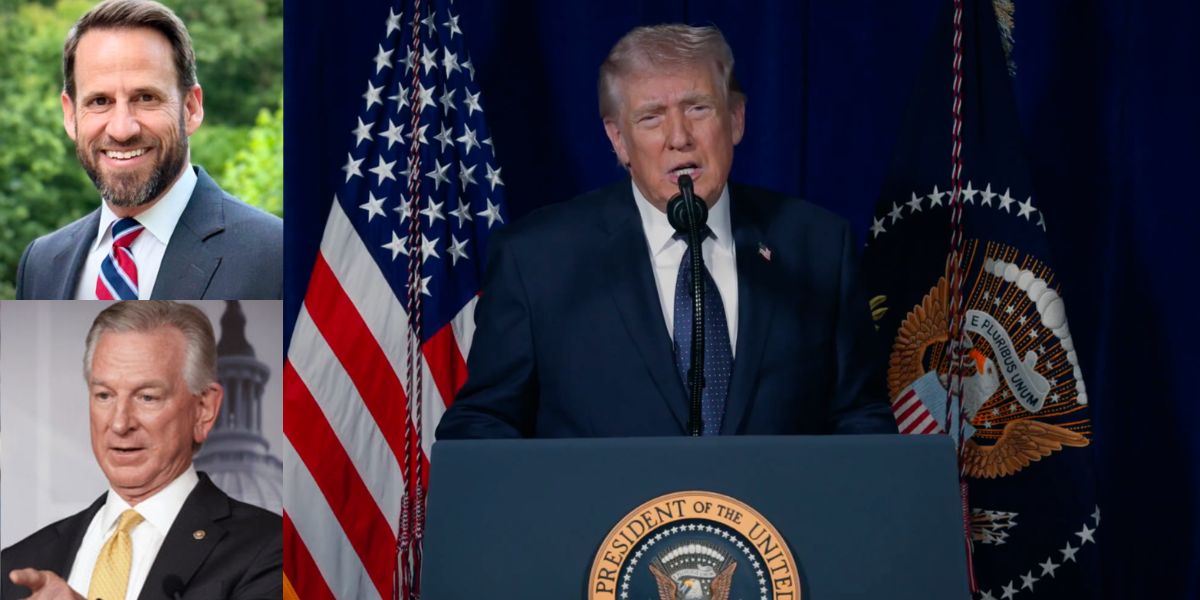
Within hours of the U.S. unleashing hell on the Iranian regime in Operation Epic Fury, Democrats in Congress sprinted to their shopworn anti-war script: “Unilateral!” “Illegal!” “War of choice!” All while being careful to disclaim any sympathies for Iran, of course.
The risk of looking like an Iranian sympathizer in an election year probably explains why Democrats are focused on these legal arguments rather than the foreign policy itself: “We’re not defending the Ayatollah, but this military strike violates international law!”
We can dispense with that myth right away.
Sen. Tommy Tuberville—hardly a fan of rudderless military interventionism—instinctively answered these bogus legal claims in expressing his cautious support for military action in Iran. Iran’s leaders, he warned, “are locked and loaded,” close to developing a nuclear weapon and reckless enough to use it. “It’s going to be a very, very tough decision,” he told Newsmax last week. “But to me, we have no choice.”
Tuberville nailed the legal issue. The legality of the strike hinges on one principle: national preemptive self-defense.
Under the United Nations Charter, invading another country is illegal unless one of two exceptions applies: (1) The UN Security Council authorizes it, or (2) the nation acts in self-defense under Article 51.
Democrats in Congress seem to think we need the UN’s blessing or we have to wait for another 9-11 (or worse) before we can respond to a threat. But Tuberville knows better.
The U.S. has long taken the position that national self-defense includes the right to strike first when American lives or American interests are at stake. Moreover, as with individual self-defense, the threat need not be certain to occur. National preemptive self-defense is justified if the nation is under a reasonable fear that the threat will materialize if nothing is done to stop it.
Controversially, even within his own party, President Bush relied on this principle, now remembered as the “Bush Doctrine,” to justify the invasion of Iraq on the reasonable fear that Iraq was hiding WMD and, in the wake of 9-11, was prepared to use it. Bush made it known that when a threat rises to a certain level, the U.S. will act alone if necessary to protect its national security—even without explicit authorization from the UN Security Council.
In other words, America First.
Critics still argue the Iraq invasion lacked proper legal authorization. But the Bush Administration invoked—accurately—the preexisting UN resolutions against Iraq and the right of national self-defense. Reasonable people can debate (and still do) the wisdom of the Iraq War, but the fact that U.S. intelligence turned out to be wrong about WMD in Iraq does not retroactively invalidate the legal justification.
Presidents must make decisions about defending America based on the information they have at the time, not what hindsight reveals.
Fast-forward to today. What would history say if the president failed to prevent a nuclear attack when he could have neutralized the threat in advance?
Iran’s nuclear program is accelerating. Current monitoring suggests Iran could produce enough weapons-grade uranium for a bomb in a week or two if it chooses to turbocharge enrichment. That shrinking breakout timeline is not hypothetical—it is the very situation preemptive self-defense was designed for.
Tuberville wasn’t exaggerating when he said we “have no choice.”
Under the doctrine of national preemptive self-defense, a president cannot wait until a missile launch or a radioactive plume proves the threat was real. When a hostile regime is preparing to inflict mass casualties on Americans, the Commander-in-Chief has both the authority and the obligation to act.
Of course America cannot and should not be the world’s policeman. But neither can it bury its head in the sand and hope threats to American interests and security suddenly abandon their ambitions. The sober reality is that American security sometimes requires decisive action abroad without waiting for an international permission slip.
Tuberville understands that this weekend’s strike is not some unprecedented legal gamble. It is a continuation of a long-standing national security doctrine—one rooted in self-defense and shaped over decades by presidents who understood that threats must be confronted before they metastasize.
In an unstable world, national self-defense isn’t meddlesome interventionism at all. It is, by definition, America First.
Bryan Taylor is a retired Army judge advocate, an Iraq War veteran, and a distinguished fellow of the Alabama Policy Institute. He is also a former Alabama State Senator and former counsel to two Alabama governors.