A $6 million Auburn NSF grant will help university researchers move promising discoveries toward practical applications through startups, industry partnerships, technology licensing and other pathways over the next four years.
The award is part of the NSF Accelerating Research Translation program, which helps universities strengthen connections between research and its potential uses.
“Auburn researchers are making discoveries across a wide range of disciplines, and we want to ensure they feel supported as they take those discoveries to market and put them to work in ways that can make a difference in people’s lives,” said Steve Taylor, senior vice president for research and economic development. “This award gives us an opportunity to strengthen the culture of innovation at Auburn.”
Led by Patrick Reed, Auburn’s assistant vice president for innovation and partnerships, the initiative will establish funding, training and other resources to help faculty explore how their research can address societal needs.
“This is about building a foundation here at Auburn for future research that has an impact beyond our campus and enabling faculty and researchers to do things here that they may have gone elsewhere to do in the past. We want to build a lasting ecosystem that’s supportive of translational research activities,” Reed said.
Problem-solving research
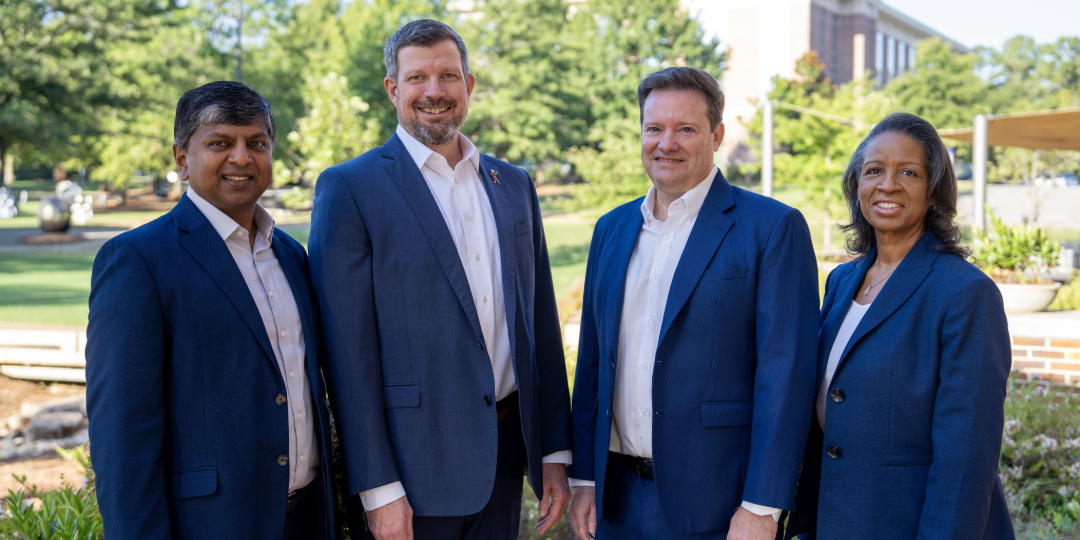
The initiative brings together faculty and administrators from the College of Sciences and Mathematics, Samuel Ginn College of Engineering, College of Agriculture and Raymond J. Harbert College of Business. Co-principal investigators include Mark Liles, associate dean for research in the College of Sciences and Mathematics, Allan David, associate dean for research in the Samuel Ginn College of Engineering, and LaKami Baker, a professor in the Harbert College of Business.
A central component is the Launch Innovation Fund, which will provide up to $50,000 for proof-of-concept work and prototype development to help researchers advance promising technologies.
“We have many faculty and students who have entrepreneurial interests,” David said. “However, the pathways to achieve these goals are not clearly apparent, even for those with start-up experience. This program will get us started in creating those paths.”
Researchers will also participate in customer discovery and entrepreneurship programming through the new Faculty Venture Studio, led by Baker, a certified I-Corps instructor. The training, mentoring and business research support will help faculty identify potential users, understand market needs and assess possible applications for their discoveries.
“I’m excited to leverage my experience in technology commercialization and entrepreneurship to help Auburn faculty recognize the entrepreneurial potential of their research and its societal value,” Baker said.
The process begins with a fundamental question: who needs the technology, and will they use it?
“You have an academic investigator who has devoted the last 10 years to this topic,” Reed said. “You are extremely invested in it. You believe very strongly that it’s going to make an enormous difference. But what does the market say?”
Customer discovery can help researchers determine whether a technology is suited for a startup, licensing agreement, industry partnership or another application. Even for faculty who don’t intend to commercialize their research, the process can reveal how potential users might benefit from their findings.
“If you take this research project that you’ve been working on and you go through a customer discovery process, even if you don’t want to take it as a company, just seeing how customers might make use of your research can be transformative,” Reed said.
The initiative also will explore ways for researchers to document and communicate their work’s broader impact and give students opportunities to gain experience in entrepreneurship and innovation.
“I love the freedom, creativity and opportunities being an academic at Auburn provides. It’s incredibly beneficial to learn about societal needs that can focus your research directions,” Liles said.
From the lab to the field
Auburn’s first funded project puts that approach into practice.
Led by Liles, the multidisciplinary project brings together researchers in agriculture and engineering to advance a seed-treatment technology that combines beneficial bacteria with a specialized pectin-based coating to protect plants against fungal disease.
Agriculture Assistant Professors Alvaro Sanz Saez, Eros Francisco, and Zachary Noel join forces with Assistant Professor Symone Alexander in chemical engineering to develop a more sophisticated, scalable seed coating and test it in the field.
The naturally occurring bacteria act as probiotics for plants, helping crops defend against disease while potentially supporting growth and resilience.
“Thanks to this award, we’re going to be able to put some things in the field that have a real-world benefit to U.S. farmers. To us, it’s all about fulfilling the land-grant mission of Auburn University,” Liles said.
The work builds upon decades of Auburn research into plant-associated microbes, including pioneering work by Joseph Kloepper, professor emeritus in the Department of Entomology and Plant Pathology.
Kloepper helped establish the field of plant growth-promoting rhizobacteria, or PGPR — beneficial bacteria that support plant growth and health. His work also led to the development of Auburn’s Plant-Associated Microbe Collection, which contains bacterial strains with potential agricultural applications.
The team is also working with farmers and industry partners to understand seed-treatment needs and exploring whether the treatment’s ability to promote root growth could offer additional benefits, including greater resilience during drought.
Those conversations with potential users are central to the broader initiative, Reed said.
“The more we do that, the more we inform our academic approaches to align with societal needs,” he said.
Auburn also will work with the University of Georgia Research Foundation and its Innovation Gateway, which will serve as the project’s mentor institution. The partnership will give Auburn opportunities to learn from an established innovation ecosystem and share best practices as it develops its own resources and programs.
Courtesy of Auburn University