At the Alabama School of Cyber Technology and Engineering (ASCTE), the future isn’t something to fear. It’s something to shape.
As the nation’s only high school fully dedicated to integrating cyber technology and engineering into every academic discipline, ASCTE is leading the way in preparing students for a rapidly evolving world, including the new era of artificial intelligence.
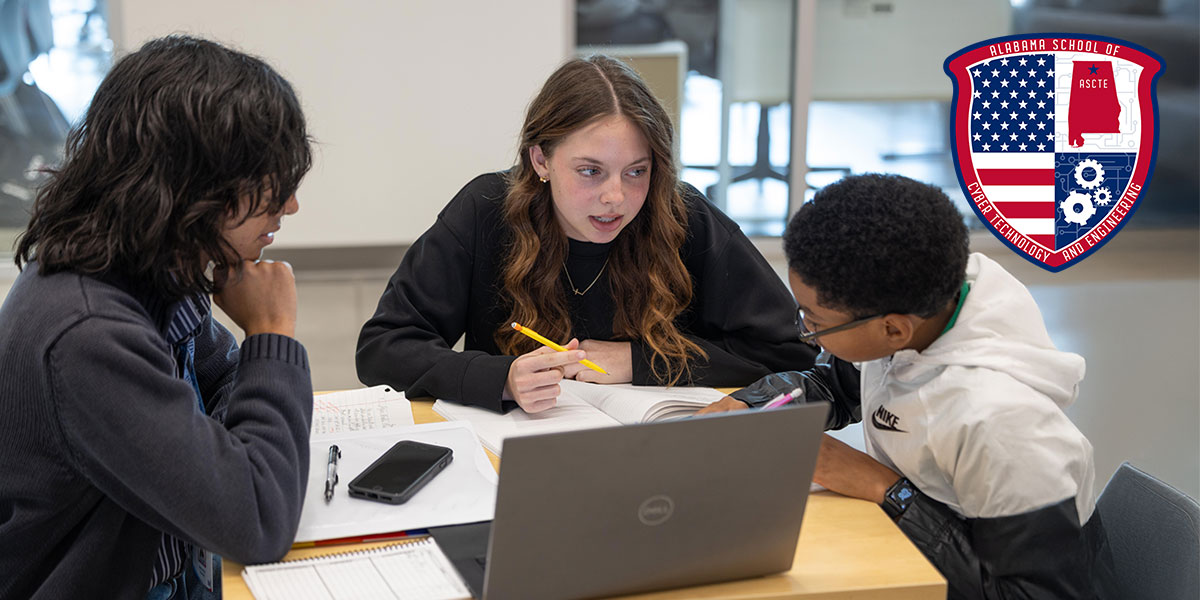
Through hands-on learning, mandatory internships, and instruction from certified teachers and industry experts, ASCTE students don’t just learn about technology; they learn how to think critically, solve problems, and navigate real-world challenges.
Now, that expertise is reaching the rest of the state: the first AI curriculum from the Alabama State Department of Education will be implemented statewide in public high schools, offering a model for how students can work alongside AI instead of being replaced by it.
A curriculum built for a moving target
Developed in collaboration with the Alabama State Department of Education, the school’s AI curriculum introduces students to AI concepts, data science, historical context, current applications, and the ethics surrounding these topics.
It aligns with Alabama’s Digital Literacy and Computer Science standards and incorporates leadership, workplace readiness, and digital literacy through Career and Technical Education (CTE) standards.
“We’re taking the approach that AI is here, and we’ve got to get students ready for it,” said Mary Clair Wright, cybersecurity instructor and instructional design expert at ASCTE.
The curriculum is designed to evolve alongside the technology. “We’re building a curriculum for teachers who have to train on the fly,” Wright explained. “It has to be a living document because this technology is changing every day.”
To support educators, the course includes “node checks,” which are structured points to assess understanding and adjust instruction in real-time. “We tried to anticipate the questions teachers and students would struggle with, because we struggled with them too,” Wright said.
Teaching students to think critically
ASCTE emphasizes critical thinking and ethical decision-making alongside technical skills.
“We get into the ethical considerations,” Wright said. “We need everyone thinking critically about what AI can do, what it shouldn’t do, and where to use it responsibly.”
Students experience AI firsthand while learning to question it. One of the earliest assignments asks students to research an AI pioneer using AI itself, discovering that the technology can produce inaccurate or incomplete information.
“One of the first assignments is researching an AI pioneer using AI, but also learning that it will hallucinate,” Wright said. “I want students asking: Why is this person important? Why isn’t this other person included? That’s the critical thinking piece.”
“If we can teach students the concerns and limitations of AI, maybe they won’t turn to it for everything,” she added.
Preparing students and teachers for the unknown
ASCTE recognizes that both students and teachers are navigating uncharted territory in the era of AI. Professional development is a cornerstone of the curriculum’s statewide rollout, and Wright begins each session with candid conversations about fears and challenges.
“We start with honesty. In my professional development sessions I ask: tell me what you hate about AI and what you’re afraid of,” she said. “Teachers deserve space to express their concerns. This is a big change, and we need to navigate it together.”
For students, the focus is on preparing for careers that may not yet exist, equipping them with the skills and mindset to adapt as the workforce evolves.
“I can’t predict what students’ jobs will look like in five years,” Wright said. “What I can do is teach them about the technology that will shape those jobs so they’re ready for the change. AI is here to stay. Some of the changes will be positive, some won’t, but our responsibility is to prepare students for all of it.”
Preparing Alabama students for the AI era
The creation of Alabama’s first AI curriculum for public high schools is the result of a close partnership between ASCTE and the Alabama State Department of Education. Mary Clair Wright has served as the architect of the curriculum, translating state standards into actionable learning experiences that prepare students for real-world challenges.
“We sat down with the state standards and turned them into essential learning targets,” Wright explained. “We asked ourselves: If I was going to teach this, how would I teach it? The result is a 155-day course designed to be flexible, accessible on a Chromebook, and adaptable to the rapidly evolving AI landscape.”
The curriculum emphasizes problem-solving, critical thinking, and ethical judgment, while connecting students to projects tied to Alabama’s needs and opportunities. Lessons like the AI Pioneers project teach students to use AI as a research tool while verifying information and considering its broader implications.
“This is a real concern,” Wright noted. “Graduating students are struggling to find jobs, and AI is as big a disruptor as the assembly line or the internet. It’s going to change both white-collar and blue-collar jobs, and it will affect the Alabama economy. If our job is to prepare Alabama students to be good citizens, gainfully employed, and adaptable, here we are at the apex of it.”
Teacher support remains central to the initiative. Wright and her team identified potential stumbling blocks for educators and students, built in checkpoints to gauge comprehension, and created resources to enable teachers to implement the curriculum confidently, even as AI continues to evolve.
“Our goal was to do as much of the heavy lifting and research for teachers as we could,” Wright said. “This technology is here to stay. Some changes will be positive, some won’t—but if we can prepare students to think critically, communicate effectively, and problem-solve, they can succeed anywhere.”
With ASCTE leading the way and partnering with the state, Alabama’s AI curriculum is more than an educational program—it’s a blueprint for economic adaptability, ethical engagement with technology, and proactive education that could inspire schools across the nation.
ASCTE is unleashing potential, expanding horizons, and building futures–and with Alabama’s new AI curriculum, that mission is reaching every corner of the state.
Learn more about ASCTE and explore opportunities for students, educators, and partners at www.ascte.org.