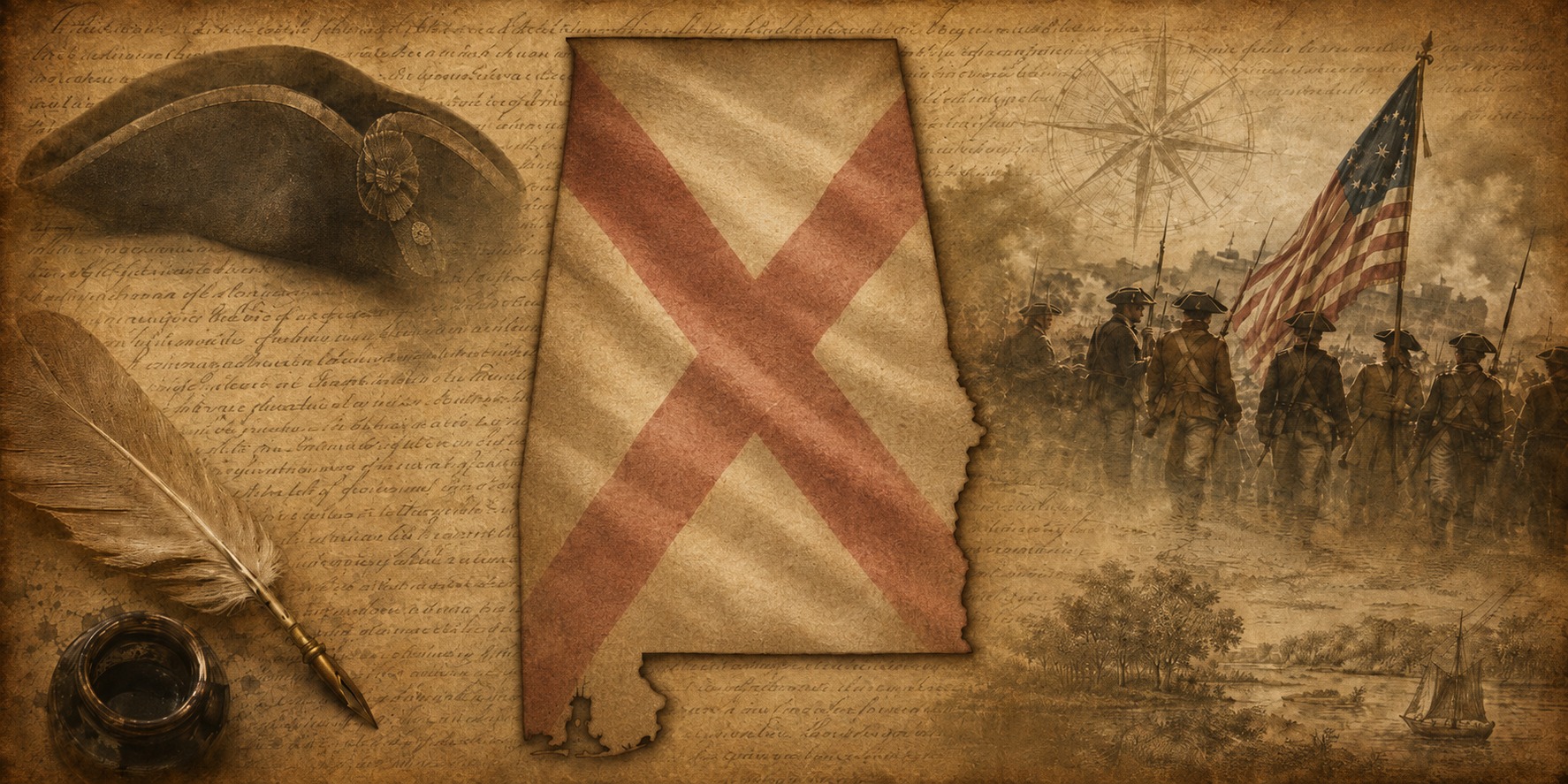
During the time of the American Revolution, Alabama was not one of the original 13 colonies. It was not a state when the Declaration of Independence was signed, and the land that would become Alabama sat far from Philadelphia when the nation’s founding document was adopted.
But as America marks its 250th birthday, Alabama’s ties to the American Revolution are closer than many realize.
More than 1,200 individuals with demonstrable involvement in the Revolutionary War were later associated with Alabama in some way, according to the Encyclopedia of Alabama. Some applied for pensions in Alabama, received pensions here or transferred pensions to the state. Others lived in Alabama, died here, were buried here or have memorial markers in the state.
Many of them arrived after the war as the young United States expanded westward.
According to the Encyclopedia of Alabama, Revolutionary War veterans began settling in Alabama before statehood, with many others arriving during the 1820s and 1830s during the period known as “Alabama Fever.” Veterans came largely from Virginia, the Carolinas and Georgia, with migration patterns carrying some into North Alabama and others into central and western parts of the state.
Most were not famous generals or national figures. Many were young enlisted men or militia members who had served brief terms during the struggle for independence before building new lives on the frontier.
That history is still visible across Alabama.
America250AL notes that many Alabama counties were named for Revolutionary War figures, including Washington, Franklin, Madison, Morgan, Marion, Fayette, Pickens, Sumter, Greene, Baldwin, Monroe and Shelby counties.
The state is also home to numerous monuments and markers honoring Revolutionary War patriots. Madison County has a monument in Veterans Park honoring Revolutionary War soldiers and patriots buried there. Montgomery has a Daughters of the American Revolution monument honoring 18 Revolutionary War soldiers who resided in the county. Fayette, Jefferson, Tuscaloosa, Clarke, Dale and other counties also have markers tied to Revolutionary War veterans or figures.
One of the most direct Alabama connections to the Revolution came along the Gulf Coast.
In 1780, Spanish Gen. Bernardo de Gálvez attacked British-held Fort Charlotte in Mobile as part of Spain’s support for the American cause. The land was then part of West Florida, not Alabama, but the battle took place in what is now Mobile.
The Alabama Historical Commission is also working to document the burial places of American Revolution patriots through its Patriot Cemetery Project, an effort to identify and preserve records of Alabama’s Revolutionary-era connections.
In Limestone County, John Wade Keyes is believed to be the first Revolutionary War veteran buried in Alabama. His grave is located in the City Cemetery in Athens.
Together, those names, counties, graves and monuments tell a larger story. Alabama did not exist as a state when independence was declared, but the people who fought for that independence helped shape the state that later emerged.
This Fourth of July, Alabama’s Revolutionary War history is not only a distant national memory. It is written across the map, marked in cemeteries and preserved in communities across the state.
Sawyer Knowles is a state and political reporter for Yellowhammer News. You may contact him at [email protected].