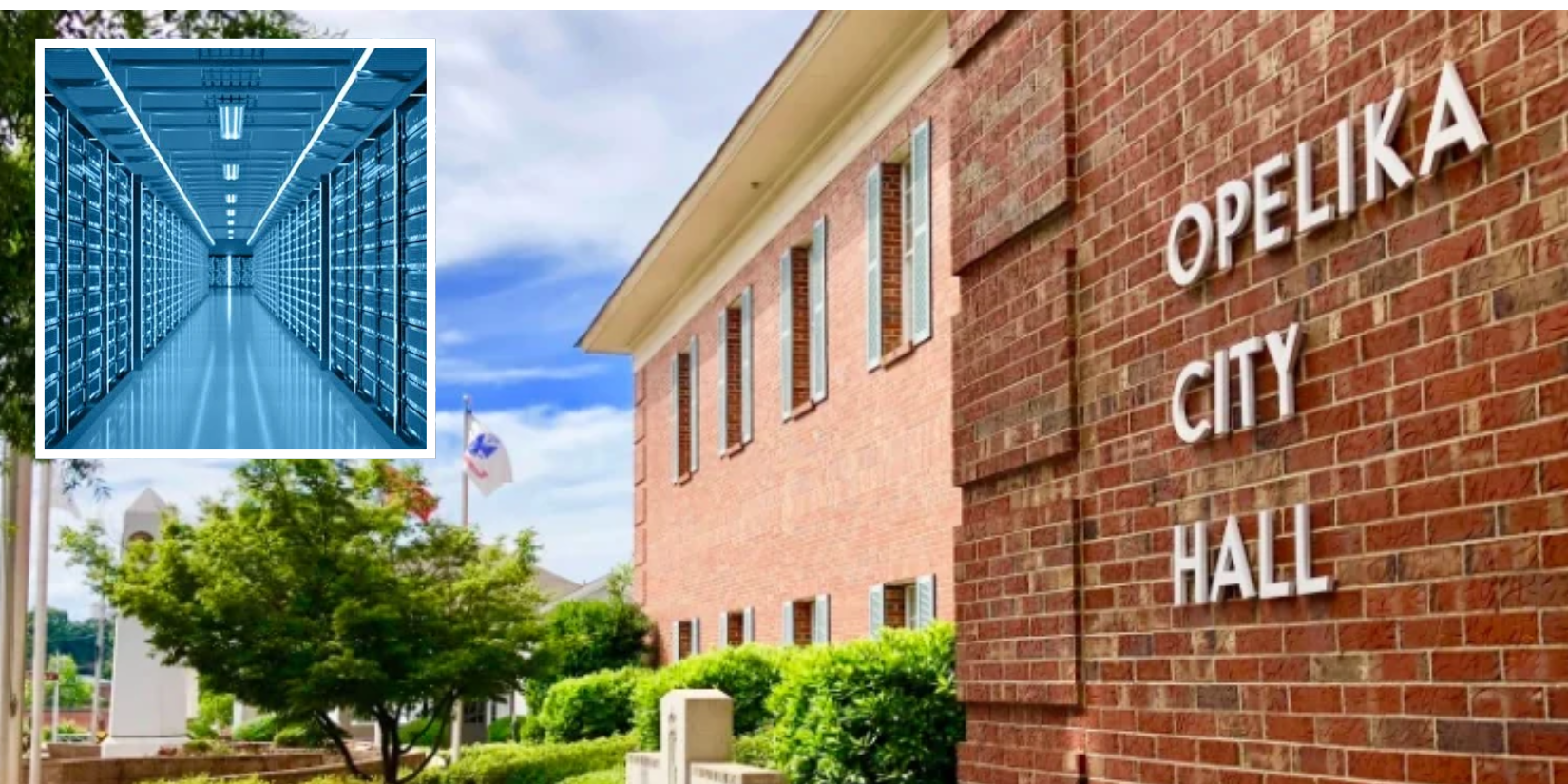
As opposition mounts to a rezoning proposal that could bring a data center to Opelika, a man who knows what he’s talking about is asking his neighbors to quit trading rumors and start demanding answers from the city council.
Tom Turkington, who has spent more than 35 years working in RF, audio, networking and communications engineering, laid out his case in a lengthy Facebook post this week.
“I’ve watched the debate about the proposed data center in Opelika get pretty heated, and a lot of what’s being said just isn’t true,” Turkington said. “Data centers are not evil. They’re buildings full of computers. Every text you send, every photo you back up, every bank transaction, every telehealth visit, and every Facebook post — including the ones against data centers — runs through one.”
Opelika’s nine-member planning commission voted Tuesday to recommend creating a technology overlay district in the city zoning code and rezoning 519 acres of undeveloped land under that district for future industry.
The property sits on West Point Parkway and is backed by developers Breland Properties and Opelika Investment Properties, LLC. Data centers are among 21 potential uses for the site, along with industries such as aerospace, defense and pharmaceuticals. The developer says it has no pending data center deal, only early talks.
The meeting lasted roughly three and a half hours. The chair paused proceedings and ordered a crowd of at least 150 people out of the room, and police officers ushered them out. They were allowed back in after about four minutes. A petition opposing the rezoning has gathered more than 5,100 signatures.
Turkington said a large data center campus takes years to build and can employ hundreds or even thousands of electricians, pipefitters, ironworkers, equipment operators and concrete crews at the height of construction. In Georgia, a state audit credited the state’s data center tax exemption alone with 8,505 construction jobs and $1.0 billion in value added to the state economy.
He acknowledged that a finished facility typically employs anywhere from a few dozen to a couple hundred technical workers. Turkington said the long-term payoff for a city like Opelika is the tax base.
“Data centers pay a lot in taxes and ask very little of the city,” Turkington said. “They don’t add kids to our schools, they don’t create rush-hour traffic, and they need little in police and fire service.”
He pointed to Loudoun County, Virginia, home to the world’s largest concentration of data centers. According to county officials, data centers generate almost half of the county’s property tax revenues, and since 2008 the county’s tax rate has dropped from $1.285 to $0.805. The county estimates that absent the data center industry, its real property tax rate would likely be more than $1 per $100 in assessed value.
Turkington also took on the water, power and noise concerns raised by opponents.
He said a data center’s water use “depends entirely on the design.” Closed-loop cooling systems are filled once and circulate the same liquid over and over, “the same basic idea as the radiator in your car.” Evaporative systems use far more water, and Turkington said the city can require the closed-loop kind.
Turkington told residents worried about their electric bills to look at Alabama’s landmark data center law, which took effect last month.
SB270, sponsored by State Sen. Lance Bell (R-Pell City), requires the Public Service Commission to determine whether large data center contracts recover the incremental cost of serving the customer from the customer, and whether they benefit other retail customers.
Turkington called noise “a real issue near homes, but it’s an engineering problem with engineering solutions.” He called for noise studies before and after construction that measure low-frequency hum, a firm limit at the property line, and real setbacks from homes. The planning commission’s recommendations include height limits, noise levels, more buffering near residential areas and restricted hours for generator testing.
“Supporting this project doesn’t mean writing a blank check,” Turkington said. “These are the right questions for the council.”
His list for the council: how long the tax abatement runs and what the city collects in years one through 10, whether the agreement will require closed-loop cooling and cap water use, who will supply the power and what protects residential customers, whether the agreement will include noise studies, a property-line noise limit and setbacks from homes, and whether the developer will put all of it in writing.
“Those questions have real answers,” he said. “‘Data centers destroy communities’ is a fear, not a fact. Let’s ask good questions, get the facts, and decide on the merits.”
The planning commission’s recommendations are non-binding and now go to the Opelika City Council for a final vote. A date has not been set.
Grayson Everett is the editor in chief of Yellowhammer News. You can follow him on X @Grayson270.