Every June, my mother opened the gates.
On the first days of summer recess, she welcomed the children of our community onto the grounds of my parents’ home in Old Westbury to pick strawberries. She called it Strawberry Fields. Kids arrived with baskets and left with stained fingers and the rare joy of eating something they had pulled from the earth themselves. My mother stood in the middle of it all, delighted. She believed summer should begin with sweetness, and she made sure it did.
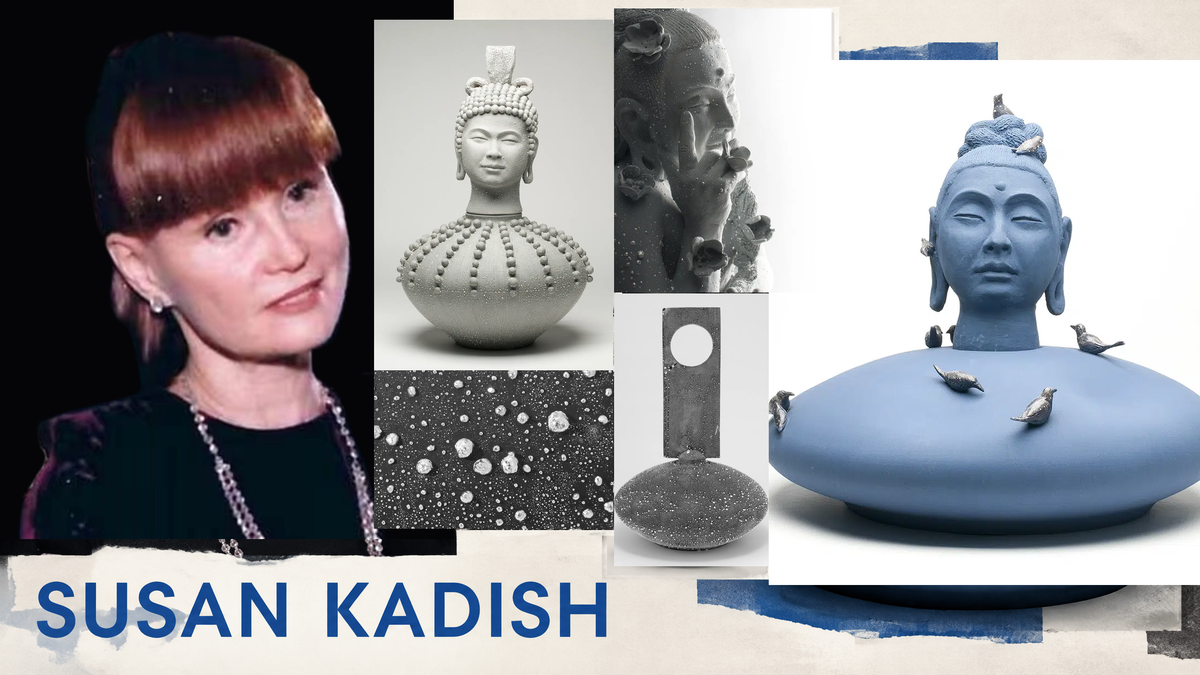
Last month, we said goodbye to her. Susan Kadish. Eighty-three years old. A wife who made it to her sixty-fifth anniversary. A mother. An artist.
My mother was born in Brooklyn into a family of fashion designers, people who made beautiful things for a living and raised her to trust her own eye. She studied fashion design at the Fashion Institute of Technology in Manhattan. Then she put her hands in clay and stone and never looked back.
She became a sculptor. She mastered marble and alabaster first, learning her craft in Italy and in her Long Island studio. Later she turned to clay and to firing methods older than the country she loved. Raku. Saggar. Techniques where the artist builds the piece, surrenders it to fire and smoke, and accepts what comes out. She worked metal, horsehair, beads, and rope into her vessels. Galleries in New York sold her work. “My life is my art,” she once said. She was right about that, though not in the way people usually mean it.
Here is what I learned watching her work. In raku, you pull the piece from the kiln while it still glows and give it to open flame and smoke. In pit firing, you bury what you made and set it burning. You cannot control fire. You can prepare the clay, choose your materials, and trust the process. Some pieces cracked. The best ones came out marked in ways no one could have planned, and the markings were the point.
She learned to combine processes and patented a method for attaching fine metals to clay. She honored me by allowing me to help her with that patent during a time of recovery in my life. She was tough as fired clay, and yet she had a beautiful, kind, giving heart. The happiness of others naturally came first to her, and she was fiercely protective of her family. When Chelsea gave her a solo show, the gallery called it The Fire Within. They meant the kilns. We knew better.
She raised three boys the same way.
She met my father in Brooklyn, where a lot of great American love stories began. My father was a prize fighter. He held an early FCC license and ran a television repair shop, and because people counted on their sets, he carried spare parts to their homes so the picture came back the same day. He never let people down. He was buying Brooklyn apartment buildings before he turned twenty-five, and people affectionately called him “Little Zeckendorf,” after Big Bill Zeckendorf, the preeminent real estate man of that era. He became a nationally known investor for a simple reason: he was the most reliable man you could enter a deal with. His word was and is his bond. He invented investment tools the industry still uses. And for sixty-five years, he had a muse. He wrote her poems. He wrote her love songs. He calls her Susie. Ask him today what he has built that matters most and he will not point to a building or a business deal. He will point to his partner, the one he woke beside each morning, which was always the best part of his day.
She introduced her grandchildren to art and encouraged them to be “free spirits.” She often brought them to her studios, including Haven Art Studio in Port Washington and C.W. Post, where she was artist in residence for decades. Of course the students loved her.
My mother never kept score of our careers or our square footage. She had a simpler measure, a principle she loved to repeat: “Find the good in everyone.” She said it so often it stopped being advice and became a description of her. She lived it in the strawberry field, and she lived it at the workbench, where she took horsehair and rope and beads and made them beautiful. And she asked her boys to start with each other. Love one another. Be a family. To her, that was the whole assignment.
At the end, she had what she wanted most. Her boys were with her. All of us, together, in one room. I believe she knew it. I believe it gave her peace, and I am very thankful for that.
My mother did not title her sculptures. She numbered them. A Buddha in powder blue stoneware went into the world as 3883. An obelisk jeweled in silver went out as 4534. I used to think it was an artist’s quirk. It wasn’t. In her whole body of work, she made three exceptions. Three sculptures with names, one for each of her sons. The world got numbers. Her boys got names.
Her greatest work was never fired in a kiln. It is a family. Like everything she made, it carries her markings, it has been through the fire, and it is built to outlast her.
Next June, when school lets out, there should be children in a strawberry field somewhere, sticky fingered and laughing. That would honor her. Her boys finding the good in each other will honor her more. That is the last commission my mother left us.
All her life, she gave the things she made to the fire and trusted what came back. At the end, she gave her boys to each other.
Will Kadish is the President and CEO of Broad Metro LLC, an Alabama based real estate development company. With over 30 years of projects across the United States, his work spans mixed use development, commercial development, and long-term community partnerships from Florida to Virginia. He is also co-founder of The Parlay Project, a nonprofit focused on sports gambling addiction awareness and recovery. He is the Treasurer of the Hoover Arts Foundation and serves on the Board of the YMCA of Alabama.