Auburn welcomed one of the nation’s senior-most military leaders to campus, exploring opportunities for collaboration and recognizing the next generation of military service members.
The commander of U.S. Space Command sees strong alignment between the command’s mission and Auburn University’s research capabilities.
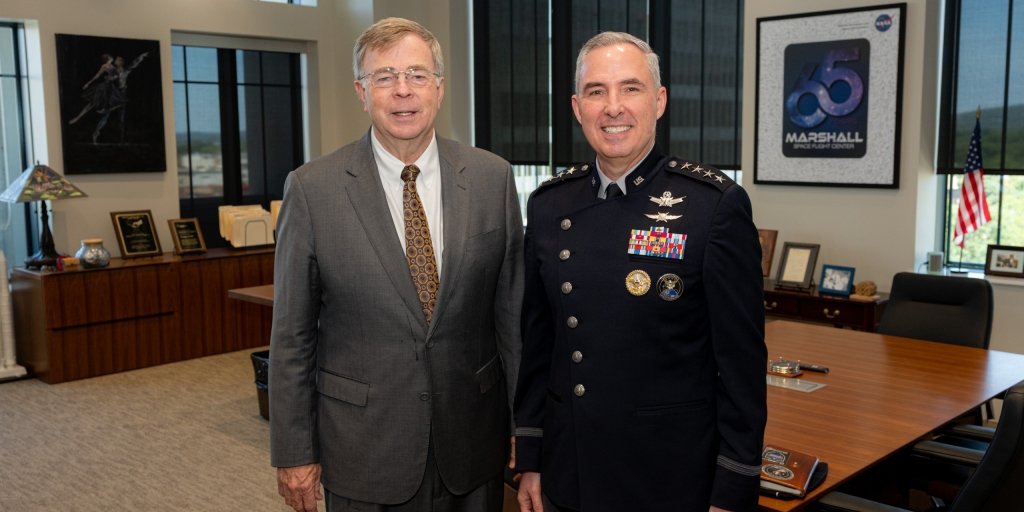
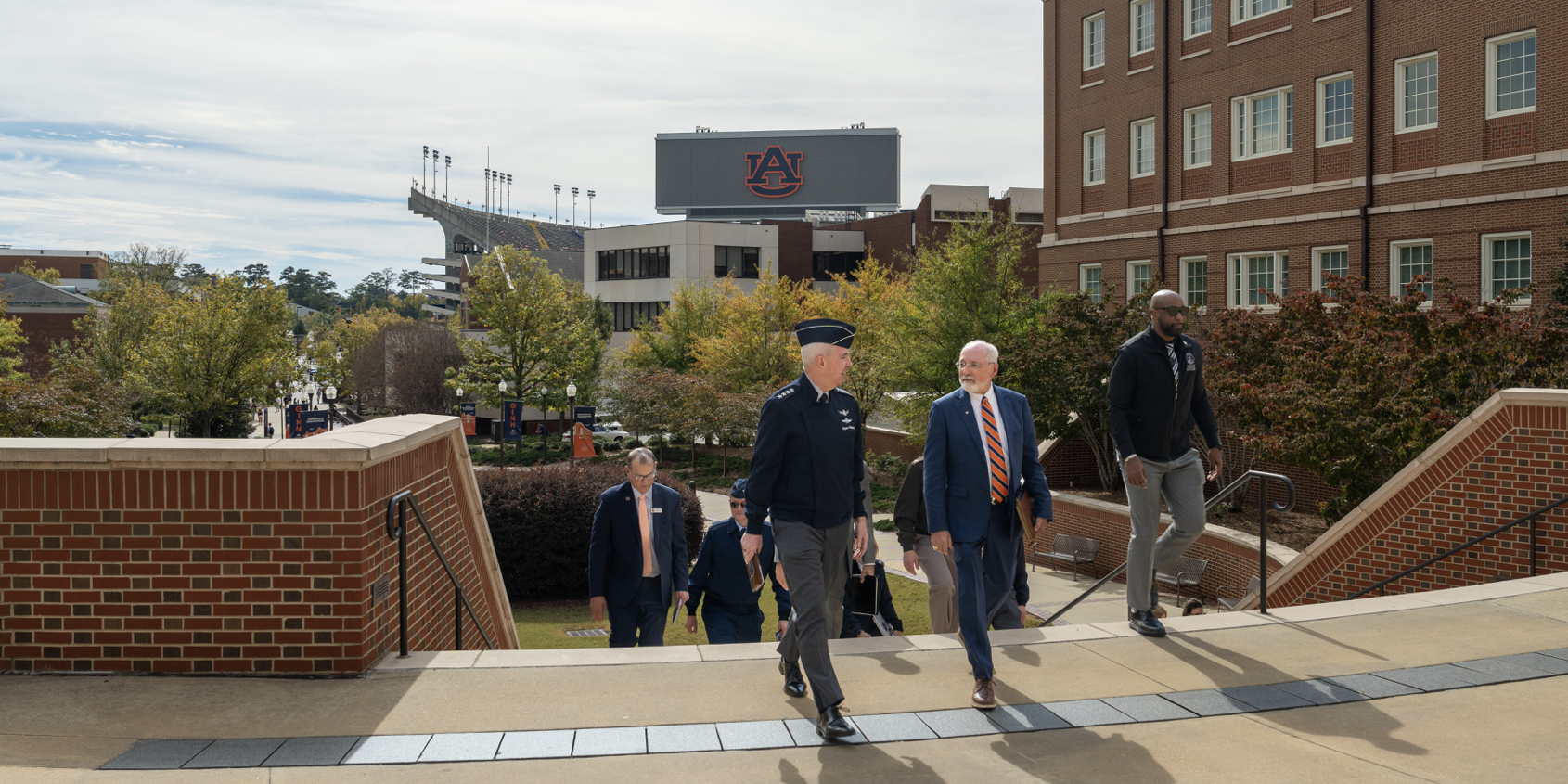
During a visit to Auburn’s main campus and the Auburn University Applied Research Institute (AUARI) in Huntsville, Gen. Stephen Whiting learned more about the university’s growing investments in space research, national security and workforce development — areas where Auburn is already working alongside military and government partners to address some of the nation’s most pressing challenges.
“The work that the Auburn University Applied Research Institute is doing aligns very well with our efforts at U.S. Space Command, and we think there are incredible collaboration opportunities,” Whiting said.
One of the U.S. military’s 11 combatant commands, U.S. Space Command exercises combatant command authority over soldiers, marines, sailors, airmen and guardians operating ground- and space-based systems around the world. The command is preparing to relocate its headquarters to Redstone Arsenal in Huntsville over the next five years, bringing approximately 1,400 jobs to the region and creating new opportunities to expand collaboration with Auburn.
University leaders focused Whiting’s visit on Auburn’s contributions to the space domain, with briefings highlighting the university’s engineering programs and research in advanced and additive manufacturing, small satellite systems, space operator development, GPS and vehicle dynamics.
Whiting also toured AUARI’s new 50,000-square-foot laboratory in Huntsville, where research engineers and scientists are developing capabilities that include the nation’s first university-led radiation effects testing facility for space electronics and a classified space operations training center.
“It’s an honor to share Auburn’s research impact and educational programs directly with the highest levels of U.S. military leadership,” said Steve Taylor, Auburn’s senior vice president for research and economic development. “National security is a top research priority for Auburn. We understand the threats we face in space and are dedicated to meeting those challenges.”
Why space matters to national security
Whiting also brought that national security mission to Auburn’s Army, Air Force and Navy ROTC detachments Friday, emphasizing the growing importance of space to everyday life and military operations.
“We take for granted how much of our life is connected to space,” Whiting told the cadets.
From financial markets to everyday credit card transactions, the global space economy was estimated at $600 billion in 2025, he said. But the stakes extend well beyond the commercial sector. Every branch of the U.S. military relies on access to space-based capabilities to carry out its missions.
U.S. Space Command works to ensure the United States can maintain that access and protect the assets that make it possible. Whiting pointed to growing threats from China and Russia, which have invested in capabilities designed to disrupt or degrade U.S. space-based systems.
The growing threat environment led the United States to reestablish U.S. Space Command in August 2019 and establish the U.S. Space Force in December 2019.
“It’s all because of the threats from these two nations,” Whiting said of China and Russia. “China is moving breathtakingly fast, so fast I have a hard time describing it.”
He described China’s expanding arsenal of counterspace capabilities, including GPS jammers, lasers and cyber weapons designed to put U.S. space capabilities at risk.
“Because they believe that’s the U.S. military’s Achilles’ heel,” he said.
For Auburn, addressing those challenges requires developing new technologies, preparing scientists and military professionals who will design, operate and protect the nation’s space capabilities.
The university has recently developed graduate programs in space systems to equip working professionals with the knowledge and skills needed in a rapidly growing space sector.
“We develop a capable, credible, highly educated workforce ready to take on the nation’s hardest problems, and many of those problems now sit in space, from exploration to the space capabilities national defense depends on,” said Derek Tournear, Auburn’s director of space innovation.
“Advancing space also means advancing manufacturing, both for space and in space, and Auburn’s research is pushing both. Industry increasingly sees Auburn as the place to solve these problems and to find the people who will keep the nation ahead in space.”
Whiting emphasized the need for that workforce will continue to grow as the Space Force expands. He said the service plans to double in size over the next three to five years, and that space capabilities will play an increasingly important role across every military service.
“You will serve in consequential times,” he told the cadets.
Auburn Connection
Whiting’s visit also carried personal significance. His ties to Auburn goes back generations — and, as he put it, he has been saying “War Eagle” all his life.
“Personally, it’s so amazing to get to come back to this campus where my mother was born,” Whiting said.
His mother was born in the university’s infirmary and later graduated from Auburn. Several other members of his family are Auburn graduates.
Whiting also attended Auburn’s Military Appreciation football game on November 7 against Arkansas, where Whiting administered the Oath of Enlistment to 69 Auburn Army and Air Force ROTC cadets, formally beginning their military service commitments.
After nearly four decades of service in the Air Force and Space Force, Whiting offered the next generation of service members a glimpse of the responsibility and opportunities ahead.
“We look forward to continuing the partnership,” Whiting said.
Courtesy of Auburn University