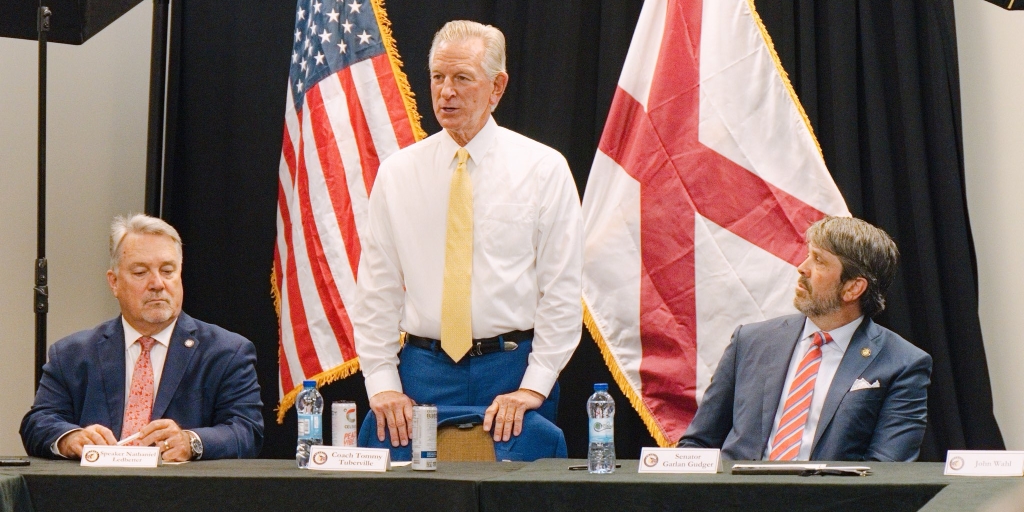
What U.S. Senator Tommy Tuberville (R-Auburn) details as his very first executive order in his new 2026 gubernatorial platform document will be read closely by Montgomery.
“Executive Order Number One does three things,” the playbook states. “On Day One, it starts an audit of every agency, grant, and contract in the executive branch. It orders a much deeper efficiency review of all of state government, due in one year, so we go into the 2028 session knowing what to save and how to save it. And it puts the State Comptroller in charge, with new technology for real time auditing.”
“The order also freezes hiring outside public safety and direct care, enforces the ban on DEI in every agency, and posts results on a public dashboard.”
The Comptroller is an unglamorous post within the Alabama Department of Finance. Under this order it becomes an office every agency head answers to on matters of spending.
According to the campaign document, Tuberville’s plan is built around several key figures: More than 450 boards and commissions, a state workforce of about 30,400 that has grown by more than 1,000 since 2021, and a target of $150 million to $200 million a year in audited savings once the workforce, back-office and contract changes are in place. Every audited dollar is earmarked for the income tax cut.
“Smaller government means lower taxes. Every dollar we save gets audited, and every audited dollar goes back to the people who earned it,” Tuberville wrote.
Agency heads would face a 90-day deadline under the order.
“Within 90 days, each agency will publish a strategic plan with public performance measures focused on improving services and reducing costs,” the document states. Agency heads “will remain responsible for carrying out the administration’s priorities, improving efficiency, and delivering results.”
The accountability order would take effect on Day One. Every agency would be audited within 90 days. In the first year, the administration would release a plan naming each proposed merger, its projected savings and the legislation required. The mergers would then be enacted over the course of the term, “one at a time, with services running the whole way,” according to the document. The goal is to merge at least a dozen agencies into larger departments by the end of the first term.
The playbook cites the law that consolidated 12 state law enforcement agencies into ALEA, and the 2019 reorganization in Arkansas that reduced 42 agencies to 15 departments.
The workforce reduction would come through attrition. “We shrink by not filling jobs people leave, with layoffs only as a last resort,” the document states. “Troopers, correctional officers, and the people who care for the most vulnerable are exempt. Teachers work for local school systems, not state agencies, and this won’t touch them.”
The Alabama State Employees Association warned its members this week that rhetoric about cutting “bureaucrats” is aimed at them.
Democrat Doug Jones (D-Mountain Brook) said a Tuberville administration would fire state employees for insufficient loyalty to President Donald Trump. According to Tuberville’s playbook, released today, that is not the case.
“We’ve got way too many agencies; we’ve got way too many people that are in state government. We have got a lot of good people in state government, and we need to keep those people that make our state run efficiently,” Tuberville said last week. “We can’t continue down this path.”
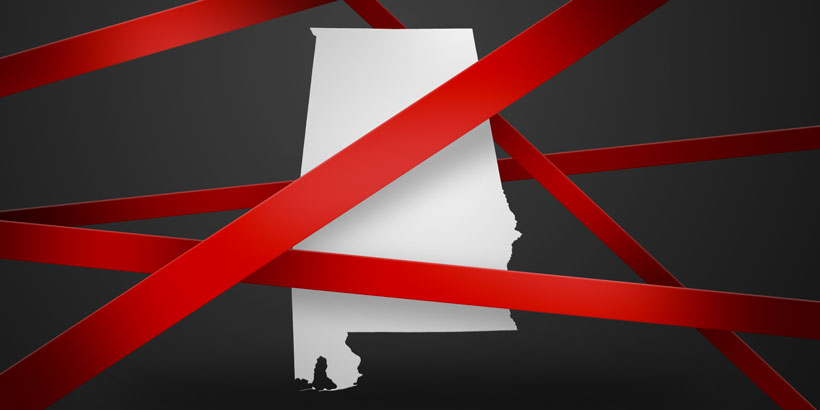
Most of the state’s boards and commissions are funded by fees from the professions they regulate, and many retain their own lobbyists. The playbook gives each board 90 days to justify its existence in writing.
“Every one makes its case in writing. Boards that can’t make the case get merged or ended, working with the Legislature where the law requires it. The first to go: licensing rules that keep qualified people from working,” the document states.
RELATED: 2025 is crucial for Alabama Legislature to reform board and licensing appointments, State Sen. Chris Elliott says (2024)
RELATED: Alabama’s licensing boards could see major overhaul after bill passes Senate committee
Alabama licenses roughly 151 occupations covering more than 432,000 workers, about 21% of the labor force, by the Alabama Policy Institute’s count.
State Sen. Chris Elliott (R-Josephine) has filed a bill to centralize the administration of the licensing boards in every session since 2023. His 2026 version passed the Senate and died in a House committee. The playbook’s “one front door for licenses” plank is that bill with a Governor behind it.
The chapter also calls for moving payroll, human resources, accounts payable, technology and purchasing into a single shared services operation. Every state contract would carry performance terms, with bonuses for work finished early and penalties when it is not. State payments would move off paper checks, and agencies would be allowed to return unspent money rather than spend it before the fiscal year ends.
Each agency would be required to name at least a quarter of its rules for repeal or simplification, and no agency could add a new rule without first cutting old ones.
The document lists four budget rules the administration says it will not break: no recurring spending on one-time money, no tax cuts on borrowed money, a cost estimate on every bill before it is filed, and no transfers between the Education Trust Fund and the General Fund to cover a shortfall in either.
“‘We’ve always done it that way’ is not a reason,” Tuberville wrote.
Grayson Everett is the editor in chief of Yellowhammer News. You can follow him on X @Grayson270.