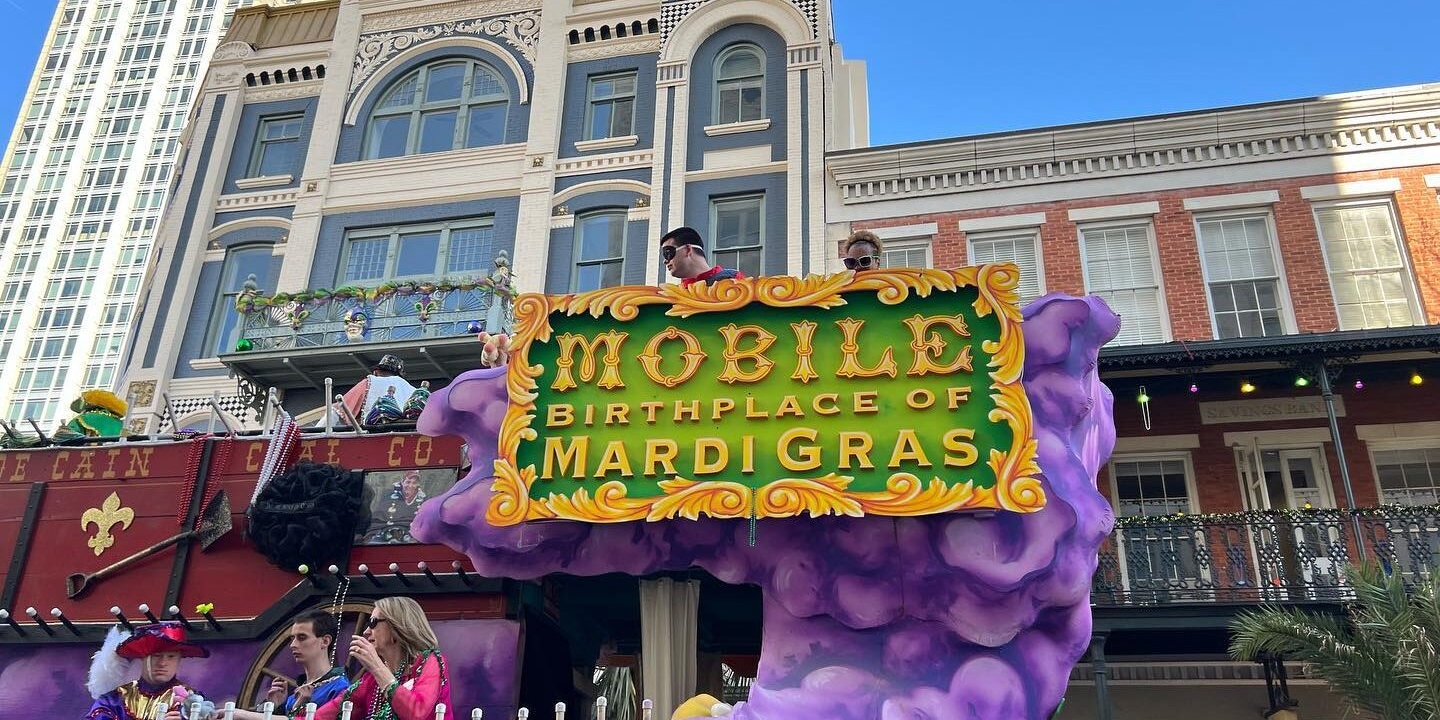
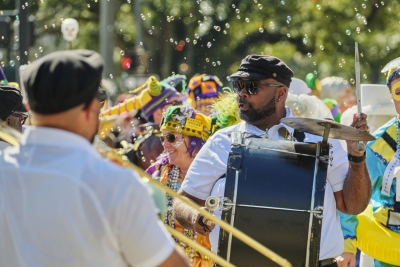
On Fat Tuesday, Dauphin Street hums with music and motion as beads arc through the air, MoonPies thud into waiting hands, and the call of “throw me something!” echoes between historic buildings. Massive, ornately decorated floats and costumed riders move through downtown as a centuries-old tradition comes fully alive. This is the peak of Mardi Gras in Mobile, Alabama, the grand finale of a celebration that unfolds over weeks and is deeply woven into the city’s identity. Often called “the birthplace of American Mardi Gras,” Mobile’s carnival season is rooted in history, shaped by community, and sustained by tradition.
A CELEBRATION TAKES SHAPE
Mobile’s Mardi Gras traces its origins back more than three centuries. In 1703, French settlers gathered in the small colonial settlement of Fort Louis de la Louisiane to observe Mardi Gras, marking what is widely recognized as the first documented celebration of the holiday in what would become the United States. Led by Pierre Le Moyne d’Iberville, the settlers honored the pre-Lenten customs of their homeland with communal feasts, music, and dancing. These early observances were modest, but they laid the foundation for a tradition that would grow alongside the city itself.
MYSTERY, TRADITION, AND SPECTACLE
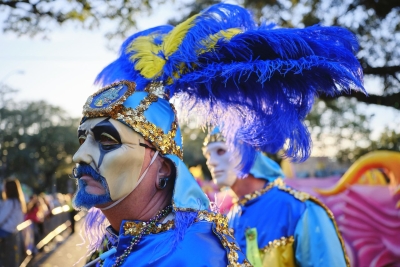
As the celebration evolved, secrecy and ceremony became defining features. By the early nineteenth century, mystic societies emerged to organize parades, host elaborate balls, and create floats rich with symbolism. In 1813, Mobile introduced the Boeuf Gras tradition, marked by a papier-mâché bull’s head paraded through the streets to signal the approach of Mardi Gras Day.
In 1830, the Cowbellion de Rakin Society staged what is considered the first organized Mardi Gras parade in Mobile, complete with decorated floats, cowbells, and satirical themes. This moment ushered in the modern era of Carnival in the city. Today, mystic societies continue to uphold these traditions, electing kings and queens and blending history, creativity, and pageantry in a way that remains uniquely Mobile.
JOE CAIN AND THE RETURN OF MARDI GRAS
Following the Civil War, Mardi Gras in Mobile was revived through the efforts of Joe Cain, a local resident who paraded through the streets in 1866 dressed as a fictional Chickasaw chief named Slacabamorinico. Cain’s costume carried symbolic meaning at a time when public celebration was discouraged during Reconstruction. His procession is widely credited with restoring Mardi Gras to the city.
Cain’s legacy lives on through Joe Cain Day, celebrated on the Sunday before Fat Tuesday. The Joe Cain Procession blends parade tradition with a street-level celebration that honors both history and community, serving as one of the most beloved events of the season.
WHAT MAKES A MOBILE MARDI GRAS
Beyond the parades, Mardi Gras in Mobile is defined by the rituals that surround it. King Cake appears in bakeries and grocery stores across the city beginning on Epiphany. The soft, brioche-style cake is often filled with cinnamon or cream cheese and topped with purple, green, and gold sugar, representing justice, faith, and power. Hidden inside is a small figurine, and whoever finds it is tasked with bringing the next cake, ensuring the celebration continues from gathering to gathering.
Local businesses embrace the season as fully as the mystic societies themselves. Restaurants plan menus around parade schedules, bars create Carnival-themed drinks, and storefronts downtown are dressed in purple, green, and gold weeks in advance. Mardi Gras is not limited to the parade route; it shapes the rhythm of daily life throughout the city.
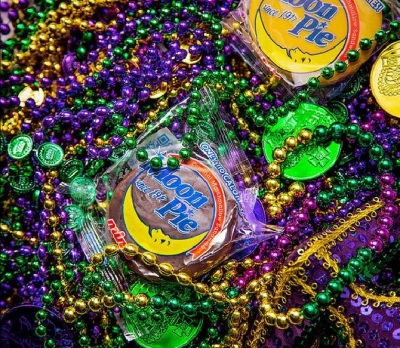 One of the most distinctive features of Mobile’s Mardi Gras is its throws. While beads and doubloons are common, Mobile is especially known for MoonPies, a tradition that dates back to the early twentieth century. Each year, millions are tossed from floats, joined by unexpected items like stuffed animals, local products like Conecuh Sausage, and novelty goods. In Mobile, you never quite know what might come flying your way.
FAN FAVORITES AND THE FINAL DAYS
As the season builds toward its close, a series of beloved parades mark the final stretch. Mystic of Time rolls on the Saturday night before Fat Tuesday, known for its illuminated floats and dramatic presentation. Sunday brings daytime parades with a more family-friendly pace, followed by Infant Mystics on Monday night, a parade steeped in tradition and local humor.
Fat Tuesday itself unfolds in layers, beginning with daytime parades and culminating that evening with the Order of Myths, whose symbolic battle between Folly and Death brings the season to a formal close. When the final float passes and midnight approaches, Mardi Gras gives way to Ash Wednesday, and the city exhales.
THE HEARTBEAT OF MARDI GRAS
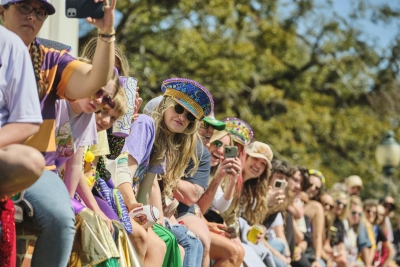
More than 300 years after its first celebration, Mardi Gras in Mobile remains deeply rooted in the community. What began as a modest gathering in a French settlement has grown into a multi-week tradition shaped not by tourism, but by generations of locals who pass it down year after year. Parade routes, King Cake recipes, throws, costumes, and even where to stand along the street are inherited knowledge, shared within families and neighborhoods.
Mardi Gras in Mobile belongs to the people who continue to show up for it, generation after generation. As the original home of Mardi Gras in America, the celebration endures not because it chases spectacle, but because it follows a steady rhythm rooted in tradition and community. Long after the last float rolls and the streets are cleared, that rhythm remains. The heartbeat of Mardi Gras lives in Mobile, carried forward by the people who know it best–and who continue to laissez les bons temps rouler.
Courtesy of SoulGrown