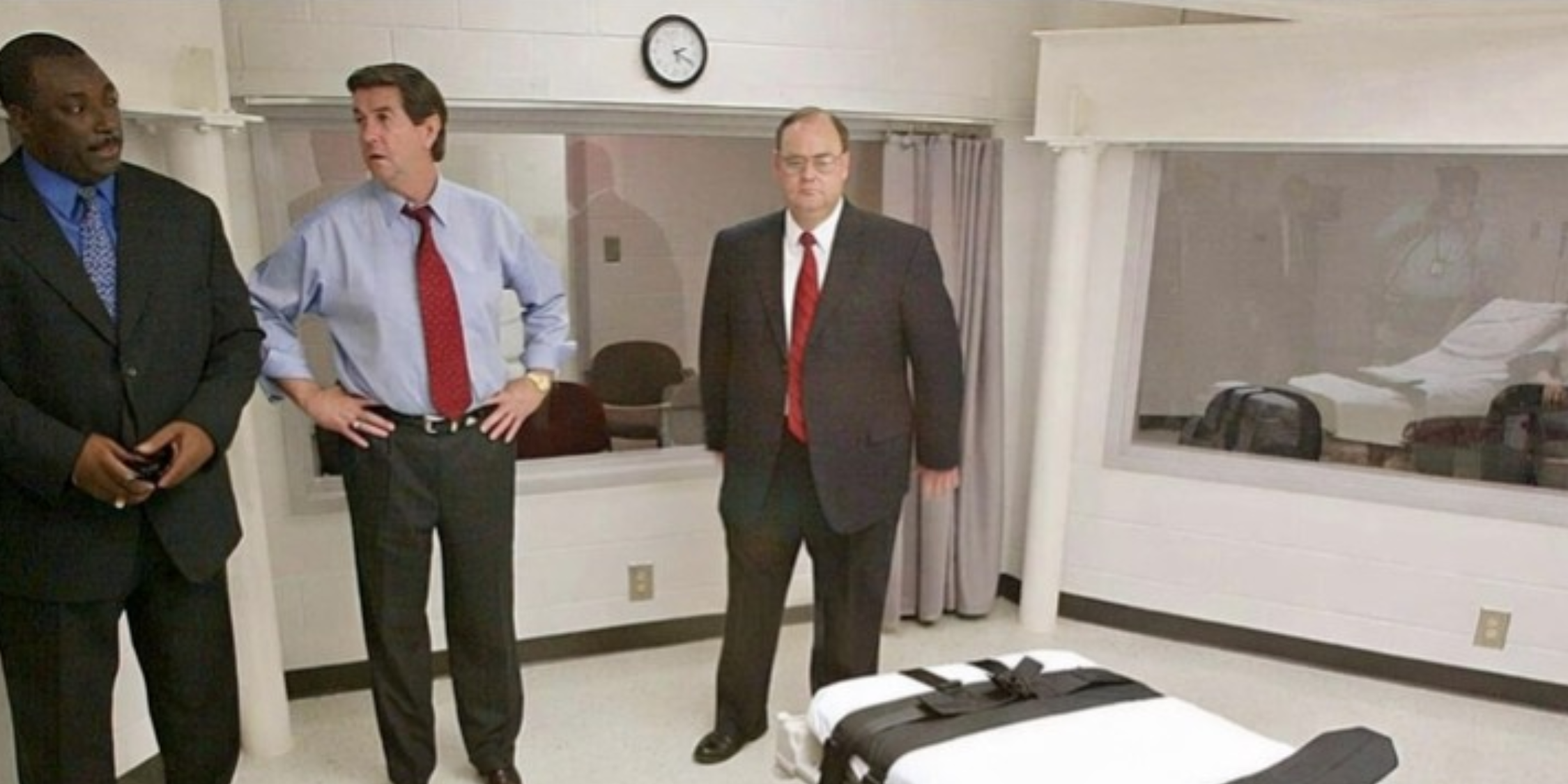
Shortly after taking office in 2003, Gov. Bob Riley did something that no other governor before him or since had done. He entered Holman Maximum Security Correctional Facility in Atmore, roamed the dorms, cells, and facilities while asking inmates and corrections officers for their insight, walked down Death Row, and witnessed a mock execution by lethal injection inside the prison’s Death Chamber.
Associated Press reporter Phil Rawls accompanied Riley on the trip and asked the governor why he chose to take such an in-depth prison tour that many might consider somewhat dangerous. “I wanted to see it, feel it, and taste it,” Riley replied.
The governor did in fact see prison dorms filled to twice their capacity with some stacked three bunks high, he felt the dank and stale air that was circulated only by ancient electric fans in the un-air-conditioned facility, and he sat in the mess hall and tasted the same fried fish and scalloped potatoes served to the inmates on the day of his visit. I know these things because I, too, accompanied him inside the prison as his press secretary.
Corrections officers and inmates alike refer to Holman as “The Bottom” because it represents the “bottom of the barrel” and houses the very worst of the worst inmates in Alabama. Riley, as Rawls reported, seemed most concerned about the safety of corrections officers who sat alone and outnumbered in raised, lifeguard-style chairs inside dormitories housing 180 inmates. Alabama had the nation’s worst prisoner-to-guard ratio at the time. “If they decide to whip up on the guard, how do you get him out?” Riley asked. “A lot of times inmates will help,” Prison Commissioner Donal Campbell said. “Most of the inmates don’t want trouble.”
Seeming to revert to the retail campaigning he utilized so effectively during the governor’s race, Riley spoke with dozens of the inmates he encountered, asked about how they got in prison, and inquired about their experiences while incarcerated. In each case, he offered the inmate a firm handshake, often draped an arm across their shoulder during the discussion, and always treated them as his equals, which was his style.
Among the inmates Riley encountered was one from his home county of Clay, who told the governor he had been sentenced to life for murder, was later paroled and returned home, but a failed drug test after smoking marijuana eventually sent him back to prison. While visiting the prison leather shop, the governor admired an ornate Bible cover made by an inmate serving life without parole. Asking if he could make another cover and send it to him for his own Bible, Riley handed the inmate his mailing address. “I’d be proud,” the inmate replied.
Much of the above was detailed in the AP story that Rawls wrote, but I have my own vivid memories of that day, though they are 23 years removed, so please forgive any imprecise details that follow.
As Riley and the few of us who were with him walked down Death Row — which is, indeed, a long row of cells stacked three tiers high with each containing an inmate being held in solitary confinement and awaiting execution — some of the prisoners hurled handwritten notes to him through the slots in their locked doors. Strings that were several feet long were tied around the notes as the prisoners held onto the other ends inside their cells. “What’s that?,” asked Riley, who was a bit startled along with the rest of us. “Ignore it,” Holman Prison Warden Grantt Culliver replied, “They’re just fishing.”
“Fishing” is a common communication method used by inmates held in solitary confinement, whereby they use long improvised lines made from torn t-shirts, mattresses, and other materials to transfer notes, known in prison parlance as “kites,” and other items between locked cells. Lines can reach up to 30 feet long with weighted items like toothpaste or wet toilet paper attached for increased distance and accuracy, and we were told that prisoners become quite adept at hitting their targets through the slots in their doors. The governor did not stop to read any of the “kites” thrown his way.
Upon reaching the death chamber, Riley was given a tour and taken into the back room where the lethal injection drugs that were used at the time were pumped. Alabama has since changed its method of execution to nitrogen hypoxia. Hanging on the wall was a Rube Goldberg-style injection system that looked as if it were made by amateurs — and it was. No retailer or manufacturer sells “lethal injection devices,” so the prison staff constructed the apparatus on its own using parts that appeared to come from Lowe’s or Home Depot.
It consisted of a panel with three large syringes, such as the kind that are used to inject flavorings into smoked meats and barbecue, and each had long lines of clear vinyl PVC tubing attached that ran into the Death Chamber. All three connected to a central line with the lethal injection needle on the end. It was explained to us that a syringe containing Midazolam, which put the inmate to sleep, would be pressed first. A syringe with Rocuronium bromide, which caused paralysis of the respiratory system, followed, and Potassium Chloride, which stopped the heart, was administered through the tubing last.
A phone in the same room off of the death chamber connected the warden or prison commissioner with the governor or his staff throughout an execution in case a last minute reprieve was given, and a window provided a view to the proceedings. Corrections officers, not doctors or nurses, would insert the needle and operate the syringes because medical professionals swear an oath to save lives, not take them.
Because he would make life and death decisions regarding clemency throughout his time in office, Riley wanted to thoroughly understand how the entire process worked, so before arriving, he asked to witness a full mock execution, another first request no other governor had ever made.
We were taken to a holding cell just off of the Death Chamber where a corrections officer portraying a condemned inmate sat handcuffed on a cot. The cell is where an inmate would be moved 24 hours prior to their execution, where they would eat their requested last meal, and where they would meet with their clergy, if desired. They remain under 24-hour surveillance by officers during this period, which is known as the “Death Watch.”
Two other officers moved the mock inmate into the chamber, placed him upon what looked to be an operating table with two extensions on either side for his arms, and strapped down his legs and head. The proxy inmate’s left arm was strapped down, as well, but not his right because a rubber arm was already strapped securely in its place.
At that point in the execution, curtains to a viewing area on the other side of glass windows would be opened for the family and guests of the condemned and family for any victims to watch the proceedings. Eventually, a corrections officer inserted the lethal injection needle into the rubber arm, but I remember thinking it was quite odd that they first swabbed the insertion point with alcohol as if to ward off an infection, which is a malady someone being executed would easily avoid by dying.
Throughout the mock execution, I noticed that the governor would continually look up at the ceiling from time to time as if to study it. I asked him during our flight back to Montgomery on the state plane why he did that, and Riley noted that the inmate’s head was strapped down during the execution, and he would be looking straight up at his last breath. The governor simply wanted to know the last thing they would see. The answer, if you’re curious, was a large, bright light like those in hospital operating rooms that hung above the injection table.
Our visit to Holman affected Riley deeply, and in August of that year, when temperatures across the state reached triple digits, he once said out of the blue, “Our prisons are powder kegs, and with this heat, I really worry about a riot breaking out. I’m praying for our corrections officers…and the inmates, too.” He referenced the trip to Holman, as well, during a conversation we shared at his going away party held at the Governor’s Mansion in 2011, just days before he turned the office over to Robert Bentley.
In the eight years that Riley was governor, 24 inmates entered the same Death Chamber that he visited and were executed for their crimes using the same injection apparatus he inspected. Turning down all requests for clemency during his tenure, the 24 executions on Riley’s watch were the most under any governor since Gov. Frank Dixon served from 1939 to 1943.
Riley told the AP in 2010 that on days of executions, which occur at 6 p.m. in Alabama so they may be reported live on the evening news as a deterrent, he would block out two hours to thoroughly review the details of each case with his staff and determine if there was need to intervene, but he always decided that the trial courts and state and federal appeals courts provided no need for commutation.
During the almost 25 years since Riley strolled behind the gates at Holman Correctional Facility, conditions in our prison system have become even worse as a result of overcrowding, difficulty in recruiting qualified corrections officers, funding needs, and other factors, and a similar tour by any governor today would be impossible from a safety standpoint alone.
But with construction of a new $1-plus billion, 4,000-bed mega-prison in Elmore County nearing completion later this year and construction of another in Atmore soon set to begin, perhaps a future chief executive can one day walk among the inmates and officers, invite their issues and concerns about the prison system, and “see it, feel it, and taste it,” just like Bob Riley did on a sunny spring day in 2003.
This story originally appeared in The Art of Alabama Politics, an outlet dedicated to the the wild, weird, and wonderful history of Alabama politics.