When Alabamians went to the polls for a special referendum election on October 12, 1999, the constitutional amendment allowing creation of a state lottery was not the only item on the ballot.
Amendment Two would have removed the 1901 Constitution of Alabama’s ban prohibiting state elected officials from participating in the state retirement system.
It marked the fifth time that the Legislature put the same constitutional question before voters – and it would also mark the fifth time that voters rejected it.
Ostensibly, the amendment abolished the supernumerary system that allowed sheriffs, district attorneys, judges, and other officials to continue receiving partial salary even after leaving office, but creative wording in its text surreptitiously opened the door to providing state-funded pensions for lawmakers and statewide public officials, who were constitutionally banned from receiving such largesse.
The simple amendment read:
“Proposing an amendment to the Constitution of Alabama of 1901, to phase out the supernumerary system for public officials and to provide for the participation of public officials in the Employees’ Retirement System of Alabama (Proposed by Act No. 99-194)”
Legislators were determined to get the amendment on the ballot without public opposition, so it was brought up for consideration during a marathon meeting day at 3:30 a.m., referred to on the floor only as Senate Bill 84, and quickly approved without debate or discussion of its purpose.
The cloak-and-dagger manner in which it was passed seemed to intensify opposition among some quarters.
State Rep. Riley Seibenhener of Hartford publicly opposed the amendment as the referendum approached and said it represented a step toward a full-time Legislature that would have less contact with Alabama voters.
“We do enough damage up there in 30 days,” Seibenhener said, referencing the 30 meeting day limit that the state constitution places on regular legislative sessions.
He noted that lawmakers had already passed two other measures allowing committees to meet even when the Legislature was not in session and permitting legislative pay raises to go into effect immediately upon passage rather than waiting until the next quadrennium.
Likewise, longtime activist Jim Zeigler, who is currently running for a seat on the Alabama Public Service Commission, said that passage of the amendment would phase out the supernumerary positions for 200 individuals while making 5,000 elected officials eligible for retirement benefits.
Zeigler also created a political action committee titled “Just Vote No On Pensions To Politicians PAC,” and said, “The terms ‘public service’ and ‘pensions’ don’t go hand in hand.”
At the same time, Alabama Education Association Executive Secretary Paul Hubbert and Retirement Systems of Alabama CEO David Bronner held a joint press conference to endorse passage of Amendment Two.
They argued that allowing lawmakers to participate in the state retirement system would be less expensive than creating a lucrative legislative supernumerary program that they predicted would result from the amendment’s failure.
Once the referendum ballots were counted, Amendment Two was defeated by a 54% to 46% margin of 640,679 Alabamians voting NO and 535,894 voting YES.
Gov. Don Siegelman’s state lottery amendment, which appeared on the same ballot, was defeated by an identical 54% to 46% margin.
Alabama’s statewide constitutional officers and legislators continue to be constitutionally barred from participating in the state retirement system today, and no serous effort has yet been taken to create a supernumerary system for lawmakers.
In 2016, the Legislature did pass – and voters ratified – a constitutional amendment that transitioned all newly elected or appointed judges, circuit clerks, and district attorneys into the Retirement Systems of Alabama while grandfathering existing officials into the old supernumerary structure, which will be eventually abolished altogether as participants pass away.
A third amendment on the ballot, which was ratified by voters, eased the way for small municipalities to transition from appointed local school boards to elected local school boards if they desired.
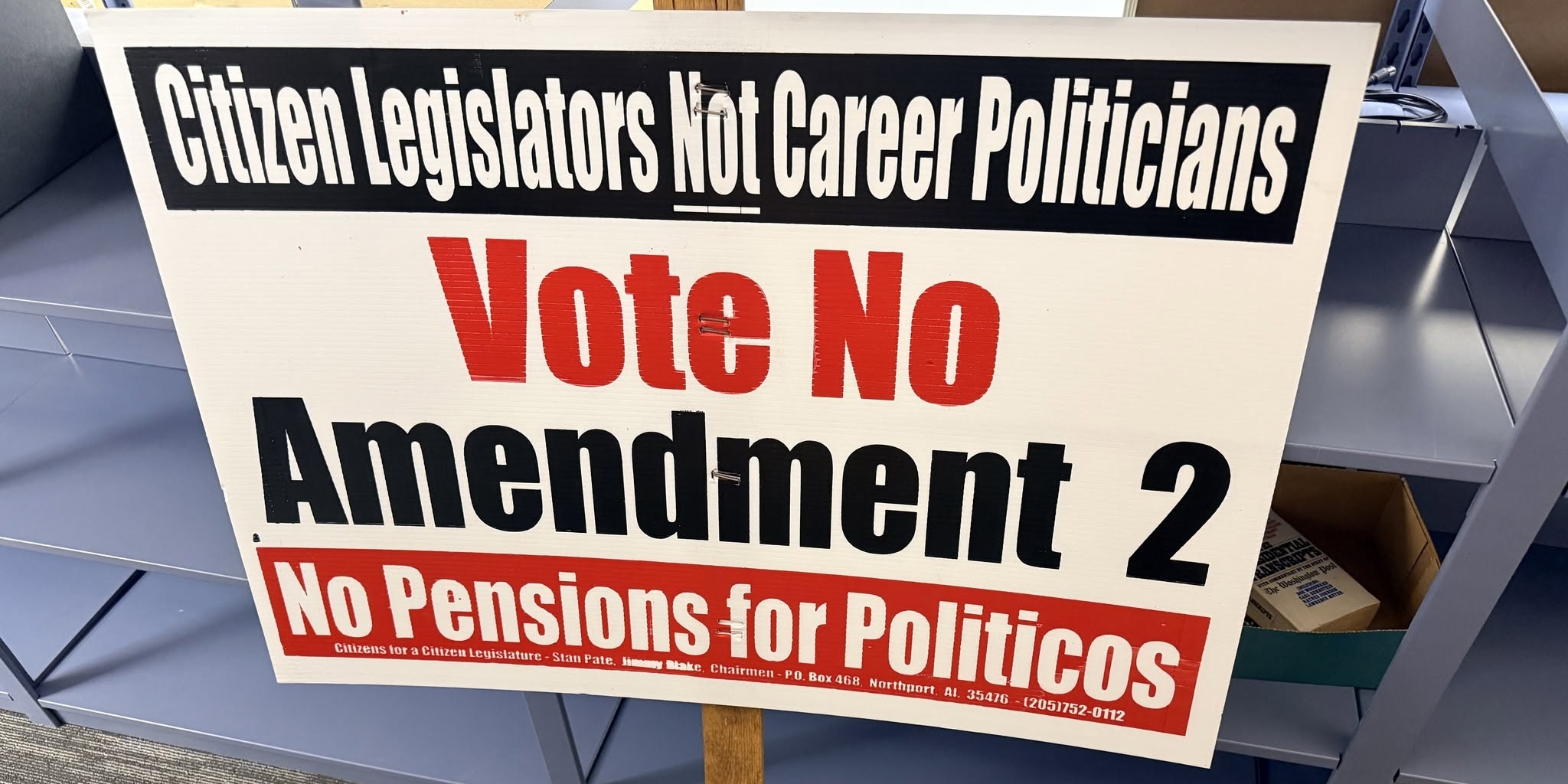
Shown here is a yard sign created by Citizens for a Citizen Legislature, a committed chaired by Tuscaloosa activist Stan Pate and Birmingham City Councilman Jimmy Blake, in opposition to Amendment Two.
This story originally appeared in The Art of Alabama Politics, an outlet dedicated to the wild, weird, and wonderful history of Alabama politics.