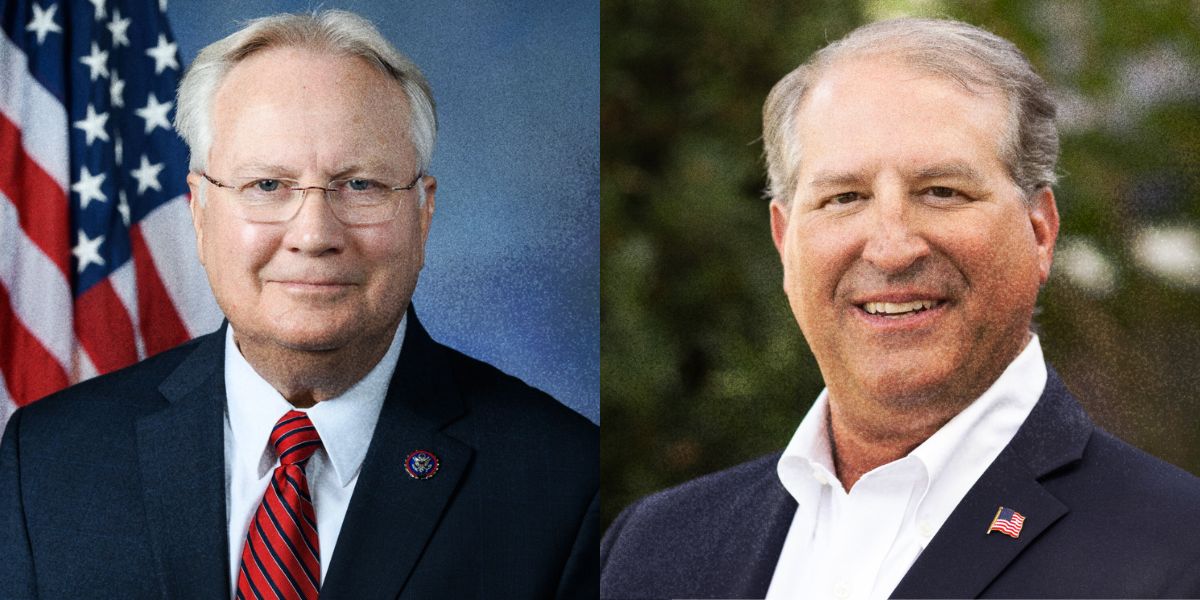
Six weeks ago, Jerry Carl held a 16-point lead. Today it’s 8 — and Rhett Marques is capturing nearly every undecided voter who makes up their mind.
The First Congressional District in Alabama is hosting one of the state’s most closely contested Republican Primary battles and features a number of fun (for political nerds like me) storylines.
Story #1 – Senator Katie Britt endorsed AL House Rep. Rhett Marques early and gave his campaign an early fundraising boost when she contributed to him.
Story #2 – the return of former Congressman Jerry Carl in his second try to capture the newly redrawn 1st District and once again grab a seat in Congress.
And for me, Story #3 – where would the money go, the former Congressman or the challenger endorsed by the popular U.S. Senator?
Last week I completed my second poll in this district, with the first running six weeks ago at the end of January. That poll showed Jerry Carl with a relatively comfortable 16-point lead in the early going.
Conventional wisdom at that time might have been excused thinking the race was setting up to expectations: Carl is a known former congressman with a distinct advantage being from the most populous part of the district, the field against him is largely unknown, and barring something dramatic, the race was his to control. But what does conventional wisdom know anyway?
My latest polling says “Not much.”
On the all-important ballot question, Carl’s lead has been cut in half. He sits at 28 percent today – up 3 points but within the margin of error from January. Rhett Marques sits at 19 percent – an increase of 10 points. Today’s 8-point gap is down from 16-points and is the first sign that momentum is shifting and Marques is currently ascendant.
But the headline number understates the story. The more important figure is what happened among the undecided voters — the 57 percent who were still uncommitted in January. Between the two surveys, roughly 13 points’ worth of those voters made up their minds.
Marques captured 78 percent of that movement, or 10 points. Carl captured less than a quarter (3 points). Joshua McKee, the third candidate in the race, captured essentially nothing and is effectively irrelevant in this race moving forward.
Read that again: nearly four out of every five voters who decided on a candidate in this race in the last six weeks chose Marques.
That is not noise. That is a trajectory. And if it continues at anything close to that pace through May 19th, this race flips.
Carl’s Ceiling Problem
Part of what’s driving this dynamic is what isn’t happening with Carl’s numbers. His name recognition has been the implicit argument of his campaign from day one: he’s the former congressman, the known quantity, the guy who already represented much of this district. But the data suggests that advantage has largely been spent.
The share of voters who have “never heard of” Jerry Carl moved from 27.2 percent in January to 26.8 percent in March. Effectively zero. His favorability improved from 33 percent to 39 percent — a modest gain, but the kind of movement you’d expect from a candidate who is already near saturation. He appears, by the numbers, to be approaching his ceiling.
There’s also a geographic dimension to this problem that the top-line numbers don’t show. Carl’s favorability in Mobile — his home market, the market he represented in Congress — is 53 percent. In the Dothan media market, which covers 35 percent of the district, it is 19 percent.
He is a regional candidate running a district-wide race. The current ballot tells the same story: in Mobile, Carl leads Marques 41 to 11. In Dothan, Marques leads Carl 35 to 8. The district has two very different electorates, and Carl is competitive in only one of them.
Marques, by contrast, is still in introduction mode — and the introductions are going well. His favorable rating has nearly doubled, from 12 percent in January to 24 percent in March. The share of voters who had never heard of him dropped 20 points in six weeks, from 62 percent to 42 percent.
He is building a coalition on favorable terms, with 42 percent of the electorate still to reach. I’ve also seen a marked increase of support for Marques in the Carl stronghold of Baldwin County. Carl has no comparable runway.
What Voters Learn When They Look Closer
There is another data point from the January survey that deserves attention, because it speaks directly to the durability of Carl’s support.
In January, I ran a standard political science exercise: an informed ballot. After exposing respondents to information about the candidates — including what Carl’s record looks like against the values of this district — I asked them again who they supported.
Carl collapsed. He fell from 25 percent on the initial ballot to 11.5 percent on the informed ballot, dropping from first place to third. Marques and McKee both surpassed him.
This is a district that is 89 percent Trump-approving, 82 percent pro-life, 72 percent evangelical or born-again Christian. It is one of the most conservative Republican primary electorates in the country.
When voters in that electorate start learning the specifics of Carl’s Washington record, they move. The January data shows they move dramatically. The question for the next eight weeks is how many of them get the information.
The Britt Message: A 56-Point Swing That Two-Thirds of Voters Haven’t Heard
Senator Katie Britt has endorsed Rhett Marques. When I tested Britt’s endorsement in January, 55 percent of likely Republican primary voters said it would make them more likely to support the endorsed candidate and only 9.8 percent said less likely — a net impact of +45 points.
In February, I wrote a column for Yellowhammer showing her endorsement tested stronger than President Trump’s in Alabama Republican primaries — wider positive margins, lower negatives. It is the most powerful persuasion asset available to any candidate in this race.
Here’s the problem: almost nobody knows about it. Here’s the positive: when people do learn about it, it moves voters. Tremendously.
The March survey asked voters which candidate Britt endorsed. Only 29 percent correctly identified Marques. Nearly 65 percent simply didn’t know.
The consequences of that awareness gap are stark. Among voters who know about the endorsement, Marques wins 68 percent of the vote. Among those who don’t know, he gets 11 percent.
That is a 56-point swing — based on a single piece of information that two-thirds of the electorate hasn’t received yet.
The geography here is especially striking. In Montgomery’s media market (admittedly a small slice of the district) — where 57 percent of voters are still undecided and no candidate has established a clear lead — only 11 percent of voters know about the Britt endorsement.
That is a market that has barely been touched by this race. It is also, given the composition of its electorate, exactly the kind of market where the Britt message converts.
The Outsider Advantage
The polling also asked voters a framing question: would you prefer “a former member of Congress who knows how Washington works” or “a political outsider who will bring fresh ideas”? The outsider frame won by nearly 20 points: 49.8 percent to 30 percent.
This is Marques’s lane — not because he’s running against Washington rhetorically, but because the electorate was structurally predisposed toward an outsider candidate before a dollar was spent. In January, when 62 percent of voters had never heard of Marques, that preference gap already existed. It was waiting for a candidate.
The message efficiency data reinforces this. Among voters who have seen, read, or heard something about Marques, 49 percent say it makes them more likely to vote for him and only 15 percent say less likely — a net conversion rate of +34 points.
For Carl, the equivalent figures are 38 percent more likely and 17 percent less likely: a +21 net. That 13-point efficiency gap means Marques’s message is simply working harder per impression. In a primary where both campaigns still need to persuade a large pool of undecideds, that compounds.
The Money
The momentum in the polls is matched by what’s happening on the fundraising side. According to the most recent FEC filings, Marques has raised $875,878 and holds $775,221 in cash on hand. Carl has raised $480,928 — nearly $400,000 less — and holds just $307,980 after spending at more than twice Marques’s rate.
A challenger who launched this race as a relative unknown has out-raised the incumbent former congressman by nearly two-to-one, outspent him at a fraction of the rate, and built a cash-on-hand advantage of more than $467,000 heading into the final weeks. That is not the financial profile of a long-shot. That is the financial profile of a candidate who has earned the resources to close.
What the Trajectory Tells Us
Down-ballot primaries are often decided in the final weeks, when voters who haven’t been paying close attention start tuning in. The candidate with momentum, message efficiency, a popular senator’s endorsement, and the resources to broadcast it is well-positioned when that moment arrives.
The March survey found Carl still leading at 8 points. But every variable beneath that number is moving in one direction. His name ID is maxed out.
His support is geographically concentrated in a single market. An informed electorate is an electorate that moves away from him. Undecided voters are breaking toward Marques nearly 4-to-1. And the single most powerful message in this race — the Britt endorsement — is still unheard by two-thirds of the district.
McKee is not a factor. His 59 percent “never heard of” number after months of campaigning tells you what you need to know. When his voters eventually sort, they are a persuadable pool — and they are not consolidating behind Carl.
Anyone telling you this race is settled is not looking at the data.
The data says it’s just getting started.
Michael T. Lowry is the founder and principal of The Alabama Poll and the founder of Backstop Strategies, a Washington, D.C.-based government affairs firm. A native Alabamian, he has more than 30 years of experience in politics and government and most recently served as chief of staff to U.S. Rep. Robert Aderholt.