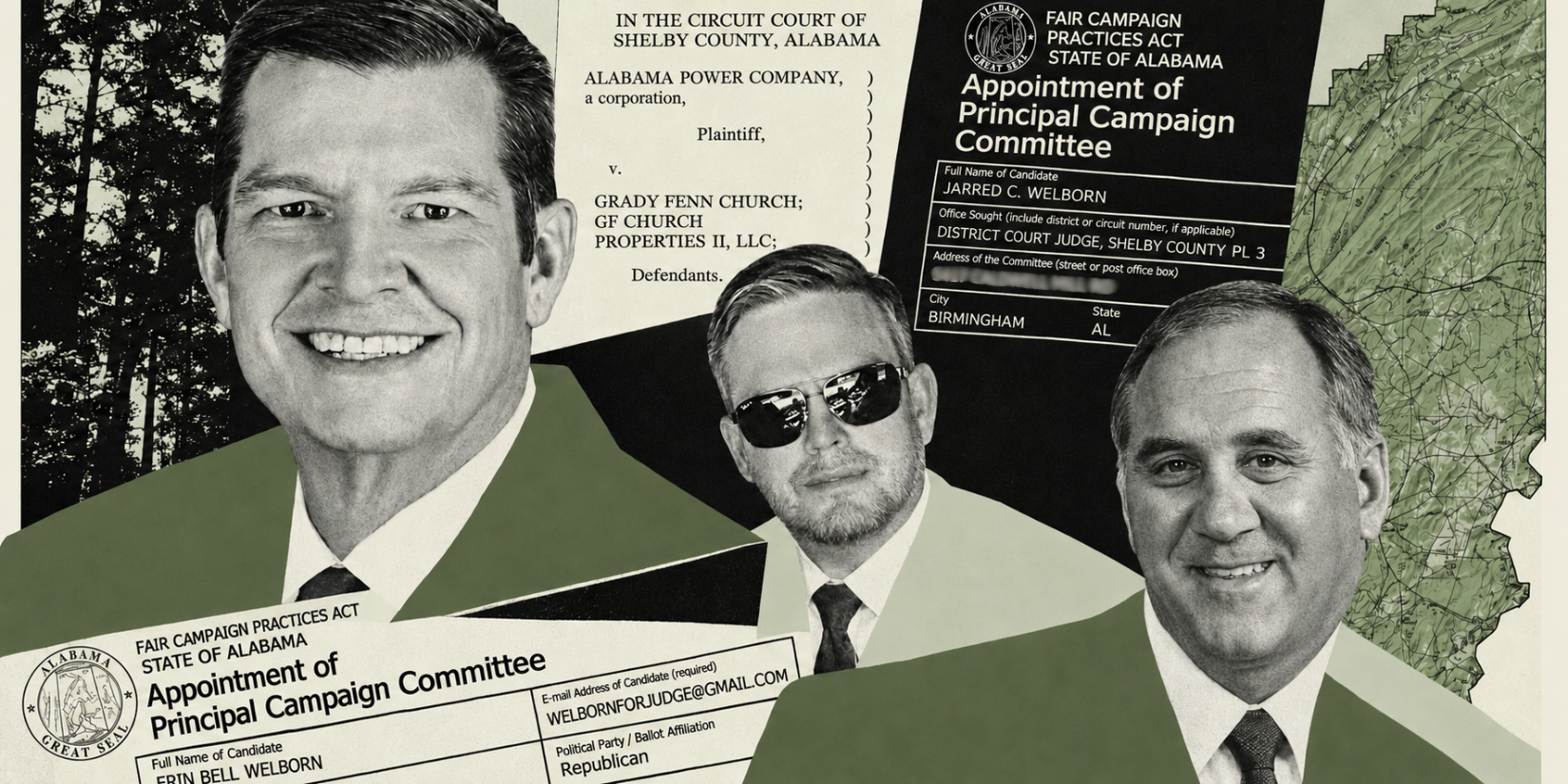
Following a September court victory over Alabama Power, Calera man Fenn Church issued glowing praise for “Judge Jonathan Spann” and “my attorneys Martin Evans and Jay Welborn.”
State records show those parties have previously been one and the same.
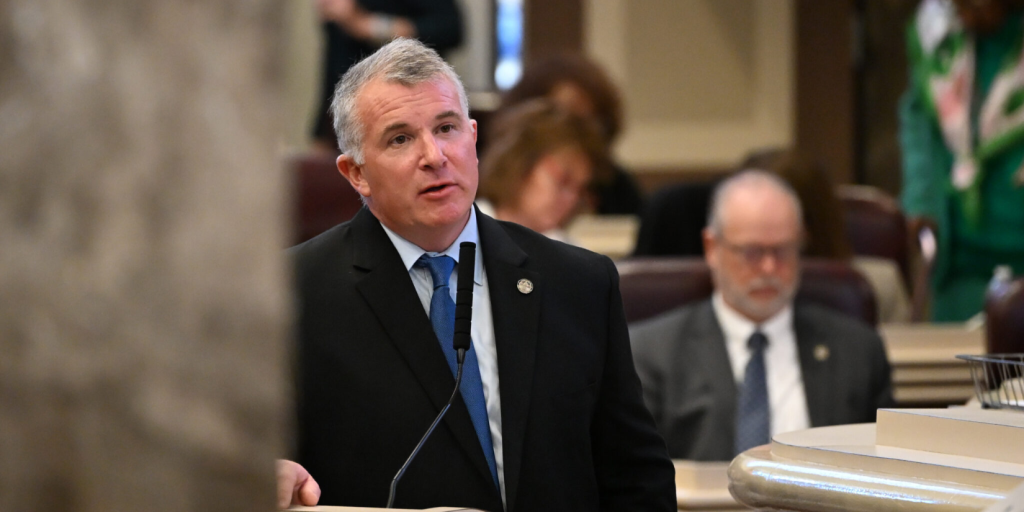
According to filings with the Alabama Secretary of State’s office, Shelby County Circuit Judge Jonathan A. Spann served as chairperson of the principal campaign committee for Jarred C. Welborn – Church’s attorney in the case.
The first form, filed March 19, 2025, lists Spann as chairperson at his judicial email address, [email protected]. Welborn, who was seeking the newly created District Court Judge, Place 3, seat, named himself treasurer. The third member is Erin Welborn, Jay Welborn’s wife, listed at [email protected]. She has served as a Shelby County District Judge since 2022.
To make matters worse, Section 17-17-5(a) of the Code of Alabama bars any person employed by the state from using state property or time “for any political activities,” such as using judicial email addresses to endorse a candidate for office.
RELATED: Attorney Jarred ‘Jay’ Welborn enters race for newly created Shelby County district judgeship
It was not the first time Spann had run a Welborn campaign.
In May 2021, Spann signed on as chairperson of Erin Welborn’s committee for her district judgeship. Jay Welborn was again working as treasurer. Spann was elected to the circuit bench in the June 2022 runoff, the same cycle in which Erin Welborn won her seat.
Three years later, as a sitting judge, he chaired her husband’s run for the seat beside hers.
In June, Ben Fuller won out the Republican Party primary 52.19% over Jay Welborn’s 47.81%
By September, Welborn was arguing a matter before his campaign chairman’s court.
This time, representing Fenn Church against Alabama Power’s condemnation of a half-mile stretch of Calera to complete a 74-mile, $247 million transmission line the company says 1.6 million customers depend on.
Welborn had found a favorable court to hear the case right from the jump.
On September 22, Judge Spann ruled in Welborn and Church’s favor, to bar Alabama Power from entering Church’s land “unless and until this Court orders otherwise.”
After Spann granted the September 22 injunction, Church said: “I’m really appreciative of everything that Judge Jonathan Spann did for my case. Judge Spann took his time, researched, and ruled on the merits of the case.”
The Alabama Supreme Court disagreed shortly thereafter.
Alabama Power filed an emergency motion on October 2, calling the order “unprecedented” and arguing “there is no authority for a circuit court to enjoin the Constitution and Code of Alabama.”
On October 21, justices voted 5-1 to overturn Judge Spann’s injunction.
Back in Shelby County, Spann never disclosed his political relationship with the Welborns from the bench.
Alabama’s Canons of Judicial Ethics require a judge to disqualify himself from any case in which “his impartiality might reasonably be questioned.”
The Judicial Inquiry Commission, which polices the canons, has said the standard is not whether the judge was fair – but whether a reasonable person who knew what the judge knew would wonder.
The question is not whether the judge was impartial in fact. It is whether the appearance of a conflict exists. If it does, the judge is required to step aside before he rules on anything. Spann ruled twice.
Despite the crusade for publicity Church has undertaken in service of what he describes as a last stand for “every Alabamian that’s a property owner” – his case is deeply ordinary in the eyes of the law.
Alabama Power has been planning a 74-mile Autaugaville-to-East Pelham line since 2021 and needs it running by May 2027 ahead of next summer’s peak demand. The company says the current grid is overloaded and risks widespread outages across central Alabama.
Spann’s injunction took a month out of that schedule.
Alabama Power sought a 125-foot-wide easement through Church’s timberland, plus the right to use an existing gravel road on the property to reach the right of way. The line runs through timber more than half a mile from his house.
Church will keep the title to all 416 acres. The power company offered Church $80,000 in January 2025, $132,000 in September 2025, and a final appraisal-based $194,000 in May 2026.
He refused all three.
In August, three Shelby County citizens appointed by the probate court – Jim Strickland, Jeff Murphy and Eddy Jowers – assessed and valued the easement at $425,435.
Alabama Power paid the full amount into court on August 6, and after Church appealed, it posted a surety bond for twice that sum.
Under Section 235 of the state constitution, that is the point at which a utility gains the right to enter the land and clear the right of way while the appeal is pending.
The Alabama Supreme Court has said as far back as 1953 that the rule exists so a condemnor “would not be delayed in his works during protracted litigation.”
Confusingly, Spann acknowledged that in his order blocking the company, writing that “absent a preliminary injunction, APCO has the right to access the Church Defendants’ Property because of its deposit of the condemnation award and a bond in double the amount.”
Spann issued the injunction regardless. He enjoined the company on a theory that the constitutional right of entry applies only when the fight is over price.
In their October ruling, the Alabama Supreme Court ended that theory.
Alabama Power’s crews have been clearing the right of way since then, and Spann’s second attempt to slow them – a November 10 dismissal of the company’s request for a safety buffer around its crews – did nothing to change it.
Church has no appeal left that can move the line. His case in circuit court can change one thing: The price.
Church has had a $425,435 check waiting on him at the Shelby County courthouse since August. But, that was never the figure he had in mind.
According to court documents, Church’s counteroffer is $1.2 million.
By comparison, his neighbor was awarded $399,951. Church has not been shy about the fact that his neighbor’s deal is not good enough for him.
Please support this overreach of eminent domain takeover of my home ! GoFundMe by donating or sharing—every bit of help makes a difference. https://t.co/8nNyFYS31q
— Fenn Church (@Gfennchurch) November 12, 2026
In his pursuit of a $1.2 million payout, Church also recently started a GoFundMe, and is pleading for the public to chip in.
“Legal battles like this are expensive, and every contribution toward his legal fees can make a difference,” the GoFundMe reads.
For a fight he says is about principle, it seems that principle can be bought with a price tag.
Grayson Everett is the editor in chief of Yellowhammer News. You can follow him on X @Grayson270.